

Click here to view as PDF. “The world economy is growing more slowly than expected, and risks are rising.” –CHRISTINE LAGARDE, managing director of the IMF
INTRODUCTION
For those rare workers who actually took advantage of the national holiday at the beginning of the week, worries of a global economic slowdown loomed in the periphery. On Monday, the International Monetary Fund (IMF) released a report stating that China’s official growth rate for 2018 was 6.6%, or the slowest it has been since 1990. And forward-looking forecasts did not soothe concerns that trouble is brewing in one of the world’s largest economies. As a result of the news – and other international political and economic concerns – almost every global market traded lower on Tuesday.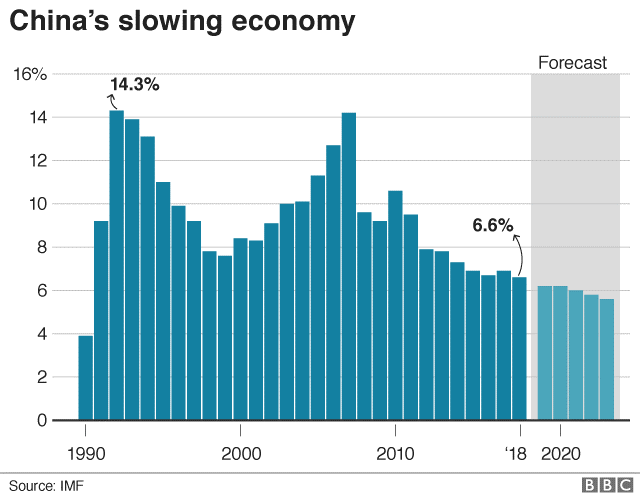 Equally alarming and adding fuel to the slowdown in the global economy, is the ongoing trade spat between the world’s two largest trading partners. With talks set to begin anew next week, hope lingers that a deal will be struck before the 90-day trade truce expires on March 1 – especially considering the increased economic and political pressures facing Beijing and Washington. But pro-deal bulls shouldn’t get too comfortable. Central to these talks, and something that we have written on extensively in previous EVAs (see The Trump Trade Tirade, Part I and The Trump Trade Tirade, Part II), is China’s willingness to “play fair” with critical IP and technology.
This week, we are presenting two missives related to how US-China relations will inform future economic and market conditions from our esteemed colleagues at our partner firm Gavekal. Gavekal has been internationally recognized as the “go-to independent global research firm for institutional investors and traders” and are particularly respected when it comes to understanding and forecasting happenings in Asia. This partnership gives Evergreen Gavekal an exceptional and unique vantage from which to understand and invest in overseas markets.
In the second article, you may be surprised by which country might soon become the main target of Mr. Trump’s legendary ire. Hint: it doesn’t start with a “C” and end with an “A”, which should come as a relief to bulls on both China and Canada!
Please enjoy this week’s special report from Gavekal, and reach out to info@evergreengavekal.com for information on how Evergreen Gavekal can help you navigate global markets.
Equally alarming and adding fuel to the slowdown in the global economy, is the ongoing trade spat between the world’s two largest trading partners. With talks set to begin anew next week, hope lingers that a deal will be struck before the 90-day trade truce expires on March 1 – especially considering the increased economic and political pressures facing Beijing and Washington. But pro-deal bulls shouldn’t get too comfortable. Central to these talks, and something that we have written on extensively in previous EVAs (see The Trump Trade Tirade, Part I and The Trump Trade Tirade, Part II), is China’s willingness to “play fair” with critical IP and technology.
This week, we are presenting two missives related to how US-China relations will inform future economic and market conditions from our esteemed colleagues at our partner firm Gavekal. Gavekal has been internationally recognized as the “go-to independent global research firm for institutional investors and traders” and are particularly respected when it comes to understanding and forecasting happenings in Asia. This partnership gives Evergreen Gavekal an exceptional and unique vantage from which to understand and invest in overseas markets.
In the second article, you may be surprised by which country might soon become the main target of Mr. Trump’s legendary ire. Hint: it doesn’t start with a “C” and end with an “A”, which should come as a relief to bulls on both China and Canada!
Please enjoy this week’s special report from Gavekal, and reach out to info@evergreengavekal.com for information on how Evergreen Gavekal can help you navigate global markets.
THIS CENTURY’S SUEZ CRISIS By Louis-Vincent Gave The history of every empire is the history of a road-building exercise. This is why, in Europe, we say that “all roads lead to Rome”. Empires build roads to bring commodities more cheaply to the heart of the empire (and as they do, commodity prices typically rise), and to push higher value-added finished goods out to the outer realms of the empire. Having a “land-based” empire has historically been an expensive proposition, if only because of the cost of stationing troops along the imperial roads to protect the goods moving along them from raids and pillaging. This probably explains why in recent centuries “sea-based” empires such as Britain and the United States have tended to fare better than land-based empires like Germany and the Soviet Union. Of course, running a sea-based empire was hardly cost-free. The central power had to maintain dominance and control of its sea lanes; a naval arms race that after World War II, Britain could no longer keep up, so passing the imperial baton to the US. In recent years, we have bored our clients to tears highlighting over and over again that Xi Jinping is a very different kind of Chinese president to all his predecessors. Xi is an “outward” looking president, and one who has no qualms about laying out an “imperialist” vision of China’s future. After all, what is China’s “Belt and Road” plan if not a massive road-building exercise? And what is “Made in China 2025” if not a clear attempt to push higher value-added goods out through the channels that China plans to build in the years between now and then? (For more on this, I can recommend my colleague Tom Miller’s excellent book China’s Asian Dream). Imperial vision In turn, Xi’s assertiveness and the roll-out of his imperial vision in recent years, most notably during the 19th Party Congress in 2017, raises a question: what was Xi thinking in laying out an imperial vision which, by any measure, could be seen as a direct challenge to the world’s existing empire, the US? Did he really imagine that he could paint a picture of a world in which “all roads lead to Beijing”, and that there would be no backlash? To this there are many different possible answers.
- Yes, Xi neither foresaw, nor anticipated, the US backlash, because he has been on a mad power rush since his arrival at the top of the Chinese pyramid. And he has been so ruthless in eliminating any internal dissent within the Chinese leadership that no other senior figures in the Chinese communist party were courageous enough to highlight to him that laying out China’s imperial vision would inevitably trigger a clash with the US.
- Yes, Xi thought there would be no backlash, because the US political leadership today is as divided as it has ever been and its ability to get anything done is seriously compromised.
- Yes, Xi thought there would be no backlash because, like any Marxist, he assumed that political decisions are taken by representatives of the top of the economic superstructure for their own benefit. And in recent decades, the representatives of the top of the US economic superstructure have always been very pro-China, attracted by the size of its domestic market, and by their ability to produce goods in China at a fraction of the cost of other countries with first world infrastructure.
- Yes, Xi thought that there would be no backlash because in recent presidential elections the US electorate has chosen the more “isolationist” ticket, rejecting more globalist approaches. So Governor George W. Bush ran a campaign of a “kinder, gentler” America, against a more globalist Vice President Al Gore. As president, Bush then sounded more “America first” than the globalist Senator John Kerry. Barack Obama turned that around by sounding much more isolationist than the neo-cons John McCain, or Mitt Romney. And of course, Donald Trump was the most isolationist-sounding candidate for decades, an isolationism that stood in sharp contrast to Hillary Clinton’s globalism. And of course, one of Trump’s first decisions as president was to pull the US out of the Trans-Pacific Partnership, which many in Beijing saw as a “contain-China” pact. So, Xi may well have concluded from Trump’s election, and his subsequent withdrawal from the TPP, that the US no longer had any interest in bearing the cost of being an empire, creating a void for China to fill.
- No, Xi knew when he laid out his cards that the US would be forced to react. But in his eyes, the US is a paper tiger whose main competitive advantage is the US dollar’s reserve currency status; a status which allows the US to fund massive twin deficits and continue to spend inordinate amounts on maintaining the world’s most powerful military. But as US budget deficits continue to spiral higher, the US dollar will come under pressure and offer a window of opportunity for China to establish itself, and its currency, on a more equal footing with the West.
- No, Xi figured that the US would fight back, but assumed that the battlelines of any new imperial confrontation have shifted. And Xi further assumed that, given these new battle-lines, China may hold the advantage.
- In the past, clashes between empires over sea lanes often led to hot wars and lots of dead bodies. However, if this new clash between today’s empire and its rising challenger is mostly over telecoms supremacy, there is no reason that this particular battle should lead to an all-out war and piles of corpses.
- If the new battleground is telecoms dominance, then supporting US telecoms equipment providers against market incursions by the likes of Huawei and ZTE is a matter of national security for the US government. This suggests that companies such as Cisco, Arista Networks and others will likely benefit from greater US government support, either directly or indirectly.
- If the battle is indeed over telecom dominance, China will need to continue subsidizing its semiconductor industry heavily in order to challenge US dominance in the field. This will be bad news for semiconductor producers everywhere, who will have to compete with Chinese producers with few capital constraints and little regard for returns on invested capital.
- If the battle between China and the US is increasingly to be fought over telecoms dominance, then it seems logical that the tensions of the future will not be over who controls the sea lanes, but instead who controls the skies, and the satellites in orbit above the earth.
TRUMP’S NEXT TRADE TARGET By Dan Wang Just when the risk from trade politics seemed to be dying down, it’s getting complicated again. Trade talks between the United States and China are in full swing, but just as important are imminent negotiations between the US and the European Union, which are clouded by the US threat to impose tariffs on cars and car parts. The fate of the China talks hinges in part on how things play out between Washington and Brussels. Since last May, the US Department of Commerce has been investigating whether to impose tariffs on automotive imports on national security grounds under Section 232 of the 1962 US trade act. (Section 232 was also used to justify last year’s tariffs on steel and aluminum.) These tariffs would hit the EU, mainly Germany, and Japan the hardest. The US imports about US$340bn of cars and car parts annually; a 25% levy would be an even bigger deal than the extension of tariffs to an additional US$250bn or so of Chinese exports that will occur if the talks with Beijing fail. Commerce is expected to wrap up its study two weeks before the March 1 deadline for US-China trade talks. For political reasons, President Donald Trump is likely to target either China or autos for trade sanctions, but not both. Therefore, the result of the Section 232 case will indicate how likely it is that the US and China can reach a trade pact. A decision or serious threat to tax car imports from Europe could signal a higher chance of a deal with China. After launching a barrage of trade actions in all directions in the first half of 2018, Trump began to back off in late July with a détente with European Commission president Jean-Claude Juncker in July. The December fall in equity markets has further encouraged an embattled Trump to be selective in his targets. Based on conversations I had last week in Washington, Trump will focus his efforts on either autos or China, and he slightly prefers a deal with the latter. That means beating up on Europe and Japan. A tariff on foreign cars would allow Trump to satisfy his protectionist tendencies. But by focusing on autos, Trump would limit the anxieties of the equity market to a single sector. He and National Economic Council director Larry Kudlow pay close attention to share prices; the recent rise of equity markets following positive news from US-China trade negotiations could encourage him to pursue a deal. A deal on tariffs might even be acceptable to the China hawks in the administration, because they will step up export controls, investment restrictions and sanctions on China regardless of the tariff situation. More important, auto tariffs would be Trump’s gift to the autoworkers in the manufacturing-heavy states that helped to elect him. Unions like the United Auto Workers and United Steelworkers have welcomed the Section 232 investigation, claiming that foreign automakers have been dumping into the US. Many of these workers are in Michigan, Pennsylvania, Ohio, and Wisconsin, all states that flipped from Democratic to Republican in 2016. A tariff on foreign autos may be more politically beneficial for Trump than tariffs on China, whose benefits would be more diffuse. Trump may not hit both European and Japanese automakers. Europe is more vulnerable. Press reports indicate that the Japanese are more willing to give in to US demands to forestall tariffs. By contrast, the Europeans have already taken a more belligerent stance, retaliating against American steel and aluminum tariffs with their own tariffs on bourbon whiskey and motorcycles. German carmakers are pushing for a tough line, and EU negotiators have already signaled that they will resist many American asks, notably on agriculture, in upcoming talks. If, on the other hand, Trump decides to spare auto imports, then it’s more likely that the US-China talks will hit a roadblock. He has to offer something to satisfy his political base, and if he lets Europe and/or Japan off the hook, then he has to act tougher on China. So, to handicap the chances of a China deal, watch what happens with cars.
OUR CURRENT LIKES AND DISLIKES
No changes this week.
LIKE *- Large-cap growth (buy more cautiously due to the recent rally)
- Some international developed markets (especially Japan)
- Cash
- Publicly-traded pipeline partnerships (MLPs and other mid-stream energy securities) yielding 7%-15% (as a result of the powerful rally of the first two weeks of the year, buy more selectively)
- Gold-mining stocks
- Gold
- Select blue chip oil stocks (still attractive despite their bounceback)
- One- to two-year Treasury notes
- Canadian dollar-denominated short-term bonds
- Short-term investment grade corporate bonds (1-2 year maturities)
- Emerging market bonds in local currency (start a dollar-cost-averaging process and be prepared to buy more on further weakness)
- Mexican stocks (after a sharp recovery, we are again trimming back on our REIT holdings)
- Large-cap value (there are a plethora of bargains now in this area)
- Intermediate municipal bonds with strong credit ratings
- Intermediate-term Treasury bonds (especially the five-year maturity)
- Solar Yield Cos (due to the PG&E-related selloff)
- Most cyclical resource-based stocks (some are looking more attractive)
- Mid-cap growth
- Emerging stock markets; however, a number of Asian developing markets appear undervalued
- Canadian REITs
- Intermediate-term investment-grade corporate bonds, yielding approximately 4%
- US-based Real Estate Investment Trusts (REITs)
- Long-term investment grade corporate bonds
- Long-term municipal bonds
- Short euro ETF
- Long-term Treasury bonds
- Investment-grade floating rate corporate bonds
- Select European banks
- Small-cap growth
- Preferred stocks
- Small-cap value
- Mid-cap value
- Lower-rated junk bonds
- Floating-rate bank debt (junk)
- US industrial machinery stocks (such as one that runs like a certain forest animal, and another famous for its yellow-colored equipment)
- BB-rated corporate bonds (i.e., high-quality, high yield; in addition to rising rates, credit spreads look to be widening) * **
- Short yen ETF (i.e., we believe the yen is poised to rally)
- Dim sum bond ETF; individual issues, such as blue-chip multi-nationals, are attractive if your broker/custodian is able to buy them