


“Doing well is the result of doing good. That’s what capitalism is all about.” – Ralph Waldo Emerson “Capitalism has not always existed in the world and will not always exist in the world.” – Alexandria Ocasio-Cortez “Communism can’t survive the captivating allure of capitalism.” – Rand Paul
Introduction
Capitalism is an economic system where private individuals or corporations own capital goods and/or provide services. In a market economy, the production of these goods and services is based on supply and demand, rather than through planning by a central government. While the system is not without fault, its principles have long-formed the foundation upon which the “American dream” was built. Over the last several years, this dream has come under increasing attack, with many questioning its ability to provide equal opportunity to all corners of the socioeconomic and demographic spheres. The United States seems to be ground zero for these discussions, especially as an already contentious federal election is fast-approaching. In this week’s newsletter, Evergreen’s partner Louis-Vincent Gave makes the case that, historically, there have been three waves that have driven capitalism forward. He argues that each of these waves tend to dominate markets for a short period before ceding to another force. One particular example he homes in on is oil, which led markets at the turn of the last decade when fears of “peak oil” persisted. However, as the waves of capitalism have turned over the past ten years, technology stocks are now in force, while massive sums of capital have left energy stocks, leading to numerous mergers and bankruptcies. It’s our belief that should a far-left-leaning candidate win the US presidency next November and ban fracking (as has been proposed), natural gas prices could quadruple, and oil prices could double or triple. The beneficiaries of such a scenario will likely be overseas while the economic fall-out could be devastating. Thus, as Louis also concludes, it’s likely that the next big wave of capitalism will not come from within the United States but rather in emerging markets in South Asia, South East Asia, Russia and Africa. We are also becoming increasingly fond of Canada as a refuge for US investors seeking shelter from what may be an escalating war on capitalism in America.The Three Waves of Capitalism by Louis-Vincent Gave
Historically, three waves have driven capitalism forward, each dominating in turn:- The Schumpeterian force to try and produce more with less.
- The Ricardian force to open new markets and new centers of production.
- The Malthusian fear that there won’t be enough for everyone.
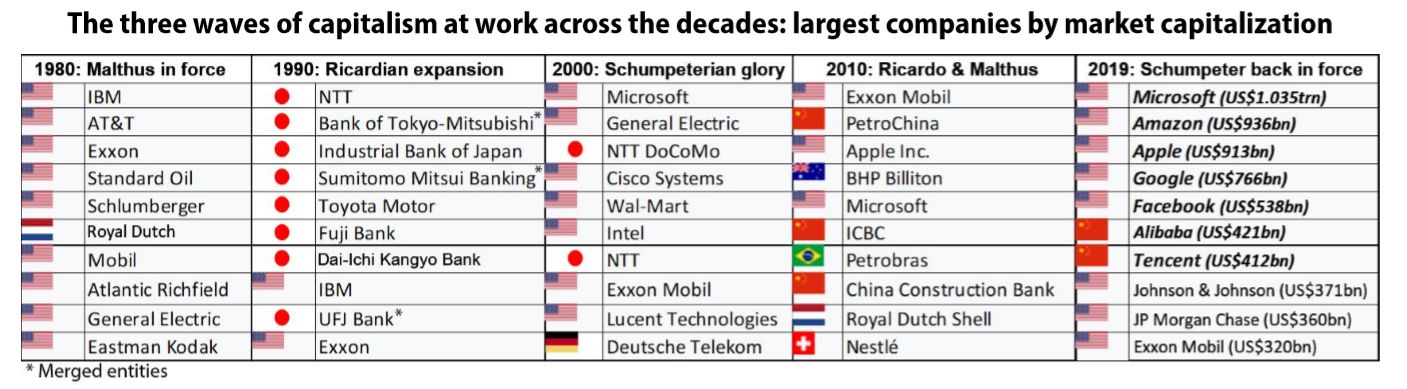 What will the returns on all this invested capital look like? To the casual observer, it might seem that:
- Despite all the capital that has poured into the tech space over the past decade, few life-changing innovations have yet to emerge. The smartphone (possibly this century’s most game-changing new device) hasn’t evolved that much in the last 10 years. The electric car is roughly the same as it was a decade ago. Sure, artificial intelligence means advertising is more targeted, and has delivered some genuine productivity gains in a bunch of industries. But have these gains been genuinely game-changing for ordinary consumers? And what invention of the past decade justifies the hundreds of billions, if not trillions, of US dollars poured into tech?
- A number of the business models that have emerged in recent years— for example Uber or WeWork—seem to be twin destroyers of capital. On the one hand, these business burn through cash on the promise of achieving future monopolistic rents (monopolistic rents which will, if ever achieved, increasingly pit tech companies against governments and regulators). And on the other hand, these cash-burning businesses attack, and often end up destroying, the margins of existing businesses.
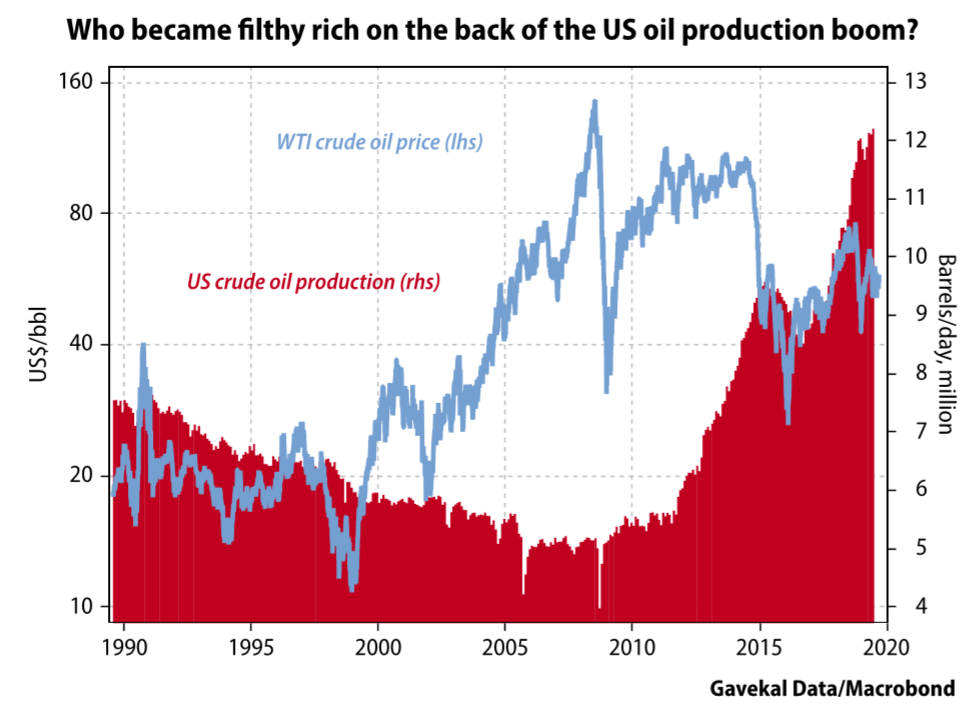 Wrong! Take the US oil services sector. You might have thought it would be a big beneficiary of the massive capital inflows into exploration and production, and of the consequent surge in production. Yet, as the left hand chart overleaf shows, today stock prices in the sector are scarcely higher than the lows seen in the aftermath of the Asian crisis—a time when WTI crude touched US$10.80/bbl, and when The Economist came out with its legendary March 1999 “Drowning in oil” cover.
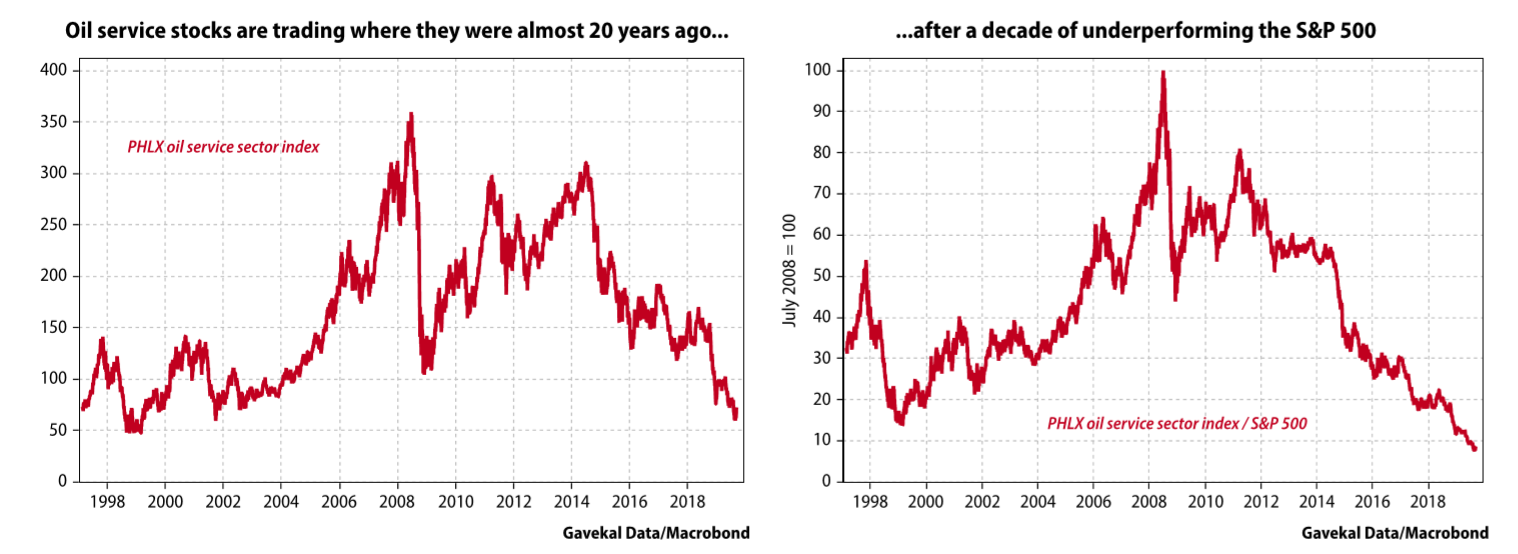 Note that the left-hand chart above is in absolute terms. As the right-hand chart shows, in relative terms, over the last decade the oil service sector index has shed a cool -91.3% of its value relative to the S&P 500!
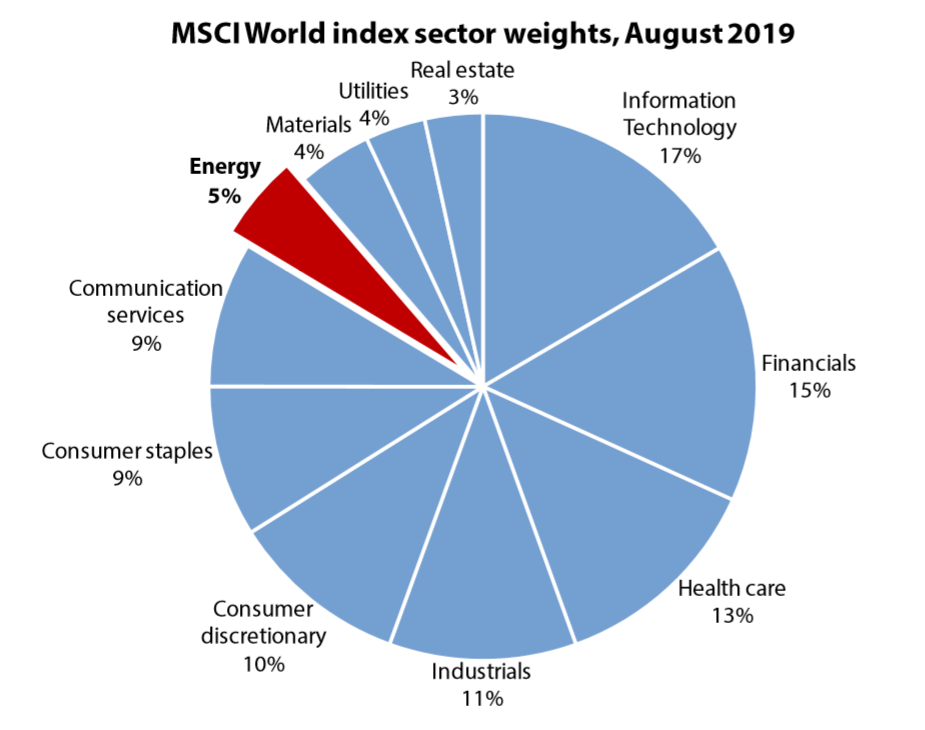
You could say this is what the aftermath of a bubble looks like. Yet a decade ago, who would have thought that with an oil price that has remained broadly flat, and with production that went through the roof, the weight of energy in the S&P 500 or the MSCI World index would fall to all-time lows of around 5% of total outstanding market capitalization?
Note that the left-hand chart above is in absolute terms. As the right-hand chart shows, in relative terms, over the last decade the oil service sector index has shed a cool -91.3% of its value relative to the S&P 500!
You could say this is what the aftermath of a bubble looks like. Yet a decade ago, who would have thought that with an oil price that has remained broadly flat, and with production that went through the roof, the weight of energy in the S&P 500 or the MSCI World index would fall to all-time lows of around 5% of total outstanding market capitalization?
 In short, a decade or so ago, investors poured capital into the US energy industry in the hope of (literally) striking oil. Oil was found, all right. But investors were left a whole lot poorer for it!
Back in 2006-10, an observer who had been told of the coming oil production boom in the Permian or the Bakken might have been tempted to load up on West Texas or North Dakota real estate. Or maybe he or she would have assumed that the hit television shows of the coming years would have featured rapacious oil tycoons plotting each others’ downfall, drinking themselves silly, and fending off (or not) the advances of blonde man-eaters, as in Dallas or Dynasty in the early 1980s. Instead, we got shows like Silicon Valley, following the lives of bland San Francisco Peninsula computer geeks: no murders, no drinking, no sibling rivalries, no affairs; just plot lines about finishing lines of codes before deadline and who gets to own what copyright.
What conclusions should we draw from this?
In short, a decade or so ago, investors poured capital into the US energy industry in the hope of (literally) striking oil. Oil was found, all right. But investors were left a whole lot poorer for it!
Back in 2006-10, an observer who had been told of the coming oil production boom in the Permian or the Bakken might have been tempted to load up on West Texas or North Dakota real estate. Or maybe he or she would have assumed that the hit television shows of the coming years would have featured rapacious oil tycoons plotting each others’ downfall, drinking themselves silly, and fending off (or not) the advances of blonde man-eaters, as in Dallas or Dynasty in the early 1980s. Instead, we got shows like Silicon Valley, following the lives of bland San Francisco Peninsula computer geeks: no murders, no drinking, no sibling rivalries, no affairs; just plot lines about finishing lines of codes before deadline and who gets to own what copyright.
What conclusions should we draw from this?
- The first possible conclusion is that extraction industries are a lousy sector to invest in. That could be because they are locked into an eternal pork cycle. As you’ll remember if you took economics class, this is when a pig shortage (like the one in China today) triggers a spike in pork prices. With prices so elevated, large numbers of farmers rightly conclude that raising pigs is a profitable business. But raising pigs takes two years. So, two years after the pork price spike, a glut of pigs hits the market, hammering the pork price. With prices depressed, farmers stop raising pigs, and the whole merry go-round begins once again. So, the first possible conclusion is that the past decade has once again demonstrated that capital attracted into the oil extraction industry (and other extraction sectors) when prices are high and rising ends up having mediocre returns. Investing in oil in 2007 was akin to investing in piglets in China today. The safe way to make money in extraction industries is to invest when prices are low and falling, and supply is consolidating (either through mergers or bankruptcies, or both). Only then does the investor stand a chance of making decent long-term returns.
- But beyond the extraction industries, the second and much more important conclusion from the complete lack of returns on US energy investments over the past decade (in spite of the US energy miracle) is that when it comes to investing and to returns on invested capital, the laws of supply and demand are critical in determining the long term return trend. More often than not, the more money that pours into a given industry/sector/country, the lower the returns on that capital. When capital flows around with few constraints, all sorts of dud projects get funded—projects which end up lowering the returns on capital for everyone involved.
- When the world is in the grips of a Malthusian panic, capital pours into extraction industries. As it does, the proponents of a commodity super-cycle inevitably insist that “this time is different”. Investors may pour capital into oil, or copper, or alternative energies; but the consensus belief is always that the inflow of capital will do little to affect a dwindling supply. At the time, the fact that increasing investment has never before delivered falling supply is no hurdle. After all, the core belief is that “this time is different”. Unfortunately for the peak oil investors of the 2000s, the recent commodity super-cycle has once again shown that iron rule of capitalism wins out over the “this time is different” argument.
- When new inventions drive capitalism forward in Schumpeterian growth, the initial outsized returns from the newly-invented technologies attract either (i) new competition (which has no difficulty getting funded given the promise of outsized returns), (ii) the heavy hand of government, in the form of new regulation, anti-trust suits or protectionism, or (iii) both. More competition and more government interference lead in turn to lower returns on invested capital, and from there to lower valuations.
- Finally, when capitalism expands into new markets in a Ricardian phase, investors typically underestimate the “friction” costs of operating in new territories. These friction costs may be linked to “hardware”—inadequate infrastructure—or “software”—unreliable legal systems or corruption. Whatever the reasons, returns on invested capital that seemed promising on “little money” all too often end up disappointing on “big money.”