


Click here to view as PDF. “[Accommodative policy] for too long could… encourage excessive risk-taking and thus undermine financial stability.” -JANET YELLEN, Federal Reserve Chair
INTRODUCTION
Market cycles tend to swing between two extremes: periods of growth and decline. On any given day, a market can be up or down; however, generally, we bucket long-term periods of performance into “bull” and “bear” terms. It should come as no surprise to those who keep their eyes fixed on the happenings of the market that we have been stuck on one side of this polarizing pendulum for a very (very) long time. In fact, there have been few instances in history where the market has experienced greater sustained growth. Overarching market performance is driven by many complicated factors so it’s difficult to call out a specific catalyst as singularly important in contributing to these extremes. However, in the case of this great bull market, the main prod is pretty obvious: central banks. Specifically, several central banks around the globe drove their interest rates to artificially low levels to support growth in the aftermath of the Global Financial Crisis. The chart below shows just how far (and quickly) these rates came down: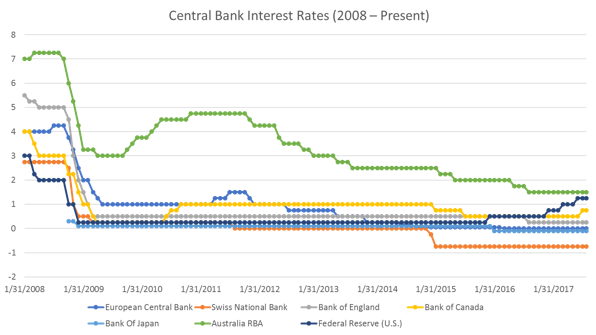 Source: Bloomberg, Evergreen Gavekal

THE STRANGULATION OF ENTERPRISE By Charles Gave
Zero interest rates have made a great many people a great deal richer. But paradoxically they have strangled wealth creation. The reason for this is that enterprise is overwhelmingly a phenomenon found among smaller companies. Among big companies it is a rare quality. Quite simply, the overriding goal of every big company is to transform itself into a monopoly, so it can move away from having to earn its profits towards collecting risk-free rents. And for a big company to become a monopoly, smaller more enterprising companies must be denied access to capital. Zero interest rates achieve exactly this objective. It works like this. In an economy there are two interest rates:- The so-called “natural” rate, which is the rate at which savings equal investments. For the sake of argument, assume the natural rate is 4%.
- The market rate, which is the rate at which companies can borrow.
- Low interest rates are nothing but a form of crony capitalism. The closer you are to the central bank or to the government, the more money you make, as outlined by Richard Cantillon way back in the 18th century.
- Low interest rates favor the rich owners of assets to the disadvantage of the poor.
- Low interest rates lead to a decline in the structural growth rate of the economy.
- Low interest rates greatly increase the fragility of the system through a massive increase in leverage in the non-wealth-generating segment of the economy.
- Low interest rates prevent creative destruction by allowing zombie companies to remain alive, trapping both labor and capital in economic dead ends.
- All this leads to the rise of demagogues.
OUR CURRENT LIKES AND DISLIKES
CHANGED HIGHLIGHTED IN BOLD.
LIKE
- Large-cap growth (during a correction)
- International developed markets (during a correction)
- Canadian REITs (on a pull-back after a healthy recent run-up)
- Cash
- Publicly-traded pipeline partnerships (MLPs) yielding 7%-12% (we like them even more after their recent correction)
- Intermediate-term investment-grade corporate bonds, yielding approximately 4%
- Gold-mining stocks
- Gold (however it appears overbought for now)
- Select blue chip oil stocks
- Mexican stocks (at lower prices after this year’s strong rally)
- Bonds denominated in renminbi trading in Hong Kong (dim sum bonds)
- Short euro ETF
NEUTRAL
- Most cyclical resource-based stocks
- Short-term investment grade corporate bonds
- High-quality preferred stocks yielding 6%
- Mid-cap growth
- Emerging stock markets, however a number of Asian developing markets, ex-India, appear undervalued
- Floating-rate bank debt (junk)
- Select European banks
- BB-rated corporate bonds (i.e., high-quality, high yield)
- Investment-grade floating rate corporate bonds
- Long-term Treasury bonds
- Long-term investment grade corporate bonds
- Intermediate-term Treasury bonds
- Long-term municipal bonds
- Intermediate municipal bonds with strong credit ratings
- Emerging bond markets (dollar-based or hedged); local currency in a few select cases
- Solar Yield Cos on a pull-back (taking partial profit on these)
DISLIKE
- US-based Real Estate Investment Trusts (REITs) (once again, some small-and mid-cap issues appear attractive)
- Small-cap value
- Mid-cap value
- Small-cap growth
- Lower-rated junk bonds
- Large-cap value
- Canadian dollar-denominated bonds (the loonie is currently overbought)
- Short yen ETF (in fact, the yen looks poised to rally)
- Emerging market bonds (local currency)
- Emerging market bonds (local currency)
DISCLOSURE: This material has been prepared or is distributed solely for informational purposes only and is not a solicitation or an offer to buy any security or instrument or to participate in any trading strategy. Any opinions, recommendations, and assumptions included in this presentation are based upon current market conditions, reflect our judgment as of the date of this presentation, and are subject to change. Past performance is no guarantee of future results. All investments involve risk including the loss of principal. All material presented is compiled from sources believed to be reliable, but accuracy cannot be guaranteed and Evergreen makes no representation as to its accuracy or completeness. Securities highlighted or discussed in this communication are mentioned for illustrative purposes only and are not a recommendation for these securities. Evergreen actively manages client portfolios and securities discussed in this communication may or may not be held in such portfolios at any given time.