

“5G will be the backbone of our digital economies and societies worldwide.” – Günther Oettinger, European Commissioner for Digital Economy
The Sprint to 5G (Part II)
When we published the first edition of The Sprint to 5G last March, we made the case that evolutions in the telecom industry typically take place once a decade and that the 2020s will be an era defined by the rollout and adoption of 5G. Those who watched this year’s Super Bowl are sure to recall the unforgettable 5G ads from Verizon and T-Mobile, both touting superior networks. But in a hilarious back-and-forth exchange between the two carriers’ Twitter accounts, they highlighted that there is still a lot of confusion in the marketplace about 5G and whether or not it has arrived on the shores of the land of the free and the home of the brave.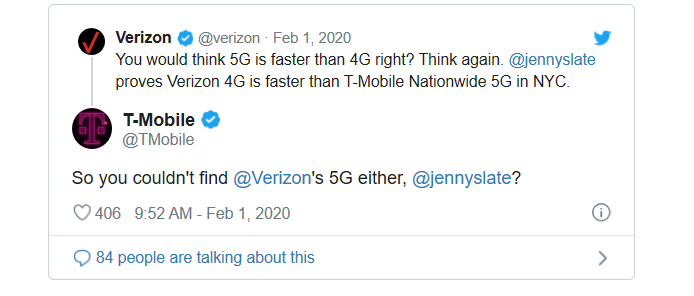 To help clarify the confusion, 5G in its purest promised form is fifth-generation wireless technology that will allow devices to transmit data at significantly higher rates and bandwidth than preceding cellular technologies. And this long-awaited technology hasn’t exactly made its broad debut in the United States just yet. Rather, a less-impressive version (let’s call it 5G-lite) has rolled out across several carriers, with the primary benefit of reduced latency (basically, sound and/or data transmission lags). This version of “5G” or “5GE” lacks the much-hyped, ultrafast mmWave (pronounced millimeter wave) technology that the world is expecting to revolutionize the Internet of Things (IoT) and Artificial Intelligence (AI).
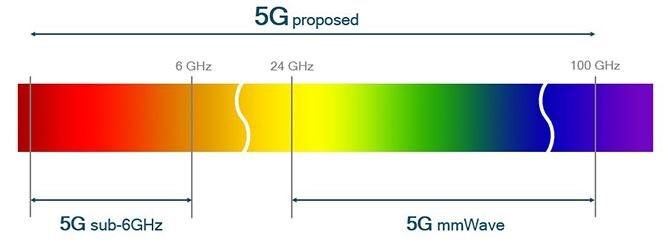
As the New York Times noted in January following the Consumer Electronics Show (CES), “the shift to 5G feels like a tech revolution happening in slow motion.” And there are some pretty good reasons for it. For one thing, as we noted in The Sprint to 5G (Part I), mmWave technology requires near line-of-sight communication between cell towers and user equipment, which in turn requires a much higher concentration of towers (and capex*!). Therefore, much of what has rolled out falls into a lower frequency band of spectrum (not mmWave) and has been laid on top of existing towers without adding new cell sites. The tradeoff is that while capex requirements have remained lower, the blazing fast data rates, higher bandwidth and download speeds that are set to define 5G are still absent.
*Capex stands for capital expenditure and is money spent by a business on fixed assets, such as land, buildings, and equipment.
To help clarify the confusion, 5G in its purest promised form is fifth-generation wireless technology that will allow devices to transmit data at significantly higher rates and bandwidth than preceding cellular technologies. And this long-awaited technology hasn’t exactly made its broad debut in the United States just yet. Rather, a less-impressive version (let’s call it 5G-lite) has rolled out across several carriers, with the primary benefit of reduced latency (basically, sound and/or data transmission lags). This version of “5G” or “5GE” lacks the much-hyped, ultrafast mmWave (pronounced millimeter wave) technology that the world is expecting to revolutionize the Internet of Things (IoT) and Artificial Intelligence (AI).
As the New York Times noted in January following the Consumer Electronics Show (CES), “the shift to 5G feels like a tech revolution happening in slow motion.” And there are some pretty good reasons for it. For one thing, as we noted in The Sprint to 5G (Part I), mmWave technology requires near line-of-sight communication between cell towers and user equipment, which in turn requires a much higher concentration of towers (and capex*!). Therefore, much of what has rolled out falls into a lower frequency band of spectrum (not mmWave) and has been laid on top of existing towers without adding new cell sites. The tradeoff is that while capex requirements have remained lower, the blazing fast data rates, higher bandwidth and download speeds that are set to define 5G are still absent.
*Capex stands for capital expenditure and is money spent by a business on fixed assets, such as land, buildings, and equipment.
 Stepping back from a slightly technical explanation of where things stand with the US race to 5G, since we published last year’s article there have been three major developments with a material impact on the broader telecommunications space:
- Trade policies aimed at curtailing China’s ability to advance its 5G initiatives, specifically regarding Huawei.
- The Federal Communications Commission’s (FCCs) recently announced proposal that should free up important C-Band spectrum.
- The T-Mobile and Sprint merger, which was finally permitted by a federal judge after challenges from several states.
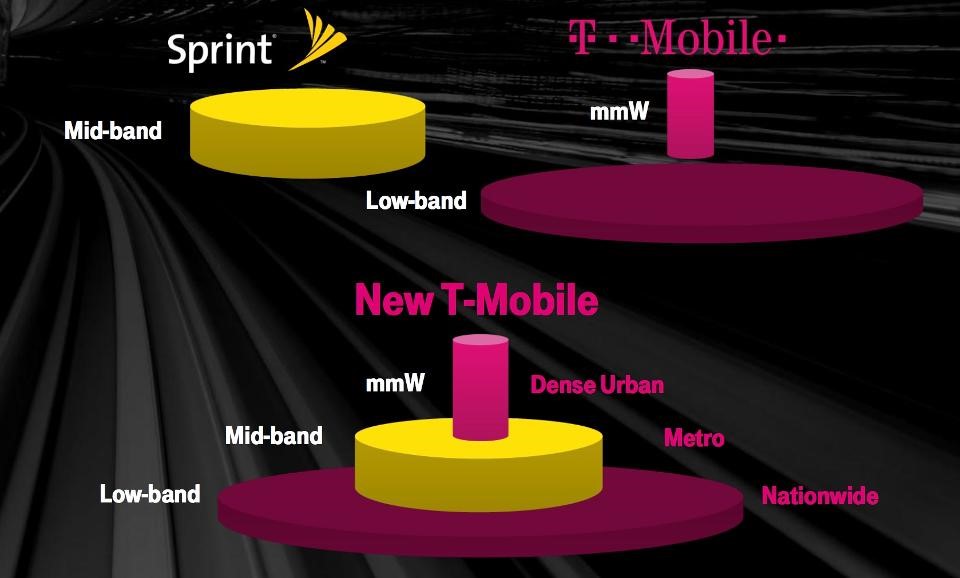
“Secure 5G networks will absolutely be a vital link to America’s prosperity and national security in the 21st century. 5G will be as much as 100 times faster than the current 4G cellular networks. It will transform the way our citizens work, learn, communicate, and travel. It will make American farms more productive, American manufacturing more competitive, and American healthcare better and more accessible. Basically, it covers almost everything, when you get right down to it… We cannot allow any other country to out-compete the United States in this powerful industry of the future…The race to 5G is a race America must win, and it’s a race, frankly, that our great companies are now involved in. We’ve given them the incentive they need. It’s a race that we will win.” (Full transcript can be found here)Speaking of the US government, a federal judge recently upheld a long-awaited merger between T-Mobile and Sprint, which will combine to become the largest telecommunications company in the United States. As a result of the merger, the new T-Mobile will become the first major U.S. carrier to have important assets in all three critical spectrum segments: low-band, mid-band, and millimeter wave.
Source: Forbes
The newly formed telecom behemoth still has a lot of work to integrate and utilize all three bands. However, their merger clears the path for a single US telecom company to operate across the three bands. This will likely put pressure on AT&T, Verizon, and Dish (which is planning to launch its own telecom network as a result of the merger) to gobble up additional spectrum assets in order to remain competitive. Conclusion The sprint to 5G (pun intended) has moved at a much slower pace in the United States than many anticipated. This has allowed China and other nations to gain an upper hand in 5G leadership. However, with political, economic, and health pressures currently weighing on China, along with an imminent public auction that will free up important C-band spectrum for nationwide 5G deployments, the stars are aligning for the United States to make up ground in an important race that will have vast implications for global leadership in the new decade – and many decades to come.