


Click here to view as PDF. “While the Trump administration may crow endlessly about how swell the economy performed last quarter, that 4.1% GDP print will quickly become a wistful memory.” -BERNARD BAUMOHL, Economist at the Economic Outlook Group
Introduction
Towards the tail-end of July, the Commerce Department reported that Gross Domestic Product (also known as GDP), or the total value of goods and services produced in the US, increased at an annual pace of 4.1% in this year’s second quarter. As expected, President Trump took a victory lap around these numbers, which were the highest GDP growth results since 2014. (However, lost in the fanfare was the fact that the first quarter GDP number was revised down from 2.9% to 2.3%.) In an equally anticipated move, the President went on to predict that this is just the start of a long-term trend, and that these numbers are “very, very sustainable” and are “going to go a lot higher.” With all due respect to the Trumpeter-in-Chief, the Evergreen Gavekal team is not nearly as confident. In fact, we would argue that there is a glaring black hole in his economic outlook. Particularly, we believe that three unstainable factors led to this
THE RECESSION OF 2019 By Charles Gave Over the last three months, I have become increasingly concerned that a recession will hit the world economy in 2019. In this paper, I shall explain why. My reasoning is simple and is based on the behavior of an indicator I have long followed, which I call the World Monetary Base, or WMB. Every time in the past that this monetary aggregate has shown a year-on-year decline in real terms, a recession has followed, often accompanied by a flock of “black swans.” And, since the end of March, the WMB has again been in negative territory in year-on-year terms. As a result, and as I shall explain, there is a significant risk of a recession next year. The World Monetary Base (WMB) Before I launch into a detailed examination of my reasoning, I should perhaps recap what the WMB is and why it is so important. It starts with the US Federal Reserve, which, because it controls the dominant reserve currency, acts as de facto central bank to the world. By purchasing government bonds from domestic banks, so flooding them with reserves, the Fed can engineer an increase in the US monetary base. The Fed also provides “reserves” to other central banks. Typically, this happens when the US dollar is overvalued and/or when the US economy grows faster than the rest of the world. This combination leads to a deterioration in the US current account deficit, which means that the US starts to pump more money abroad. These excess dollars appear first in the hands of foreign private sector companies. But if they earn more than they need for working capital, they sell the excess to their local central banks in exchange for local currency. As a result, local monetary bases rise, and the surplus US dollars get parked in central bank foreign reserves, where they show up as a line item of the Fed’s balance sheet called “assets held at the Federal Reserve Bank for the account of foreign central banks”. Increases in this item must have as their counterpart increases in the monetary bases of non-US economies (unless foreign central banks sterilize their purchases of US dollars). So, if I take the US monetary base, and add to it the reserves deposited by foreign central banks at the Fed, I get my figure for the World Monetary Base. From this aggregate, I can get a rough idea of the pace of base money creation around the world, either through direct intervention by the Fed in the US banking system, or indirectly through US dollar accumulation by foreign central banks. When the WMB is growing, I can be relatively confident about the future nominal growth of the global economy. And when it’s contracting, it makes very good sense to worry about a recession.
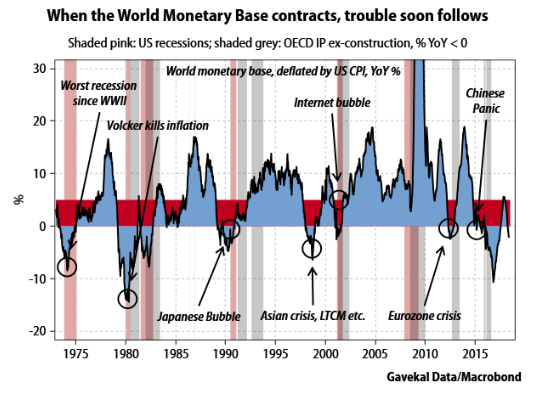 As the chart above shows, it is contracting now. So, based on the experience of the past 45 years, it seems likely that the world is entering its seventh international dollar liquidity crisis since 1973.
- Already the usual suspects—Argentina, Brazil, Turkey, South Africa—are having a tough time. And the times are likely to get even tougher for those countries which have external debts in US dollars coupled with a current account deficit.
- Already, the US stock market is outperforming all other major stock markets (most of which are actually going down)—a sure sign that the world is starting to suffer from a shortage of US dollars.
- Already the spreads between the US bond market and a number of government bond markets outside the US have started to widen. This is a sign that countries outside the US have started to raise interest rates in an attempt to stabilize their exchange rates. Unfortunately, the attempt is destined to fail, if, as I believe, the problem is not an overabundance of local currencies but a shortage of US dollars.
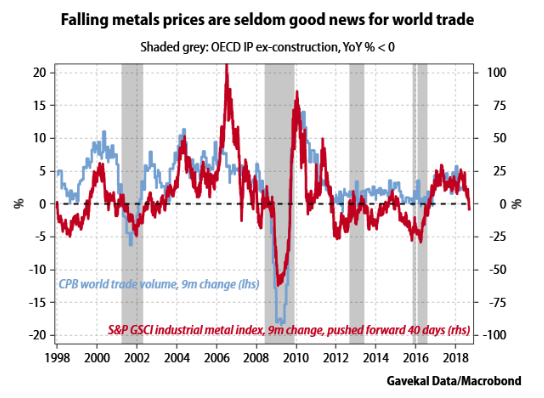 When the volume of trade goes down, together with the prices of commodities, commodity-producers (essentially the emerging markets outside Asia) usually see their stock markets tank. And ex-Asian emerging markets have certainly taken a beating recently.
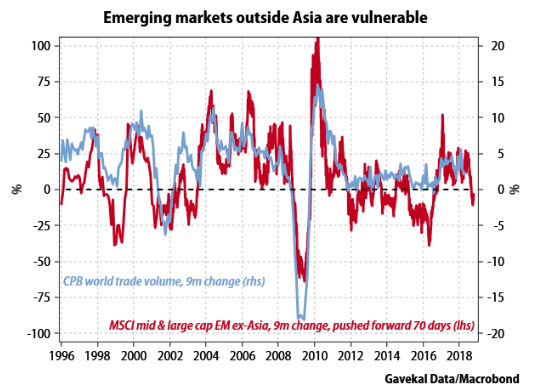 Needless to say, if these countries are having a hard time today because they have borrowed too freely in US dollars in the past, then it stands to reason that whoever lent them those dollars must be feeling the heat too. And sure enough, bank shares have cratered lately.
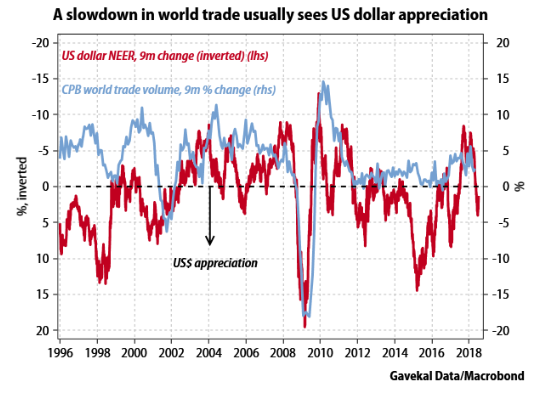
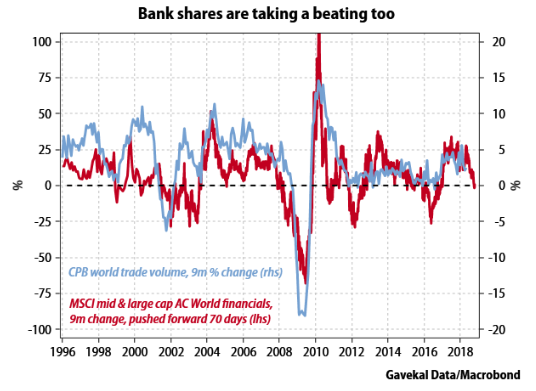 And, to add insult to injury, the US dollar is going up, as it tends to do every time world trade slows down or contracts.
 Conclusion
A world-wide recession is looking more and more probable. And if the time lag is similar to those in the past, it could hit by March 2019. Indeed, looking at the performance of markets over the last six months, it looks as if a bear market may have already started everywhere but in the US. As I have written repeatedly in recent months, bears are sneaky animals. Their victims seldom see them coming.
As usual, little is certain. But at this point, there are a number of things that I can say with confidence.
Conclusion
A world-wide recession is looking more and more probable. And if the time lag is similar to those in the past, it could hit by March 2019. Indeed, looking at the performance of markets over the last six months, it looks as if a bear market may have already started everywhere but in the US. As I have written repeatedly in recent months, bears are sneaky animals. Their victims seldom see them coming.
As usual, little is certain. But at this point, there are a number of things that I can say with confidence.
- Gavekal’s statistical system to assist decision making, TrackMacro, is now registering risk-off for almost every stock market in the world. It has seven components, two of which are the WMB and world trade.
- The eurozone economies in general, and Italy and France in particular, are not in a position to navigate another recession.
- China has foreseen the danger of a US dollar shortage, and has tried to arrange things in Asia to allow the region to ride out a dollar squeeze. As a result, Asia is likely to be a zone of relative stability in the coming turmoil.
- For the first time in almost 20 years, cash is an alternative to risk assets. The yen is probably the cheapest currency there is today. Cash should be held in yen.
- Investors should hedge the equity risk in their portfolios with US long bonds and Chinese long bonds.
- Investors should avoid financials everywhere, as I have repeated until I am blue in the face.
- Investors should sell the shares of companies with negative cash flow, especially if they are short US dollars.
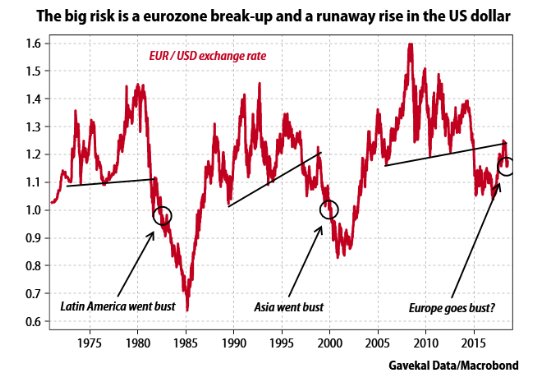
- The big risk is an uncontrollable rise in the US dollar if Europe’s fixed exchange rate system falls apart, much as earlier US dollar liquidity crises led to the collapse of fixed exchange rate systems in Latin America and Asia. Buy calls on the US dollar against the euro.
OUR CURRENT LIKES AND DISLIKES
Changes highlighted in bold.
LIKE- Large-cap growth (during a deeper correction)
- International developed markets (during a deeper correction)
- Cash
- Publicly-traded pipeline partnerships (MLPs) yielding 6%-12% (buy carefully after the recent rally; long-term, however, future returns look highly attractive)
- Gold-mining stocks
- Gold
- Select blue chip oil stocks (as with MLPs, be selective given the magnitude of the recent rally)
- Mexican stocks
- Short euro ETF (due to the euro’s weakness of late, refrain from initiating or adding to this short)
- Investment-grade floating rate corporate bonds
- One- to two-year Treasury notes
- Canadian dollar-denominated short-term bonds
- Select European banks
- Short-term investment grade corporate bonds (1-2 year maturities)
- Emerging market bonds in local currency (start a dollar-cost-averaging process and be prepared to buy more on further weakness)
- Most cyclical resource-based stocks
- Mid-cap growth
- Emerging stock markets; however, a number of Asian developing markets appear undervalued
- Solar Yield Cos
- Large-cap value
- Canadian REITs
- Intermediate-term investment-grade corporate bonds, yielding approximately 4%
- Intermediate municipal bonds with strong credit ratings
- US-based Real Estate Investment Trusts (REITs)
- Long-term Treasury bonds *
- Long-term investment grade corporate bonds *
- Intermediate-term Treasury bonds *
- Long-term municipal bonds *
- Small-cap value
- Mid-cap value
- Small-cap growth
- Lower-rated junk bonds
- Floating-rate bank debt (junk)
- US industrial machinery stocks (such as one that runs like a certain forest animal, and another famous for its yellow-colored equipment)
- Preferred stocks
- BB-rated corporate bonds (i.e., high-quality, high yield; in addition to rising rates, credit spreads look to be widening) * **
- Short yen ETF
- Dim sum bond ETFs; individual issues, such as blue-chip multi-nationals, are attractive if your broker/custodian is able to buy them