

Click here to view as PDF. “The Internet is the first thing that humanity has built that humanity doesn’t understand.” -ERIC SCHMIDT, former CEO and Executive Chairman of Alphabet Inc. (Google)
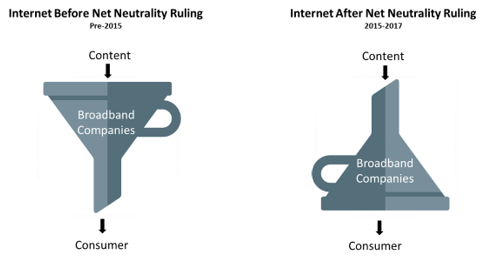
On December 14th, 2017 the Federal Communications Commission (FCC) ruled in favor of overturning Obama-era net neutrality regulations by a vote of 3-2. While not necessarily underreported, the ruling was, in many ways, overshadowed in the financial media by two parallel events: tax reform and the Bitcoin bubble. Case in point, we have used these pages to share our view on both of these topics over the past several weeks, while completely ignoring the FCC’s landmark decision. And yet, despite its importance, it’s easy to see why the net neutrality repeal took a back seat: it’s not a get-rich-quick scheme (à la Bitcoin), nor does it have an immediate bottom-line impact on nearly every American’s net worth (à la tax reform). But to brush the reversal aside and let the other two acts take center stage is a short-sighted approach to dealing with a momentous decision that will affect almost every American. And, make no mistake, it will impact almost every American. For those who are showing up late to the show or need a quick refresher on what net neutrality is, it’s basically a set of rules passed in 2015 under the Obama administration intended to protect consumers as more Americans take to the internet for communications. It also ensures media companies can sell their goods, services, and distribute information without restrictions from internet service providers (ISPs). In perhaps the most simplistic terms I can think of to describe it, the purpose of these rules is to allow information to flow freely and without bias from content providers to consumers (see my crude depiction below illustrating how content could be filtered by broadband companies prior to the net neutrality ruling, and how the pipeline between content and consumers widened after the 2015 ruling).
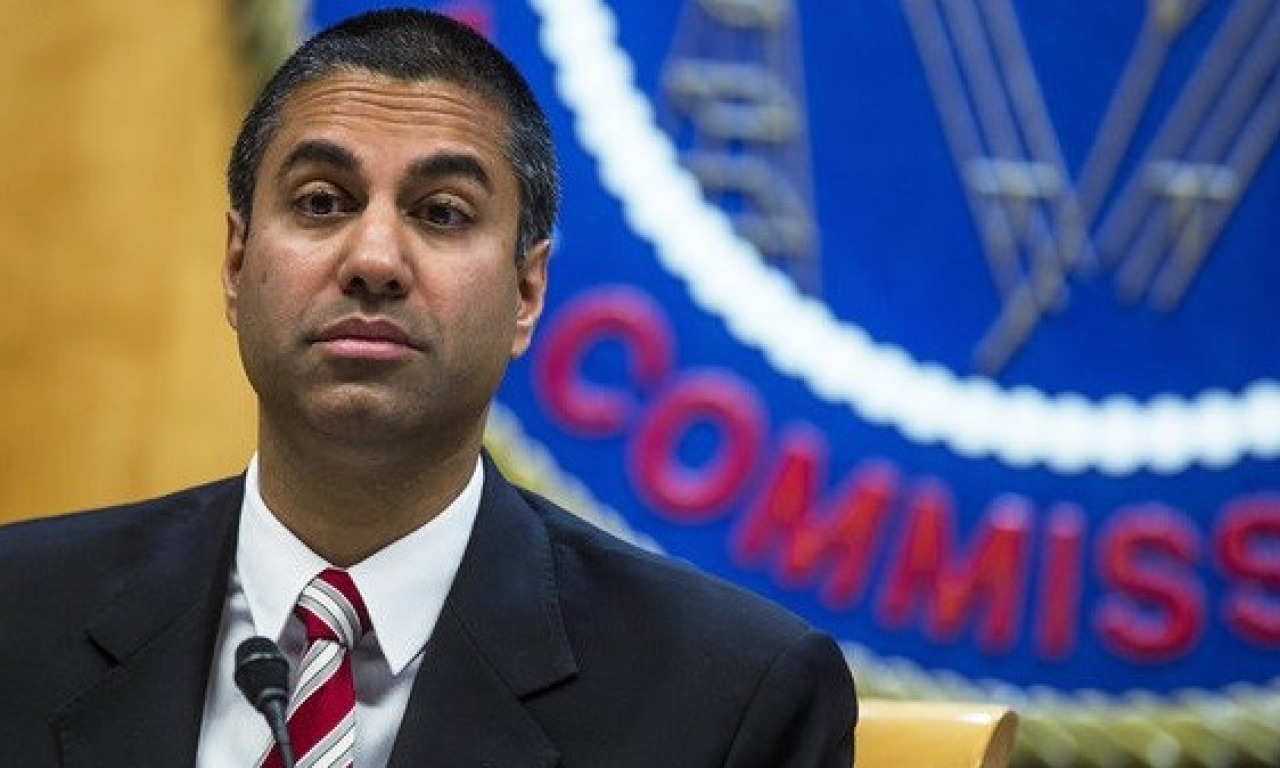
 This 2015 ruling was, in most regards, a win for consumers. So, it should come as no surprise that, leading up to the most recent December 14th, 2017 vote, the masses littered the internet with propaganda aimed at keeping these rules intact and swaying the newly appointed FCC-Chairman, Ajit Pai, away from what was an almost certain reversal (we’ll return to Ajit Pai in a minute, but for now, enjoy a few of my favorite internet memes poking fun at the very serious debate).


 However, this internet-fueled campaign was in vain as Pai gathered the necessary support from a Republican-majority board to continue on his path towards destroying the rules his predecessor put in place.
At the risk of (and suggestion to avoid) getting too political, the main point here is that up until last January, Tom Wheeler, a Democrat, sat at the head of the FCC. He fought for net neutrality with support from the Obama administration under the premise that it was good for the majority of Americans. When Trump was elected, he replaced Wheeler with Pai, a Republican intent on repealing and retracting those laws and shifting the balance of power to a select few corporations.
In theory, the idea that internet service providers shouldn’t abuse their market power is hard to contest. However, where the debate gets sticky is putting these rules down on paper and determining a fixed set of standards to regulate the internet.
In a classic free market debate, the blue-blooded policy-makers are, generally, for more regulation while the red-blooded are, generally, for less oversight. This trickles into the debate around net neutrality as one side argues that the government should have no hand in dictating how internet service providers can operate, while the other side argues the opposite.
Now, no one has ever accused Evergreen of being anti-free enterprise, and we don’t want the finger-pointing to start now. But, what’s alarming about the repeal of net neutrality is the implications for American consumers and small businesses. But, before getting in to that, let’s take a look at where things have been in order to understand where they’re going.
Relegated to the Slow Lane
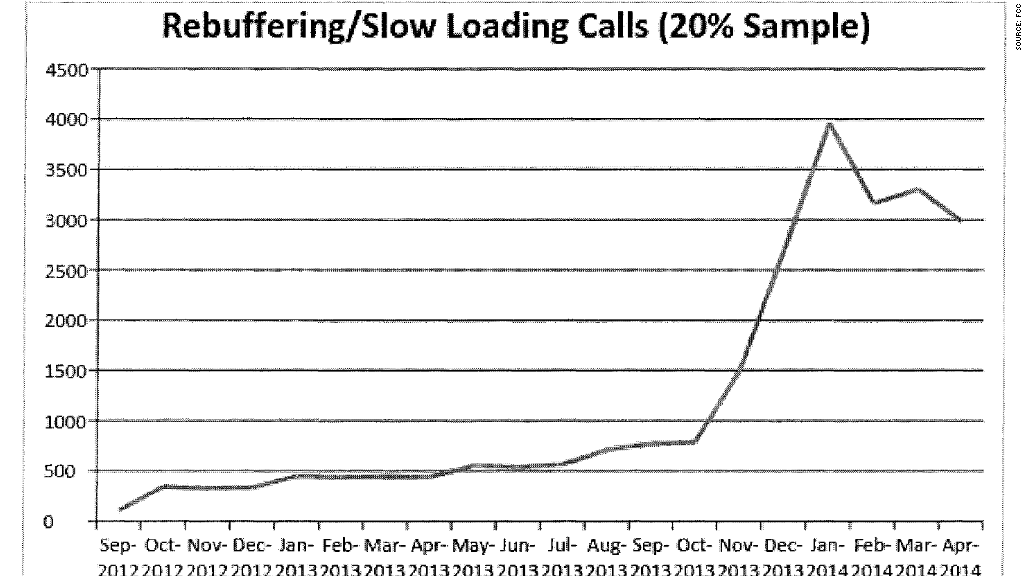
In February 2014, Netflix reluctantly paid Comcast to gain direct access to its network. The reason for doing so was that Comcast had been intentionally reducing speeds for consumers trying to access the streaming-service (which led to an ungodly rise in customer service complaints between September 2012 and January 2014, as shown below).
However, this internet-fueled campaign was in vain as Pai gathered the necessary support from a Republican-majority board to continue on his path towards destroying the rules his predecessor put in place.
At the risk of (and suggestion to avoid) getting too political, the main point here is that up until last January, Tom Wheeler, a Democrat, sat at the head of the FCC. He fought for net neutrality with support from the Obama administration under the premise that it was good for the majority of Americans. When Trump was elected, he replaced Wheeler with Pai, a Republican intent on repealing and retracting those laws and shifting the balance of power to a select few corporations.
In theory, the idea that internet service providers shouldn’t abuse their market power is hard to contest. However, where the debate gets sticky is putting these rules down on paper and determining a fixed set of standards to regulate the internet.
In a classic free market debate, the blue-blooded policy-makers are, generally, for more regulation while the red-blooded are, generally, for less oversight. This trickles into the debate around net neutrality as one side argues that the government should have no hand in dictating how internet service providers can operate, while the other side argues the opposite.
Now, no one has ever accused Evergreen of being anti-free enterprise, and we don’t want the finger-pointing to start now. But, what’s alarming about the repeal of net neutrality is the implications for American consumers and small businesses. But, before getting in to that, let’s take a look at where things have been in order to understand where they’re going.
Relegated to the Slow Lane
In February 2014, Netflix reluctantly paid Comcast to gain direct access to its network. The reason for doing so was that Comcast had been intentionally reducing speeds for consumers trying to access the streaming-service (which led to an ungodly rise in customer service complaints between September 2012 and January 2014, as shown below).
 Source: CNN
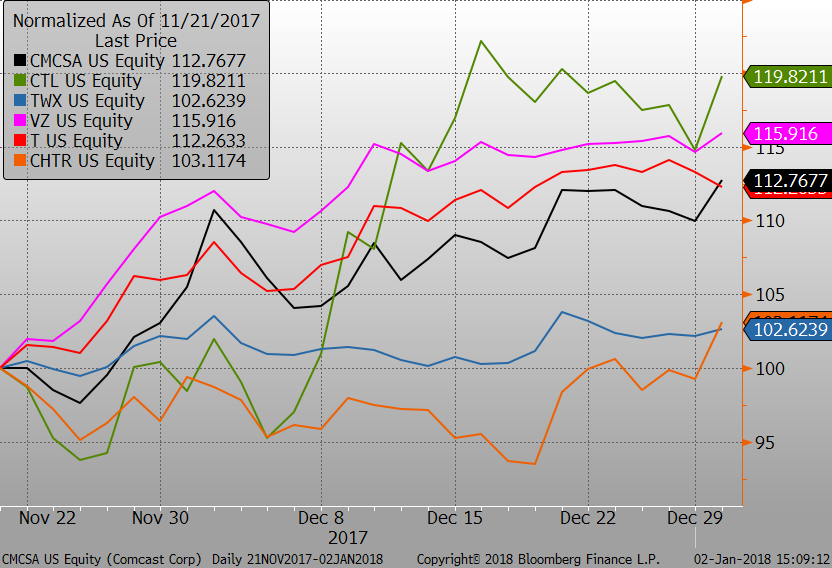 Source: Evergreen Gavekal, Bloomberg; Comcast (CMCSA), CTL (CenturyLink), TWX (Time Warner), VZ (Verizon), T (AT&T), CHTR (Charter Communications)

OUR CURRENT LIKES AND DISLIKES
Changes highlighted in bold.
LIKE
- Large-cap growth (during a correction)
- International developed markets (during a correction)
- Cash
- Publicly-traded pipeline partnerships (MLPs) yielding 7%-12% (buy less aggressively due to the recent sharp rally)
- Intermediate-term investment-grade corporate bonds, yielding approximately 4%
- Gold-mining stocks
- Gold
- Select blue chip oil stocks (wait for a pull-back after their recent strong run)
- Mexican stocks (at lower prices after this year’s robust rally)
- Bonds denominated in renminbi trading in Hong Kong (dim sum bonds)
- Short euro ETF (due to the euro’s weakness of late, refrain from initiating or adding to this short)
- Intermediate municipal bonds with strong credit ratings
- Investment-grade floating rate corporate bonds
NEUTRAL
- Most cyclical resource-based stocks
- Short-term investment grade corporate bonds
- High-quality preferred stocks yielding 6%
- Mid-cap growth
- Emerging stock markets, however a number of Asian developing markets, ex-India, appear undervalued
- Select European banks
- BB-rated corporate bonds (i.e., high-quality, high yield)
- Long-term Treasury bonds
- Long-term investment grade corporate bonds
- Intermediate-term Treasury bonds
- Long-term municipal bonds
- Emerging bond markets (dollar-based or hedged); local currency in a few select cases
- Solar Yield Cos (taking partial profits on these)
- Large-cap value
- Canadian REITs
DISLIKE
- US-based Real Estate Investment Trusts (REITs) (once again, some small-and mid-cap issues appear attractive; also, some retail-exposed REITs look deeply undervalued)
- Small-cap value
- Mid-cap value
- Small-cap growth
- Lower-rated junk bonds
- Canadian dollar-denominated bonds (the loonie is currently overbought)
- Short yen ETF (in fact, the yen looks poised to rally)
- Emerging market bonds (local currency)
- Emerging market bonds (local currency)
- Floating-rate bank debt (junk)
- US industrial machinery stocks (such as one that runs like a certain forest animal, and another famous for its yellow-colored equipment)
DISCLOSURE: This material has been prepared or is distributed solely for informational purposes only and is not a solicitation or an offer to buy any security or instrument or to participate in any trading strategy. Any opinions, recommendations, and assumptions included in this presentation are based upon current market conditions, reflect our judgment as of the date of this presentation, and are subject to change. Past performance is no guarantee of future results. All investments involve risk including the loss of principal. All material presented is compiled from sources believed to be reliable, but accuracy cannot be guaranteed and Evergreen makes no representation as to its accuracy or completeness. Securities highlighted or discussed in this communication are mentioned for illustrative purposes only and are not a recommendation for these securities. Evergreen actively manages client portfolios and securities discussed in this communication may or may not be held in such portfolios at any given time.