

“This attack introduces a new, irreversible premium into the market.” –JP Morgan analyst Christy Malek, who expects oil to surge to $80, or higher, over the next three to six months ______________________________________________________________________________________________________
INTRODUCTION
In the mid-1950s, geologist M. King Hubbert theorized that “peak oil” would come when the maximum rate of extraction of petroleum was reached, after which the production of oil would enter terminal decline. At the time Hubbert first presented his theory, he predicted that US peak oil would occur around 1970. While the theory appeared accurate for many years, pessimistic prophesies on the future of oil have continued to prove false as world oil production has not only risen but hit a new all-time high in 2018. Yet, for the better part of this decade, the narrative of “peak oil” has continued to weigh on oil prices, dragging down energy stocks along with it. If there’s any silver lining (at least for energy investors) in the aggressive attacks last weekend on Saudi Arabia oil facilities, it’s that the long-forgotten energy sector has been re-energized. At one point following the attacks, oil prices surged nearly 20% with Brent crude posting its largest intra-day gain since the Gulf War in 1991. Shares of many major energy corporations also soared on Monday. It should come as no surprise to regular readers of Evergreen’s newsletter that the long-detested energy sector is one of our favorite corners of the market. Specifically, high-yielding energy stocks and Master Limited Partnerships (MLPs) offer seemingly rare value in an environment where securities with cash flows reminiscent of the 1990s—6% to 12—are nearly impossible to come by. The long-term impact of last weekend’s attacks will play out over time as Saudi Arabia, the United States and other nations determine an appropriate response to the unprovoked aggression. On Wednesday, the United States announced a major increase in sanctions on Iran as Saudi Arabia presented evidence that the provocation was “unquestionably sponsored by Tehran.” As of this writing, Saudi Arabia and its allies have stopped short of counter-attacking the presumed guilty party through a show of force. However, escalating tensions in a region that has been extremely volatile for decades could continue to create waves for oil prices, energy stocks, energy-dependent companies, and consumers for the foreseeable future. On Monday, JP Morgan estimated that crude could jump by “anything between $5 and $30 in the upcoming months.” Evergreen believes the attack may accelerate a trend that was already evident prior to this event: consolidation. Senior management teams at energy companies may now realize the urgency of acquiring geopolitically safe US oil and gas reserves and/or infrastructure assets at bargain prices. This week, we are presenting a very informative Q&A on the Saudi oil attacks, written by Evergreen Gavekal’s esteemed partner Louis-Vincent Gave. In the pages below, Louis seeks to answer some of the week’s most pressing questions, namely:- Why did the attacks take place?
- Who stands to benefit the most from the current mess?
- Who loses from the attacks?
- Should investors buy or sell bonds?
- Why hasn’t oil risen more in the days following the attack?
- What should we make of the Saudi peg (its currency link to the US dollar)?
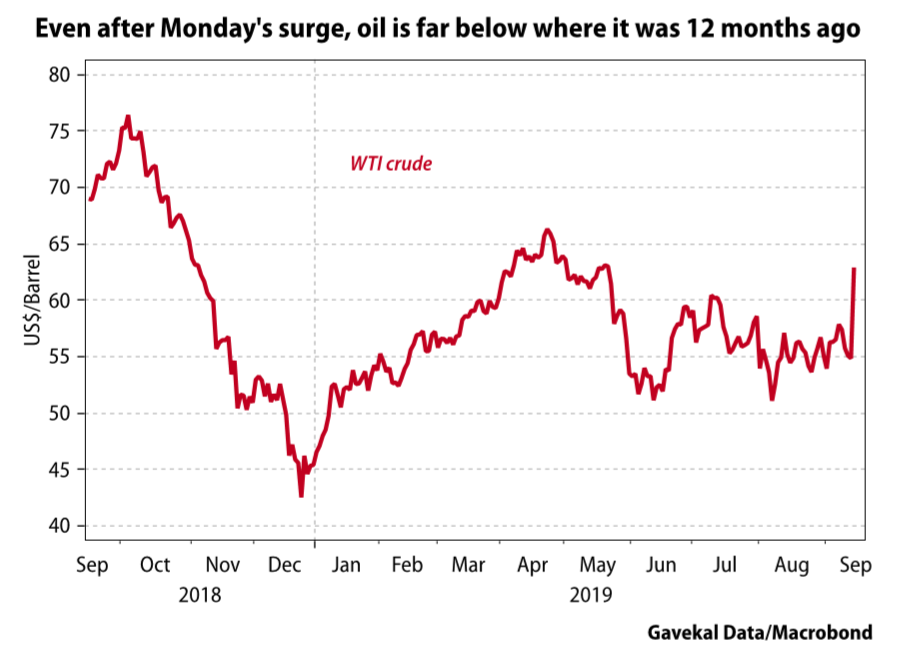 Or maybe the market assumes the whole mess will blow over. As Donald Trump put it on Monday, “I don’t want war with anybody.” So maybe investors are resisting the temptation to panic. Even so, this weekend’s attacks have clearly unsettled a number of our clients, and over the past 48 hours we have received a number of questions on the topic. Here are my attempts at answers.
Question #1: Why?
You may have heard the story of the camel and the scorpion. The scorpion wants to cross the river and asks the camel to carry him across. The camel answers: “If I give you a ride on my back, you will sting me and I will die.” The scorpion replies: “But if do that, I will die too.” Persuaded, the camel agrees to carry the scorpion across. But in the middle of the river, the scorpion stings the camel. As the poison takes hold, the camel asks: “Why did you do that? Now we will both die”. The scorpion replies: “Yes. This is the Middle East”.
Jokes aside, considering the likely motive for, and timing of, last weekend’s attacks, there are three possible conclusions:
Or maybe the market assumes the whole mess will blow over. As Donald Trump put it on Monday, “I don’t want war with anybody.” So maybe investors are resisting the temptation to panic. Even so, this weekend’s attacks have clearly unsettled a number of our clients, and over the past 48 hours we have received a number of questions on the topic. Here are my attempts at answers.
Question #1: Why?
You may have heard the story of the camel and the scorpion. The scorpion wants to cross the river and asks the camel to carry him across. The camel answers: “If I give you a ride on my back, you will sting me and I will die.” The scorpion replies: “But if do that, I will die too.” Persuaded, the camel agrees to carry the scorpion across. But in the middle of the river, the scorpion stings the camel. As the poison takes hold, the camel asks: “Why did you do that? Now we will both die”. The scorpion replies: “Yes. This is the Middle East”.
Jokes aside, considering the likely motive for, and timing of, last weekend’s attacks, there are three possible conclusions:
- Iran wasn’t behind the attacks. While Secretary of State Mike Pompeo was quick to point the finger at Tehran, Saudi Arabia has so far remained much more muted, and Trump seems to be walking back on his bellicose tweets from Sunday. Perhaps one possible explanation is that the attack was the work of domestic terrorists. Abqaiq is in Saudi’s eastern province where Shia Muslims, who make up a third of the local population, have historically been treated as second class citizens, gaining few rewards from the exploitation of the oil beneath their feet.
- There is a deep split within the Iranian regime. It could be that Iran’s Revolutionary Guards are pursuing their own agenda in defiance of the administration of president Hassan Rouhani. This could explain June’s attack on a Japanese tanker on the same day that Japanese prime minister Shinzo Abe met Rouhani and Iranian supreme leader Ayatollah Ali Khamenei in Tehran. In this scenario, the Revolutionary Guards are actively sabotaging potential peace efforts, lest peace should threaten their position and perhaps even their existence.
- Tehran wants to sabotage Aramco’s IPO*. Perhaps Tehran has decided that an IPO for oil giant Saudi Aramco could pose a threat to the Iranian regime, as it would give the Saudi royal family more funds to throw into proxy wars in Yemen, Syria and Iraq.
- Tehran feels invulnerable. The Iranian government feels confident enough to throw the gauntlet directly in Saudi’s face because it now has (or is very close to obtaining) nuclear weapons.
- In the short term, President Xi Jinping must feel like he is dealing with a perfect storm. To begin with, pork-loving China is hit by African swine fever. Then, China’s financial capital, Hong Kong, is rocked by months of persistent street protests. And now, to top it all off, oil prices are surging higher.
- In the longer term, China had just spent the summer negotiating a multi-year deal with Iran, with plans to invest hundreds of billions of renminbi into the Islamic Republic over the coming decade to help modernize its energy industry so Iran can sell its oil to China for renminbi. These planned investments will look a lot less promising with missiles flying about the place.
 Question #5: Why hasn’t oil risen more?
The US shale boom of the last decade, combined with the recovery of Iraqi production (Iraq was producing 2mn barrels per day (bpd) a decade ago; it now pumps 4.5mn), and more recently Libyan production (from less than 0.5mn bpd to more than 1mn) may have lulled the market into a false sense of security in which the prevalent belief is that the world is awash with oil. Combine this with the growing rumbles from politicians around the world—in Germany, France, the UK, China, and from the US Democrats—that they are going to pour billions into “green technologies” and investors may naturally be gun-shy.
Another factor may be that for the last decade, energy has been the biggest dog of a sector in the market. By now, any portfolio manager with a pro-energy bias has either been fired or has forsworn energy investing entirely, if only for career preservation. As the financial media have repeated again and again over the last 24 hours, in one form or another: “If it takes the threat of a full-blown war for energy to be interesting, then energy really can’t be that interesting as an investment!”
As readers may know, in recent times I have argued precisely the opposite. In a world in which almost every asset is now priced off a stupidly low interest rate and the hardcore belief that central banks will always provide a backstop, energy may well be one of the few remaining genuinely uncorrelated asset classes.
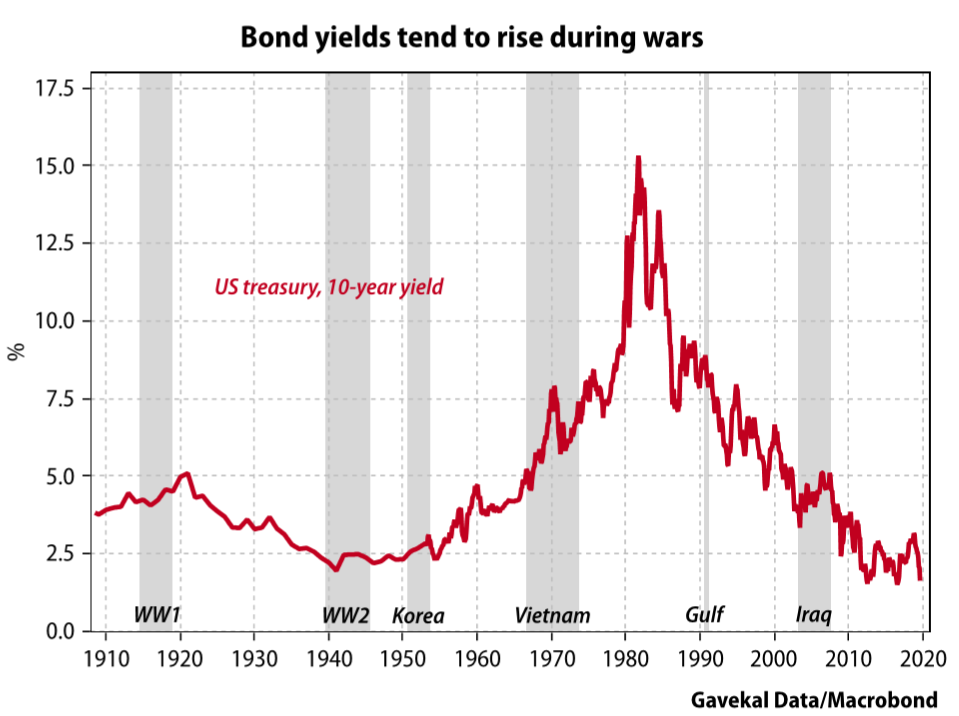
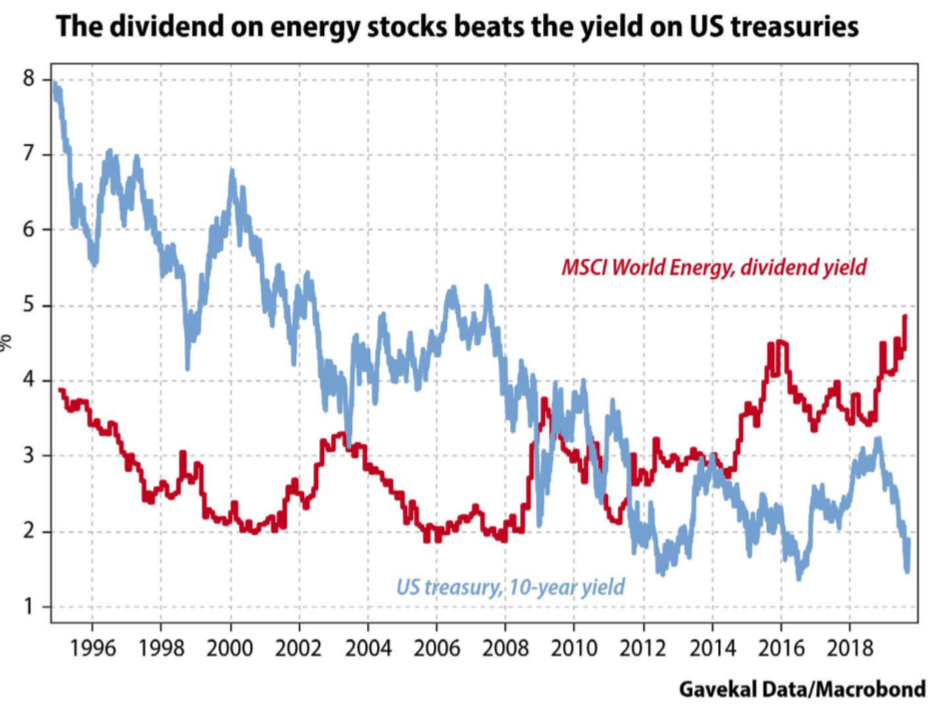
With this in mind, perhaps a truly balanced portfolio no longer consists of growth stocks hedged with a long bond position—that is a “dumbbell portfolio” which is now a doubled-up bet on ever-falling interest rates. Instead, the balanced portfolio of the future might be growth stocks hedged with energy stocks. Instead of owning 10-year US treasuries, investors may be better served holding energy stocks. Firstly, such holdings would offer a buffer should war break out and oil prices continue to shoot up, destabilizing the current narrative of ever-falling inflation. Secondly, unlike most government bonds today, energy stocks actually offer solid yields of around 5%*. In fact, energy stocks offer record high yields, which unless oil prices tank should help cushion any potential price downturn, which is more than bonds can now say.
*Evergreen note: And far higher with US energy infrastructure securities.
Question #5: Why hasn’t oil risen more?
The US shale boom of the last decade, combined with the recovery of Iraqi production (Iraq was producing 2mn barrels per day (bpd) a decade ago; it now pumps 4.5mn), and more recently Libyan production (from less than 0.5mn bpd to more than 1mn) may have lulled the market into a false sense of security in which the prevalent belief is that the world is awash with oil. Combine this with the growing rumbles from politicians around the world—in Germany, France, the UK, China, and from the US Democrats—that they are going to pour billions into “green technologies” and investors may naturally be gun-shy.
Another factor may be that for the last decade, energy has been the biggest dog of a sector in the market. By now, any portfolio manager with a pro-energy bias has either been fired or has forsworn energy investing entirely, if only for career preservation. As the financial media have repeated again and again over the last 24 hours, in one form or another: “If it takes the threat of a full-blown war for energy to be interesting, then energy really can’t be that interesting as an investment!”
As readers may know, in recent times I have argued precisely the opposite. In a world in which almost every asset is now priced off a stupidly low interest rate and the hardcore belief that central banks will always provide a backstop, energy may well be one of the few remaining genuinely uncorrelated asset classes.
With this in mind, perhaps a truly balanced portfolio no longer consists of growth stocks hedged with a long bond position—that is a “dumbbell portfolio” which is now a doubled-up bet on ever-falling interest rates. Instead, the balanced portfolio of the future might be growth stocks hedged with energy stocks. Instead of owning 10-year US treasuries, investors may be better served holding energy stocks. Firstly, such holdings would offer a buffer should war break out and oil prices continue to shoot up, destabilizing the current narrative of ever-falling inflation. Secondly, unlike most government bonds today, energy stocks actually offer solid yields of around 5%*. In fact, energy stocks offer record high yields, which unless oil prices tank should help cushion any potential price downturn, which is more than bonds can now say.
*Evergreen note: And far higher with US energy infrastructure securities.
 Question #6: What about the Saudi peg?
Is the Saudi currency peg to the US dollar at risk? And if Saudi’s peg goes, who else follows in its wake? Could we have a tidal wave like in Asia in 1997?
For the Saudi budget to balance, Riyadh needs oil to be at or above U$80/bbl with the kingdom producing and selling just shy of 10mn bpd. Now, if the Saudis continue to pump only 5mn bpd for any meaningful period, it seems pretty obvious that the price of oil won’t stay where it is. But will it rise to US$160/bbl? If so, then mathematically, selling 5mn bpd at US$160 will be a much better deal for Riyadh than selling 10mn bpd at US$65.
Of course, we are a long way from seeing such numbers, which would surely trigger a surge of production around the world—from US shale producers, Brazilian offshore fields, Russia etc.—that would likely end up considerably undermining Saudi’s long-term position as global swing producer.
In the meantime, for every day that 5mn barrels stay in the ground, Saudi loses approximately US$300mn. That’s unfortunate. And if we assume that most of the production will come back on stream fairly quickly, but that it will be months before the last 500,000 barrels see the light of day, then Saudi Arabia still stands to lose US$30mn per day. That’s US$10bn a year, or in other words, one whole contribution to SoftBank’s Vision Fund.
In short, Saudi can easily take a US$10bn hit. But a 5mn bpd, US$100bn a year hit would be crippling, even if Riyadh does still have some US$500bn in official foreign exchange reserves.
Question #6: What about the Saudi peg?
Is the Saudi currency peg to the US dollar at risk? And if Saudi’s peg goes, who else follows in its wake? Could we have a tidal wave like in Asia in 1997?
For the Saudi budget to balance, Riyadh needs oil to be at or above U$80/bbl with the kingdom producing and selling just shy of 10mn bpd. Now, if the Saudis continue to pump only 5mn bpd for any meaningful period, it seems pretty obvious that the price of oil won’t stay where it is. But will it rise to US$160/bbl? If so, then mathematically, selling 5mn bpd at US$160 will be a much better deal for Riyadh than selling 10mn bpd at US$65.
Of course, we are a long way from seeing such numbers, which would surely trigger a surge of production around the world—from US shale producers, Brazilian offshore fields, Russia etc.—that would likely end up considerably undermining Saudi’s long-term position as global swing producer.
In the meantime, for every day that 5mn barrels stay in the ground, Saudi loses approximately US$300mn. That’s unfortunate. And if we assume that most of the production will come back on stream fairly quickly, but that it will be months before the last 500,000 barrels see the light of day, then Saudi Arabia still stands to lose US$30mn per day. That’s US$10bn a year, or in other words, one whole contribution to SoftBank’s Vision Fund.
In short, Saudi can easily take a US$10bn hit. But a 5mn bpd, US$100bn a year hit would be crippling, even if Riyadh does still have some US$500bn in official foreign exchange reserves.
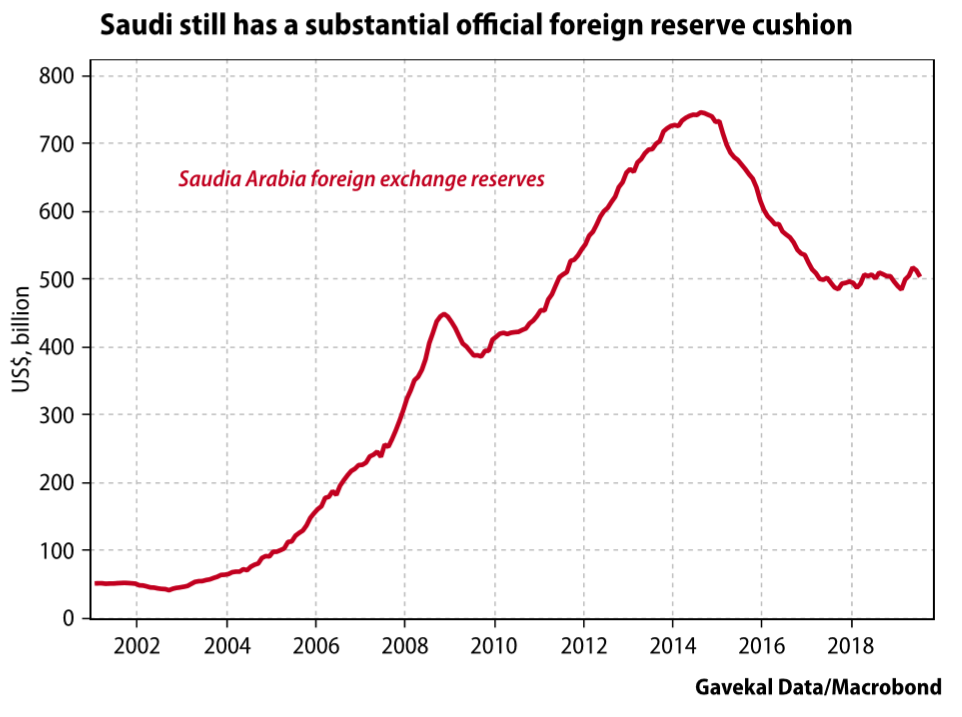 On this topic, note how Saudi’s reserves were in precipitous decline up until November 2017. Then the decline stopped, and ever since reserves have been flat lining. As it turns out, November 2017 happens to be the date when the Riyadh Ritz-Carlton stopped taking new bookings, and when the rich Saudis who were in residence found themselves wishing dearly they were staying almost anywhere else!
Clearly, with a little arm-twisting, Crown Prince Mohammad bin Salman managed to “convince” his various cousins to stop exporting capital, and perhaps even to bring some capital home. This helped to stabilize a peg that, at the time, seemed under threat. But is this a trick that can be repeated?
Having said that, for now the peg doesn’t seem to be in immediate danger of imploding. This is just as well, because it is very possible that a rupture of the Saudi peg could unleash a new wave of instability and revolutions across the Middle East. Consider the following:
On this topic, note how Saudi’s reserves were in precipitous decline up until November 2017. Then the decline stopped, and ever since reserves have been flat lining. As it turns out, November 2017 happens to be the date when the Riyadh Ritz-Carlton stopped taking new bookings, and when the rich Saudis who were in residence found themselves wishing dearly they were staying almost anywhere else!
Clearly, with a little arm-twisting, Crown Prince Mohammad bin Salman managed to “convince” his various cousins to stop exporting capital, and perhaps even to bring some capital home. This helped to stabilize a peg that, at the time, seemed under threat. But is this a trick that can be repeated?
Having said that, for now the peg doesn’t seem to be in immediate danger of imploding. This is just as well, because it is very possible that a rupture of the Saudi peg could unleash a new wave of instability and revolutions across the Middle East. Consider the following:
- If the Saudi peg goes, then food prices in Saudi Arabia will surge (almost all Saudi’s food is imported).
- More than 60% of the Saudi population is below 30 years old—the sort of age where you are most likely to throw stones at the police and to fight for a better future.
- You don’t have to be a Marxist to believe that there is a strong correlation between young and hungry populations and revolutions.