

INTRODUCTION
This week’s edition of the Evergreen Virtual Advisor (EVA) is a return to one of our most popular formats, the Evergreen Exchange. This structure gives three members of our investment team the chance to agree, disagree, or simply comment on a topic of interest. The theme of this issue revolves around common misconceptions in the market. First, Jeff Dicks outlines his view that the market is misguided by the prevailing sentiment that longer interest rates have nowhere to go but up. He makes a compelling case, highlighting key economic indicators to support his argument. Next, Jeff Eulberg argues that the “Trump Bump” has been buoyed by hope rather than concrete changes. He urges investors to keep a watchful eye on indicators of a market correction. Finally, Tyler Hay discusses the rise of robo-advisors in the financial services world, and whether or not they will be able to answer the call during the next bear market. As we often do with our Exchange issue, we ask readers to select which case was made most persuasively. We would greatly appreciate it if you’d take the time to submit your vote here. Thank you!Common Misconception #1: Interest Rates Have Nowhere to Go but Up!
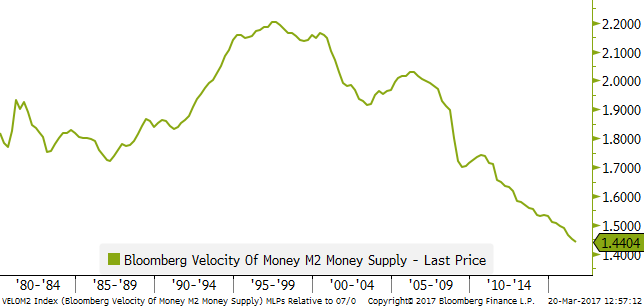
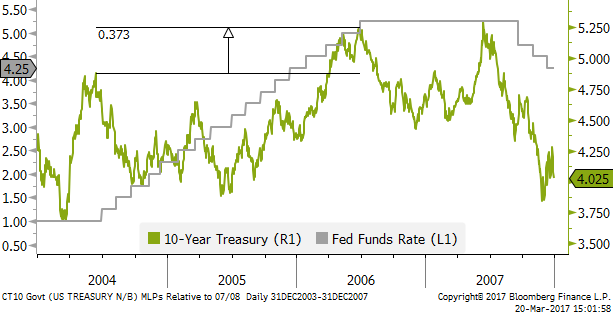
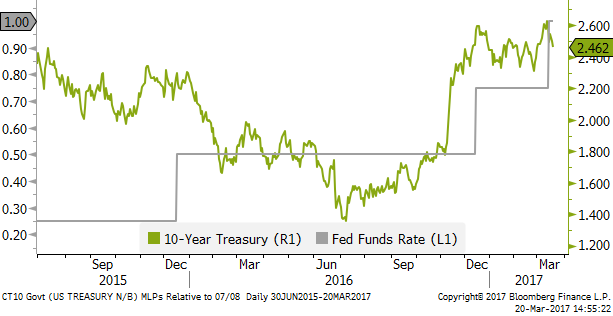
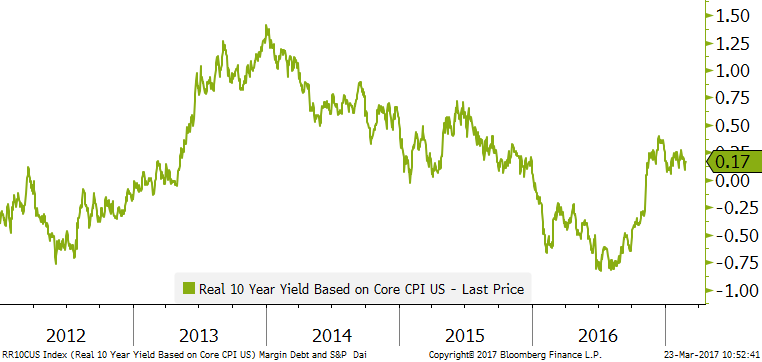
One of the most common market misconceptions is that long-term interest rates have nowhere to go but up. Over the last six years, we have heard this touted by the media and some of the world’s most renowned bond investors. As the chart indicates below, we have yet to break a downtrend for interest rates that began in 1981. Annotations A and B represent points in time where Bill Gross, once nicknamed the “King of Bonds” (dethroned by Jeff Gundlach), flipped bearish on bonds. The first instance (A) was in March of 2011, when Gross claimed rates were far too low and subsequently took a short treasury position in his Pimco total return fund. The second, (B), was during the 2013 “taper-tantrum,” when Gross pronounced an end to the secular bull market. In hindsight, both instances turned out to be exceptional buying opportunities. With the 10-year treasury yield recently crossing above a key resistance level of 2.60%, Gross (now CIO of Janus Capital) is again predicting the end of the nearly 40-year bull run for bonds.
10-Year Treasury Yield
 Source: Bloomberg, Evergreen GaveKal
Velocity of M2 Money Supply
 Source: Bloomberg, Evergreen GaveKal
10-Year Treasury Yield and Open Interest
 Source: Bloomberg, Evergreen GaveKal
10-Year US Treasury Yields and the Fed Fund Target Rate
 Source: Bloomberg, Evergreen GaveKal
Real 10-Year Yield Based on Core CPI
 Source: Bloomberg, Evergreen GaveKal
 Jeff Dicks, CFA
Portfolio Director
To contact Jeff, email:
jdicks@evergreengavekal.com
Jeff Dicks, CFA
Portfolio Director
To contact Jeff, email:
jdicks@evergreengavekal.com
Common Misconception #2: Keep Buying into the “Trump Bump!”
As an ardent skeptic, I’ve yet to passionately fight for any political candidate. I’m not in perfect alignment with either major U.S. political party and I certainly see flaws in most candidates. I have issues that are important to me and I vote for those who I believe will champion them. Yet, ultimately, I believe that the power of any individual, including the President of the United States, is limited by the checks and balances of the Constitution. Due to my general apathy for most Presidential candidates, I’m fascinated by the passionate reactions that inevitably follow most elections. Beyond the victory tours and rallies, markets typically experience some short-term volatility, but eventually refocus on other events. In fact, legendary investor and Democrat, Warren Buffett, has repeatedly advised against making investment decisions based on who’s in the White House. Therefore, as you can imagine, the 13% rally in the S&P 500, affectionately known as the “Trump Bump”, has my attention and full skepticism. Throughout 2016, it was common to hear proclamations that Trump was the better candidate because he was a successful businessman who could surely revitalize an anemic U.S. economy. As markets stabilized and rallied post-election, the details of Trump’s market-friendly agenda and Wall Street-laden team continued to throw fuel on the markets’ fire. However, up until this past week, the 13% appreciation in the S&P 500 was primarily based on the hope of future action rather than concrete changes. Accompanied by his self-professed skills at creating new jobs, Trump believes a 3% GDP growth rate is achievable if his policies are enacted. Post-election, industrial companies appreciated following the President’s promise to rebuild crumbling infrastructure in the United States. Financials rallied due to the belief that lower taxes and fewer regulations were coming. Surveys-based indexes, such as the Institute of Supply Management (ISM) and Consumer Confidence, echo the markets’ optimism for potential growth. The Trump administration has generated its fair share of negative headline-worthy news, but thus far markets have remained unfazed. Now, as the administration completes its second month in the White House, we’re starting to get a clear picture of which agenda items are on top of the priority list. Along with immigration reform, repealing and replacing the Affordable Care Act is clearly a top priority. Markets view this favorably due to the belief that the bill has acted as a governor on economic growth for the past 7 years. On March 6th, Wisconsin Congressman Paul Ryan released the first details of the House of Representatives’ new healthcare plan. In the two weeks following the announcement, many members of the Republican party voiced displeasure with the bill. Dissenting House Republicans believe the new plan remains too costly for the Federal Government. Conversely, several members of the more centrist Republican Senate have expressed displeasure with the bill, viewing the cuts as too harsh on poor and elderly communities. In what appeared to be an admission that repealing and replacing the ACA may be more time-consuming than originally thought, President Trump recently commented on the surprising complexity of our healthcare system. Until this week, the market appeared to have faith that Congress would ultimately agree to a replacement and move on to the next agenda item. However, Tuesday’s market decline was the first sign that faith in this administration’s ability to negotiate a bill through Congress is wavering. For now, tax reform and infrastructure packages appear to be shelved until cost savings from a repealed Affordable Care Act are identified. Recently, Treasury Secretary Steve Mnuchin went as far to say that August might be the appropriate time to address tax reform. Subsequently, on Friday of last week, President Trump released his first budget proposal as President. While unlikely to be enacted by Congress, it does offer insight into the President’s desired path for the year ahead. Discretionary spending remained flat year-over-year and a surge in deficit spending appears to be of no interest to this administration. In fact, in her recent press conference, Federal Reserve Chairwoman Janet Yellen echoed my skepticism when she stated, “If we were to see a major shift in spending reflecting those expectations, that could very well affect the outlook. I’m not seeing it at this point.” If Congress is unable to agree on a replacement for the Affordable Care Act, based on recent history in Washington, it’s easy to imagine gridlock eliminating any hope of tax reform and expansive infrastructure programs. Further, even if Congress can pass a new healthcare bill, the battle between austerity and deficit spending is likely to intensify. Regardless of whether these market-friendly agenda items are addressed, other factors could ultimately side-swipe equity investors buying the “Trump Bump.” In fact, despite abnormally warm weather this winter (which normally supports consumer-spending trends), the Atlanta’s Federal Reserve forecast for first-quarter GDP has declined from over 3% at the start of the year to below 1% today. While lackluster growth is old-hat to the second longest bull market since the Great Depression, the Fed raising interest rates in consecutive quarters is certainly new. The Federal Reserve Board believes that it will raise interest rates twice more this year, putting pressure on the lofty valuations equities have enjoyed due to the lowest interest rates in US history. While we admit that equities can ignore this change early in a tightening process, it’s important to recognize the shifting environment that has supported this rally for the last 7 years. If you’re buying the “Trump Bump” today, hope needs to quickly turn into definitive policy change. Otherwise, the decline seen on Tuesday may just be the start of the “Trump Slump.” As shown below, it’s not uncommon for a first-term President to experience a significant decline in the markets. If Trump disappoints as a legislator, and the markets shift focus to valuations and interest rates, I fear his market drawdown could be dramatic.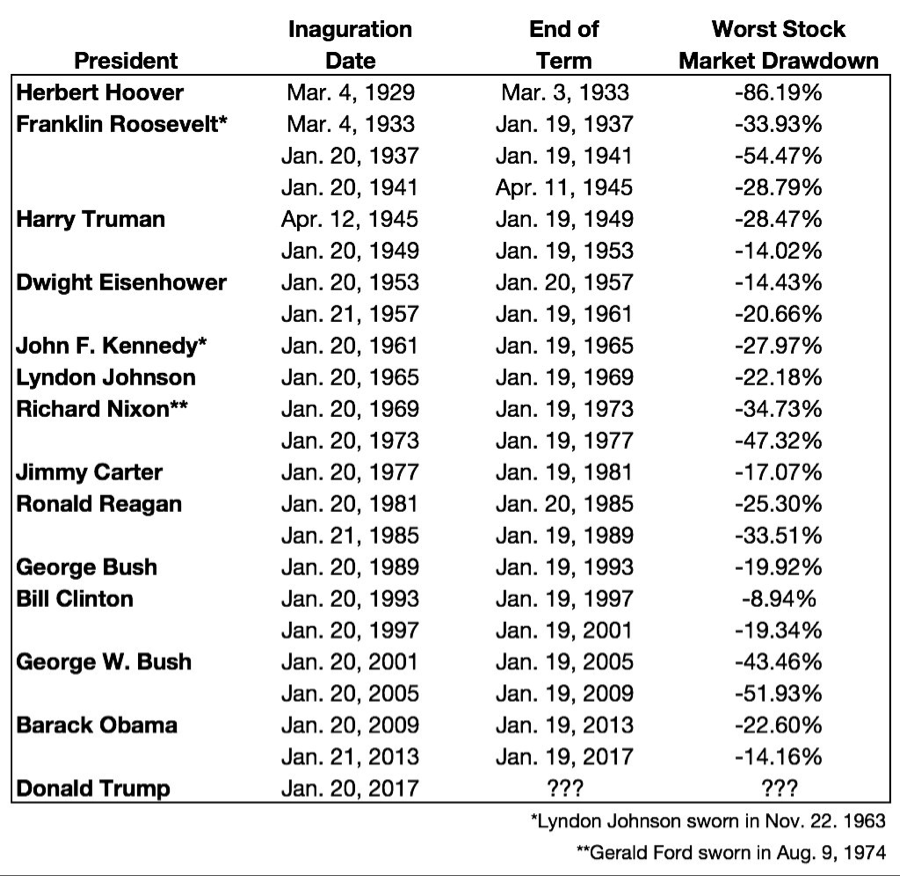
 Jeff Eulberg, J.D., CFP®
Director of Wealth Management
To contact Jeff, email:
jeulberg@evergreengavekal.com
Jeff Eulberg, J.D., CFP®
Director of Wealth Management
To contact Jeff, email:
jeulberg@evergreengavekal.com
Common Misconception #3: Robo-Advisors Will Save the Day!
Recently, robo-advisors have exploded in popularity, emerging as one of the fastest-growing sources for financial advice. According to Investopedia, “A robo-advisor is an online wealth management service that provides automated, algorithm-based portfolio management advice without the use of human financial planners.” It seems like every week there’s a new article announcing another bank or firm that’s joined the party by launching a robo-advisor. Goldman Sachs, JPM, Charles Schwab—my inbox is bombarded with articles from industry publications warning me of the dangers they present to wealth managers. They have titles like “Are You Ready to Lose Your Job to an Algorithm?”, “How to Avoid Being Outsmarted by the Machines,” and “Wealth Management, Under Attack by Robots!” Given all the hype these new financial services are receiving, I thought I’d use this week’s “common misconception” theme to share my perspective on the matter. In a strange way, the wealth management/financial services industry helped create the robo-advisor, though not directly through capital investments or creative innovation. In fact, it was quite the opposite. Many inefficiencies in the financial world created a vacuum for robos to fill. As technology continued to progress, it evolved and expanded the way investors chose to interact with their advisor. Five years ago, it wasn’t possible to open an account digitally. Today, it’s becoming increasingly commonplace. New investment vehicles, such as ETFs, have gained increased momentum, making investing seem both easier and safer. Additionally, markets themselves have played a key role. In particular, the lack of volatility has had an obscuring effect on all managers. As Warren Buffett says: “Only when the tide goes out do you discover who’s been swimming naked.” Somewhere around 2010, robo-advisors truly began to gain traction. They burst onto the scene and offered enhancements that were long overdue. For starters, they eliminated something everyone hates: paperwork. Our industry is still behind the curve in this respect. Some firms have begun moving away from FedEx packages filled with paperwork and countless “sign here” stickers. Others (especially larger companies bogged down with corporate red tape), are slower to adapt. In the case of, emerging robo-advisors, they did something that’s considered heresy in the financial world—they simplified things. Instead of using countless acronyms, big words, and confusing charts, robo-advisors made the experience for investors simple and intuitive. Another important differentiator they offered was a willingness to take on small accounts and charge low fees. On average, robos tend to charge around 0.30%, which is a sizeable discount from traditional advisors who typically offer management fees of 1% or more. Robos, which offer tech-savvy websites allowing small investors to easily access financial markets, are particularly popular with younger investors. Combine this with the pre-installed disdain millennials carry for Wall Street (or anyone wearing a suit) and it’s no wonder robos are “trending.”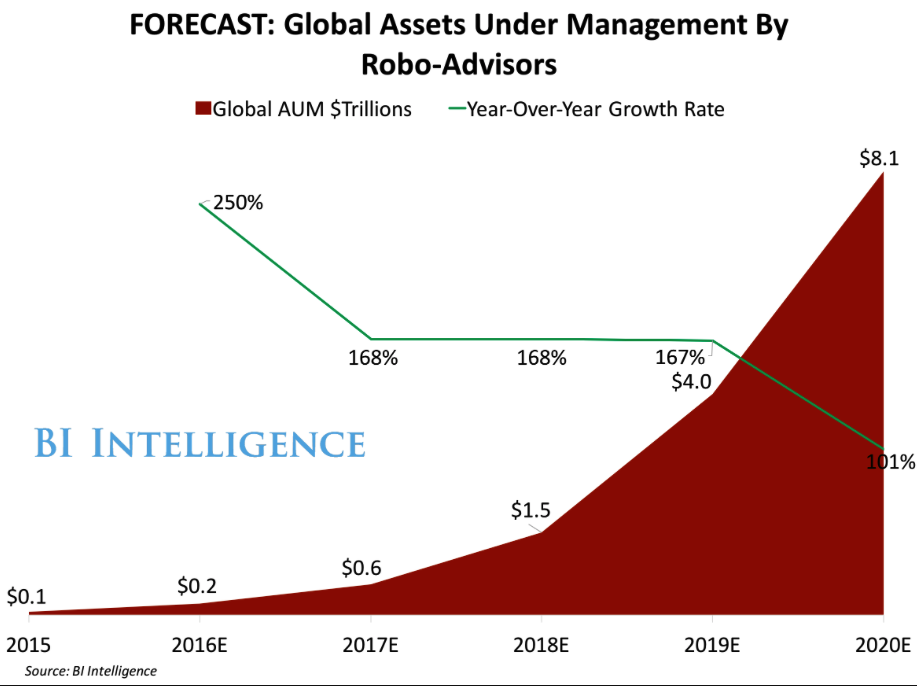 Source: BI Intelligence
 Tyler Hay, MBA
Chief Executive Officer
To contact Tyler, email:
thay@evergreengavekal.com
Tyler Hay, MBA
Chief Executive Officer
To contact Tyler, email:
thay@evergreengavekal.com
Ready to vote?
Cast your vote for whomever makes the most compelling case.
OUR CURRENT LIKES AND DISLIKES
No changes this week.
LIKE
- Large-cap growth (during a correction)
- International developed markets (during a correction)
- Canadian REITs
- Cash
- Publicly-traded pipeline partnerships (MLPs) yielding 7%-12%
- Intermediate-term investment-grade corporate bonds, yielding approximately 4%
- Gold-mining stocks
- Gold
- Intermediate municipal bonds with strong credit ratings
- Select blue chip oil stocks (on a pull back)
- Emerging bond markets (dollar-based or hedged); local currency in a few select cases
- Investment-grade floating rate corporate bonds
- Mexican stocks
- Solar Yield Cos on a pull-back (and profit-taking for tax deferred accounts, in some cases)
- Long-term municipal bonds
- Long-term Treasury bonds
- Long-term investment grade corporate bonds
NEUTRAL
- Most cyclical resource-based stocks
- Short-term investment grade corporate bonds
- High-quality preferred stocks yielding 6%
- Short yen ETF (closing out positions and removing)
- Emerging market bonds (local currency)
- Short euro ETF (sell a portion for solid gain)
- Bonds denominated in renminbi trading in Hong Kong (dim sum bonds)
- Canadian dollar-denominated bonds
- Mid-cap growth
- Emerging stock markets, however a number of Asian developing markets, ex-India, appear undervalued (taking profits on India)
- The Indian stock market
- Floating-rate bank debt (junk)
- Select European banks
- BB-rated corporate bonds (i.e., high-quality, high yield)
DISLIKE
- US-based Real Estate Investment Trusts (REITs) (once again, some small-and mid-cap issues appear attractive)
- Small-cap value
- Mid-cap value
- Small-cap growth
- Lower-rated junk bonds
- Large-cap value
DISCLOSURE: This material has been prepared or is distributed solely for informational purposes only and is not a solicitation or an offer to buy any security or instrument or to participate in any trading strategy. Any opinions, recommendations, and assumptions included in this presentation are based upon current market conditions, reflect our judgment as of the date of this presentation, and are subject to change. Past performance is no guarantee of future results. All investments involve risk including the loss of principal. All material presented is compiled from sources believed to be reliable, but accuracy cannot be guaranteed and Evergreen makes no representation as to its accuracy or completeness.