

“First to mind when asked what ‘the cloud’ is, a majority respond it’s either an actual cloud, the sky, or something related to weather.” – Citrix Cloud Survey Guide, August 2012 “At no other point in time has there ever been such a need for the instant availability of IT resources enabled by the cloud than during this coronavirus pandemic… the cloud will continue to be a fundamental enabler for decades to come.” – Forbes article, March 2020
Cloudy with a Chance of…
For years, the concept of ‘the cloud’ was as cloudy as a winter morning in Seattle, Washington. It seemed that only the techiest of tech people understood what the term meant and even fewer had a grasp on how the technology would revolutionize businesses, industries, and economies. The closest analogy I can think of to an emerging modern-day technology with an equally high ceiling that still confounds a lot of people is blockchain tech. But I’m going to stay away from that rabbit hole for the purposes of this newsletter… (For those interested in a quick read on the subject, please see our piece from November 2019 titled, “All In On Blockchain?”). It took years for ‘the cloud’ to become a digestible household term, but now it’s almost inconceivable to think of the word in any other terms. In fact, if you type ‘cloud’ into Google, you won’t find any reference to the plumes of water and dust particles floating around most of earth’s atmosphere for many pages’ worth of search results. Instead, you’ll find articles on cloud computing and web links to leading cloud providers. To underscore how rapid the ascent of ‘the cloud’ has been in business and everyday life, consider an article that Vox ran in 2015 titled, “Too Embarrassed to Ask: What Is ‘The Cloud’ and How Does It Work? It has nothing to do with white fluffy things in the sky.” The title is almost comical considering that only five years later nearly all of us rely on cloud-based services for at least some aspect of daily life (i.e. ordering goods from Amazon, streaming shows on Netflix, getting food delivered from DoorDash, posting on Instagram or LinkedIn, listening to music on Spotify, hailing a ride from Uber or Lyft…the list goes on, and on). For those that utilize cloud services, but might still be a little cloudy on what the term actually means, the same Vox article mentioned above does a good job of summarizing the basic concept: “When tech companies say your data is in the cloud, or that you can work in the cloud, it has nothing to do with white fluffy things in the sky. Your data isn’t actually in heaven or in the wind. It has a terrestrial home. It’s stored somewhere — lots of somewheres — and the network of servers find what you need and deliver it. The cloud refers to software and services that run on the Internet, instead of locally on your computer. Most cloud services can be accessed through a Web browser like Firefox or Google Chrome, and some companies offer dedicated mobile apps.” Covid-19: Accelerant or Change Agent? Over the weekend, Scott Galloway, an esteemed marketing professor at NYU Stern School of Business, made a very interesting point on one of CNN’s flagship shows. During a discussion on the future of higher education, he stated, “if you think about it, Covid-19 is more of an accelerant than a change agent.” While he was specifically discussing his views on imminent changes to the higher education industry, the same thought can be applied to a number of industries – specifically, the technology industry and, even more specifically, cloud technologies. Consider the following: prior to the Covid-19 pandemic, 17% of employees worked at-home full-time. In less than three months, the number has skyrocketed to over 50%. While this surge has undoubtedly been fueled by recent stay-at-home orders and will come back to earth as restrictions are lifted, major tech giants such as Amazon and Microsoft have told employees not to come back to work until at least October, while other big tech companies like Twitter and Facebook have told workers to stay home permanently. CEO and founder of Shopify, Tobi Lutke, tweeted the following last week, emphasizing the “remote work revolution” that’s currently underway: “As of today, Shopify is a digital by default company. We will keep our offices closed until 2021 so that we can rework them for this new reality. And after that, most will permanently work remotely. Office centricity is over. Until recently, work happened in the office. We’ve always had some people remote, but they used the internet as a bridge to the office. This will reverse now. The future of the office is to act as an on-ramp to the same digital workplace that you can access from your #WFH setup.” To reiterate Professor Galloway’s point, the Covid-19 pandemic is more of an accelerant than an outright change agent. Many employees in a variety of industries worked from home at least part-time prior to Covid-19, but the pandemic has fast-tracked this trend out of necessity, with implications that will last well beyond the end of the epidemic. Specifically, the remote work revolution will impact:- Employers (especially in the tech industry) who can lower fixed and variable costs by leveraging a virtualized workforce.
- Employees who can work from virtually anywhere in the world with a computer and internet connection.
- Landlords and commercial real estate owners who will see less demand for large office spaces and corporate campuses.
- Large metropolises who have seen a mass influx in residents over the past century, but will likely see an exodus as companies shift to a virtualized workforce and workers evaluate the risks associated with living in big cities (see Bloomberg article titled, Young Join the Rich Fleeing America’s Big Cities for Suburbs).
CLOU ETF vs. S&P 500 Since March 23rd, 2020 Low
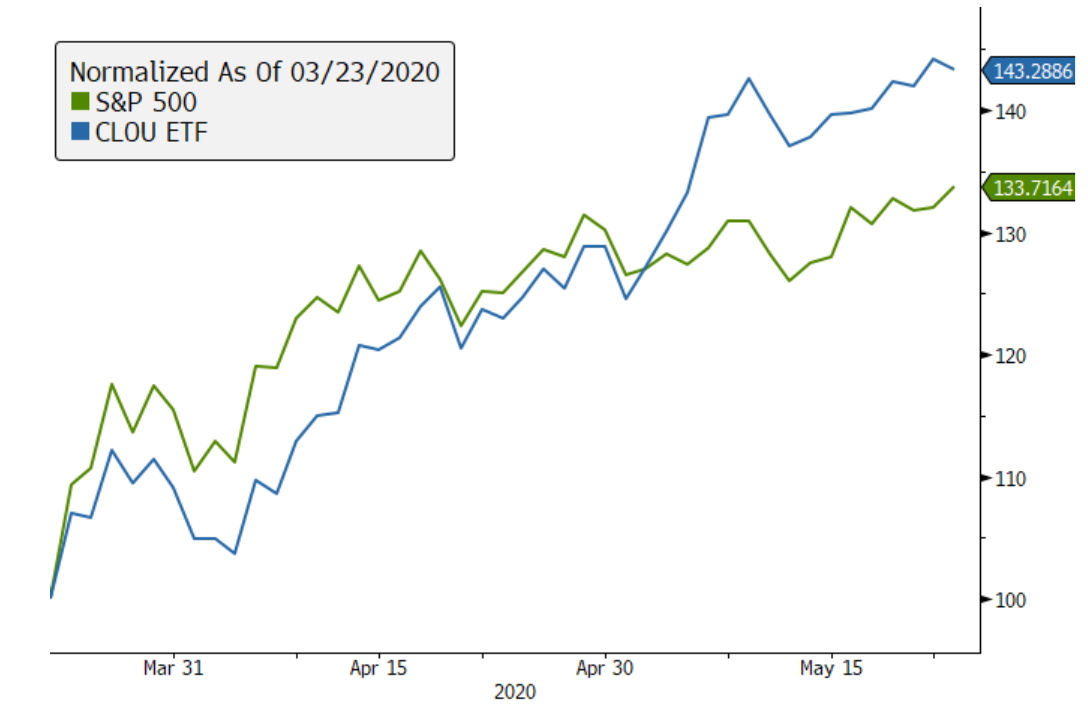
*Source: Bloomberg, Evergreen Gavekal. As of May 26th, 2020.
Prior to the Covid-19 pandemic, “big tech” was under extreme scrutiny from regulators. However, tech stands out as one of the sectors that will likely dodge a bullet for the time being, as governments focus their attention on other sectors of the economy (i.e. health care, finance, real estate, and utilities). This is yet another godsend for several cloud and technology companies that already have the wind at their backs. Despite these tailwinds, many publicly traded technology companies are trading near all-time highs, failing to provide investors with an overwhelmingly attractive entry point. Because of this, Evergreen believes that specific private technology investments are particularly desirable in this market environment. The future of the cloud is anything but cloudy, and we believe there are several meatball-sized opportunities in the space for investors that know where to look.