


Click here to view as PDF. “The chance which now seems lost may present itself at the last moment.” -JULES VERNE
INTRODUCTION
Around the world in
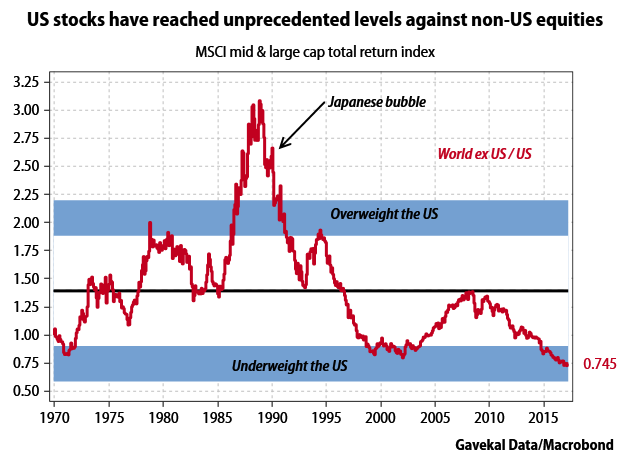
WHETHER OR NOT TO UNDERWEIGHT THE US By Charles Gave At recent Gavekal seminars, I have argued that investors should start to underweight US assets in favor of foreign equivalents. This call was squarely valuation-based as my models show the dollar, US corporate bonds and US equities as being overvalued. Moreover, on a relative basis US stocks are unprecedentedly expensive when compared to non-US alternatives. The aim of this paper is to assess this position in light of non-valuation-based macroeconomic factors. First however, let me briefly summarize that valuation argument: stock markets are a forum for measuring the return on invested capital across economies. In a truly “open” world, returns should tend to equalize on a trans-national basis to a single common level. As such, the ratio of two stock markets’ total returns should exhibit no trend, and—strange as this may seem—over the long term, this is indeed the case. Yet from time-to-time a core global stock market will become cheap relative to its peers. Since mean reversion is inevitable, at such times any manager who is serious about asset allocation must buy the cheap market and sell the expensive one. Since 1970, there have been three key times to buy US equities and sell the rest of the world; namely 1979, 1987-89 and 1994. By contrast, key times to sell the US and buy the rest of the world were 1971, 1999-2002 and the period since late 2014. As the chart below shows, should the relationship between the US and the rest of the world revert to its long-term mean—never mind overshoot— then an equity portfolio orientated to this outcome would achieve 100% better performance than one exposed merely to US stocks.
 Source: Gavekal Data/Macrobond
Source: Gavekal Data/Macrobond
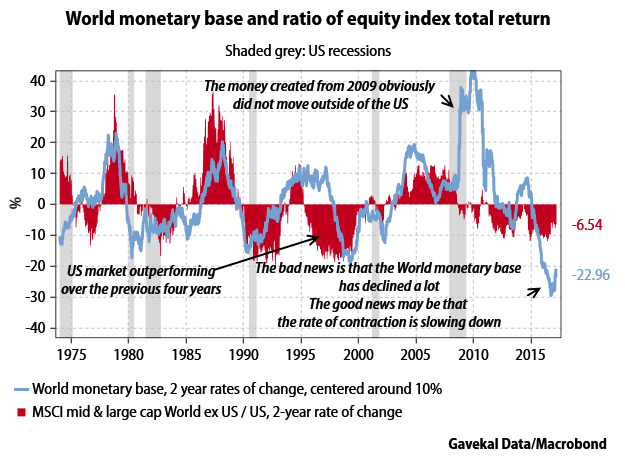
To cut a long story short, when the supply of dollars goes up, non-US markets should outperform. When their supply falls, non-US markets will underperform. So how to explain the 2011-13 period when the WMB was expanding, yet non-US equities underperformed? It could be argued that US equities were simply way too cheap (my valuation argument), or more worryingly that money printed in the US through quantitative easing did not, in fact, leave the confines of the US. If correct, this would offer one more sign of monetary velocity collapsing on a global basis—this has been a core contention of mine in recent years. This leads to a split conclusion. While on valuation grounds investors should be moving away from the US, the fundamental argument is less compelling as the world seems to face a structural shortage of dollars. To complicate matters, monetary factors often have delayed and variable impacts on both real economic activity and financial markets. Variations in the WMB tend to correlate tightly with moves in the US dollar exchange rate, as shown by the chart below, and this time there is no lead. Thus an optimistic take is that since the dollar is no longer appreciating, the world monetary base may once again be growing.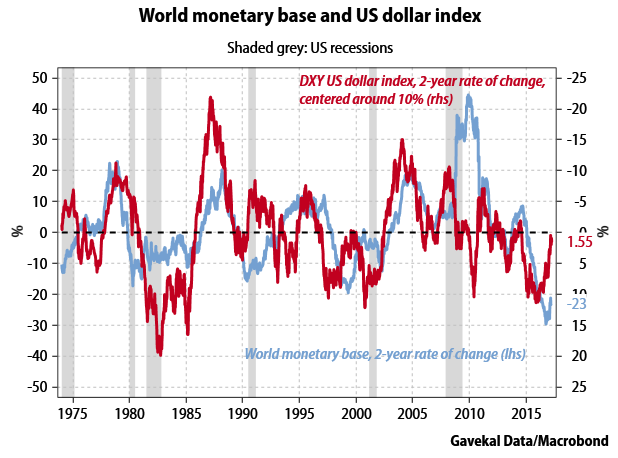 Source: Gavekal Data/Macrobond
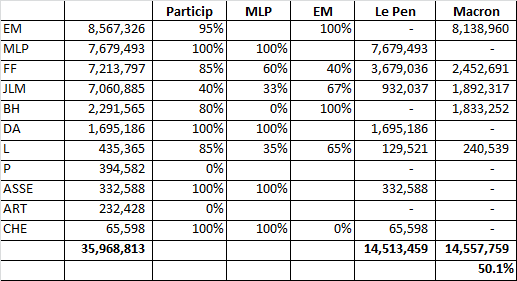
SECOND ROUND COULD STILL BE QUITE CLOSE… By Louis-Vincent Gave The reason Brexit and the US election surprised people is that everyone thought the race was already won and so voters for the “perceived winning team” (especially young people) didn’t bother to vote. And that was enough to tip the balance. Could we see the same thing in France? Taking the final votes tally from the first round, we made some simple projections. SCENARIO 1: Let’s imagine that…
- Only 95% of the people who voted for Macron in the first-round bother to show up for the second round because they figure that the thing is already won so why waste a nice Sunday in May lining up
- 100% of the voters for Marine Le Pen (MLP) show up for second round as they are more motivated
- Only 85% of those who voted for Fillon show up to vote in the second round, and that out of those 60% vote for MLP and 40% vote for Macron
- Only 40% of the commies who voted for Melenchon show up for the second round… Not a stretch as the interviews post first round all seemed to indicate that these guys would stay home. Especially the young. Let me further suggest that out of the Melenchon voters who do show up, MLP captures a third (the true anti-Euro/anti-system/anti-globalization guys). Again, I don’t think that is a stretch
- Macron gets 100% of the 80% of the Hamon voters who bother to turn up
- MLP gets 100% of Dupont-Aignan, Cheminade and Asselinau voters, and they do show up (they are all anti-Euro/anti system)
- Nobody shows up from the two Trotskyites (historically, they don’t show up for the second round… and let’s face it, if they really wanted to change the system, they should have folded behind Melenchon who had a shot at getting to the second round instead of splitting the vote. In fact, if you add up the two Trotskyites to Melenchon’s vote tally, MELENCHON WOULD HAVE MADE THE SECOND ROUND (with 7,687k votes to MLP’s 7,679k)!
- The votes from Lasalle are split one third Le Pen and two thirds Macron (it was mostly farmers voting for Lasalle who promoted a new vision for rural France) with 85% of people showing up…
 SCENARIO 2:
Let’s imagine that…
SCENARIO 2:
Let’s imagine that…
- Only 85% of the people who voted for Macron in the first round bother to show up for the second round because they figure that the thing is already won so why waste a nice Sunday in May lining up
- 100% of the voters for MLP show up for second round as they are more motivated
- Only 75% of the guys who voted for Fillon show up to vote in the second round, and that out of those 60% vote for MLP and 40% vote for Macron
- Only 30% of the commies who voted for Melenchon show up for the second round… Out of the Melenchon voters who do show up, MLP captures a third (the true anti-Euro/anti-system/anti-globalization guys). Again, I don’t think that is a stretch
- Macron gets 100% of the 70% of the Hamon voters who bother to turn up
- MLP gets 100% of the Dupont-Aignan, Cheminade and Asselinau voters and they do show up (they are all anti-Euro/anti-system)
- Nobody shows up from the two Trotskyites
- The votes from the fun shepherd Lasalle are split two thirds Le Pen and one third Macron
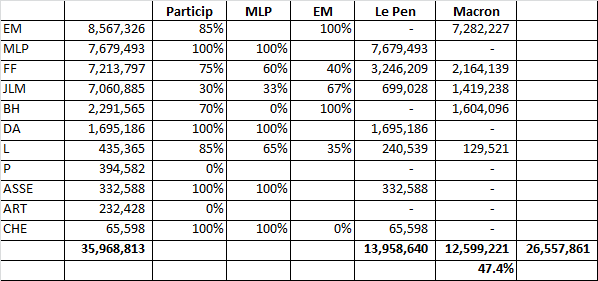 Unthinkable? A lot will depend on the turnout… With markets, pundits, and polls all pointing to a massive Macron win, a lot of Melenchon/Hamon (and even Macron) voters may well decide to stay home.
THE CONSEQUENCES OF TRUMP’S SYRIAN STRIKE By Louis-Vincent Gave In his 1992 book Give War a Chance, P.J. O’Rourke remarked that “wherever there’s injustice, oppression and suffering, America will show up six months late and bomb the country next to where it’s happening.” Now, in fairness to Donald Trump, the bombing of assorted Middle Eastern countries by the US armed forces did not just start. Nonetheless, by launching his cruise missiles at a Syrian airbase, Trump has now waded into the Islamic civil war that pits the region’s Sunni Muslims, broadly supported by Saudi Arabia, Qatar and Turkey, against the region’s Shias, backed by Iran and Russia. The question now has to be whether the US intervention will tip the scales against Bashar al-Assad’s Syrian regime, which until just a few days ago looked set to survive to the detriment of the Saudi-Qatari coalition. Interestingly, the markets do not seem to care that much about the answer. After five years of horrors, the world has clearly grown immune to daily reports of barely describable human suffering. Yet beyond the harrowing images coming out of Syria lies an important question: does the US intervention mean that the latent conflict between Iran and Saudi Arabia, which so far has been fought mostly through proxies in Syria and Yemen, will now explode into the open? If it does, it seems obvious that Trump is ready to throw in his lot with the Saudis—unlike Barack Obama who always sounded ambivalent about Saudi and seemed keen on normalizing the US-Iran relationship. Indeed, within a few weeks of his inauguration, Trump had already carried out more than 30 airstrikes against Yemen’s Houthi rebels, who are backed by Iran. That is as many as the US air force carried out in the whole of 2016. Of course, the fact that Vladimir Putin has clearly aligned Russia with the region’s Shias only throws further complications into the picture. Needless to say, the reason this will end up mattering for investors—as ever with the Middle East—is linked to oil (and arms). So far, the market seems to have greeted Trump’s intervention in the Middle Eastern civil war by bidding up both. On the face of things, this makes sense. After all, Obama’s policy of bringing Iran in from the cold coincided with the major drop in oil prices. Investors naturally reasoned that Iran’s vast hydrocarbon reservoirs, which for years had been unproductively exploited, would, over time make their way to the global market. Since then new discoveries have revealed large and exploitable oil basins, from Brazil, to the Permian Basin of Texas, to Alaska. The idea of “peak oil” has been buried for at least a generation, if not forever. These discoveries, of course, make Middle Eastern conflicts that much less threatening to global growth, and reduce the need for other countries to stockpile oil at the first sign of trouble. So, returning to Syria, investors are left facing a simple decision tree. The first question is this: Does the US intervention make a Saudi-Iran war more, or less, likely? Investors who fear that the odds of open conflict have now increased will likely want to overweight the US dollar, defense sector companies, and energy stocks. However, there may be other, less direct and perhaps more efficient, ways of playing the same theme, including:
- The Canadian dollar. The loonie tends to do well when oil prices rise. Not only that, but the Canadian dollar is currently undervalued on a purchasing power parity basis against the US dollar, and in recent months has been remarkably stable against the US currency.
- The Mexican peso. The peso has just posted its best quarter in a generation. As a result, it may be due a breather. Even so, the Mexican peso remains undervalued and should be a beneficiary of any rise in energy prices.
- Ruble bonds. Cedric recently revisited the case for Russian local currency debt, and concluded that investors should stay long ruble bonds. Needless to say, any breakout in energy prices, or any sustained upheaval in the Middle East, will favor ruble assets.
- Indonesian assets. Indonesia remains a major supplier of high quality coal to China—a position that would once again look rewarding should energy prices bounce back.
- Australian dollar assets. If the above is true for Indonesia, it is true in spades for Australia.
OUR CURRENT LIKES AND DISLIKES
Changes in italics.
LIKE
- Large-cap growth (during a correction)
- International developed markets (during a correction)
- Canadian REITs
- Cash
- Publicly-traded pipeline partnerships (MLPs) yielding 7%-12%
- Intermediate-term investment-grade corporate bonds, yielding approximately 4%
- Gold-mining stocks
- Gold
- Intermediate municipal bonds with strong credit ratings
- Select blue chip oil stocks
- Emerging bond markets (dollar-based or hedged); local currency in a few select cases
- Mexican stocks
- Solar Yield Cos on a pull-back
- Long-term municipal bonds
- Long-term Treasury bonds
- Long-term investment grade corporate bonds
NEUTRAL
- Most cyclical resource-based stocks
- Short-term investment grade corporate bonds
- High-quality preferred stocks yielding 6%
- Short yen ETF
- Emerging market bonds (local currency)
- Short euro ETF
- Bonds denominated in renminbi trading in Hong Kong (dim sum bonds)
- Canadian dollar-denominated bonds
- Mid-cap growth
- Emerging stock markets, however a number of Asian developing markets, ex-India, appear undervalued
- Floating-rate bank debt (junk)
- Select European banks
- BB-rated corporate bonds (i.e., high-quality, high yield)
- Investment-grade floating rate corporate bonds
DISLIKE
- US-based Real Estate Investment Trusts (REITs) (once again, some small-and mid-cap issues appear attractive)
- Small-cap value
- Mid-cap value
- Small-cap growth
- Lower-rated junk bonds
- Large-cap value
DISCLOSURE: This material has been prepared or is distributed solely for informational purposes only and is not a solicitation or an offer to buy any security or instrument or to participate in any trading strategy. Any opinions, recommendations, and assumptions included in this presentation are based upon current market conditions, reflect our judgment as of the date of this presentation, and are subject to change. Past performance is no guarantee of future results. All investments involve risk including the loss of principal. All material presented is compiled from sources believed to be reliable, but accuracy cannot be guaranteed and Evergreen makes no representation as to its accuracy or completeness.