

“Right now, the Fed would love a little more inflation, which has persistently fallen short of its 2% target. But what if it’s headed well past 2%? The Fed knows what to do, because it’s done it before: raise rates and cool the economy.” – The Wall Street Journal’s Greg Ip on 4/23/20 “History clearly indicates that there will be some limit to the market’s willingness to tolerate increased deficits and rising public sector debt ratios, particularly when the latter (even excluding off balance sheet items), are already at unprecedented levels.” – Bill White, former chief economist of the Bank of International Settlements (BIS), considered to be the central banker for the planet’s central banks “The more we look to over-optimize everything (supply chains, balance sheets, portfolios) and not keep any safety cushions because the ‘governments and central banks’ have our backs, the more fragile we make the system.” – Louis-Vincent Gave
______________________________________________________________________________________________________
INTRODUCTION
At the end of 2017, we initiated a special-edition EVA series with excerpts from David Hay’s upcoming book titled “Bubble 3.0: How Central Banks Created the Next Financial Crisis.” If you are just joining us at the end of this series, which will soon culminate in a full-length publication, please read the prior installments in the series here:-
- Bubble Watch: A New Series Dedicated to Investors Interested in Preserving Their Wealth (December 22, 2017)
- Bubble 3.0: How Central Banks Created the Next Financial Crisis (April 27, 2018)
- Bubble 3.0: How Did We Get Here? (Part I) (June 1, 2018)
- Bubble 3.0: How Did We Get Here? (Part II) (June 8, 2018)
- Bubble 3.0: A Fast and Furious Challenge (July 6, 2018)
- Bubble 3.0: Up from the Ashes (August 24, 2018)
- Bubble 3.0: The Biggest Bubble Inside the Biggest Bubble Ever (September 21, 2018)
- Bubble 3.0: What Could Go Right (October 12, 2018)
- Bubble 3.0: The Upside of Downside (November 30, 2018)
- Special Edition EVA: The Stealth Bear Market (December 14, 2018)
- Bubble 3.0: What Price Prosperity? (Part I) (January 11, 2019)
- Bubble 3.0: What Price Prosperity? (Part II) (January 18, 2019)
- Bubble 3.0: No Way Out (February 22, 2019)
- Bubble 3.0: Can an Acronym Save the World? (Part I) (April 5, 2019)
- Bubble 3.0: Can an Acronym Save the World? (Part II) (April 12, 2019)
- Bubble 3.0: The Intersection of Bubble and Bubble (May 17, 2019)
- Bubble 3.0: A Blast From A Bubble Past (June 14, 2019)
- Bubble 3.0: The Post-Retirement Society (July 12, 2019)
- Bubble 3.0: Debt-End (August 9, 2019)
- Bubble 3.0: Deja Vu 2000 or Flashback 2007? (Part I) (September 6, 2019)
- Bubble 3.0: Deja Vu 2000 or Flashback 2007? (Part II) (September 13, 2019)
- Bubble 3.0: Back to the 2015 Future (November 15, 2019)
- Bubble 3.0: Bye-Bye Buybacks? (February 14, 2020)
- Bubble 3.0: End Game (Part I) (April 24, 2020)
SUMMARY
- As we have seen repeatedly, it doesn’t take an outright emergency to catalyze action by the Fed.
- However, given the present situation, the Fed is right to be infusing liquidity into the economy.
- Despite this, the Fed has been a reprehensible protector of our nation’s currency, excelling at money creation to fight busts, and neglecting to correct course during booms.
- Now we are on the fifth iteration of Quantitative Easing (QE), which is almost certain to be bigger than QEs 1 through 4 combined.
- This rapid and unprecedented move by the Fed is why we have the odd situation of a pandemic-stricken economy combined with the S&P 500 which is technically back in a new bull market.
- No matter how long you’ve been in finance, this is like nothing we’ve ever seen before.
- Most pundits today think that the trillions in US government spending is not a problem and is certainly not inflationary.
- But fast-forward into next year and conditions could be dramatically different.
- The good news is that things don’t go directly from a deflationary bust to an inflationary boom, much less an inflationary bust, but Dave predicts a faster-than-expected inflation burst.
- Beyond the Fed, the government is sending out hundreds of billions of income support payments. Additional federal spending will be in the trillions. The combination is looking a lot like Modern Monetary Theory (MMT).
- History is unmistakably clear that MMT doesn’t work, even for countries that can issue debt in their own currency.
- The US will survive and eventually thrive but the US dollar, as we know it, may be the sacrificial lamb.
- The “End Game” plan could very likely be along the lines of the Fed canceling a large portion of the Treasury debt it holds in return for a non-interest bearing 100-year maturity bond.
- But, if the Fed ends up injecting trillions more into the system AND the federal government deficit spends most of that, it’s hard to believe a debt forgiveness of an equivalent amount won’t be inflationary at some point.
- Additionally, with rates around zero or below on most government debt, interest rates could go missing indefinitely. The Fed may act to suppress rates even as inflation accelerates.
- In Dave’s view, the repercussions of the current pandemic will be with us for many years, as the disconnect between markets and the economy widens.
- Fortunately, investors have a powerful portfolio protection option available.
BUBBLE 3.0: END GAME (PART II) – THE END OF THE BEGINNING…AND THE BEGINNING OF THE END
This book has clearly been an indictment of Fed policies over the last twenty-five years. Some will no doubt think it has been unfair, particularly when, like now, the Fed is in its fire brigade mode. In other words, its popularity tends to soar during times of crisis that cause it to use its limitless money manufacturing machine to save the day. As we have repeatedly seen, it doesn’t take much of an emergency to catalyze yet another Fed monetary deluge. Currently, however, this is a five-alarm fire and the Fed is right to be fire-hosing the conflagration with its endless supply of liquidity. Yet, this is not to excuse its role in starting the inferno, a point I attempted to make in “End Game (Part 1)”. To requote Jim Grant, the Fed has repeatedly played both arsonist and fire-fighter. In order to directly confront the many who disagree with my take on our seemingly all-knowing and all-powerful central bank, consider this reality: each of the Fed’s rescue efforts in the wake of Bubbles 1.0, 2.0 and 3.0 have become larger and further outside of its original charter. A cynic might say it has become increasingly desperate. But let me make an even more damning and irrefutable assertion: the Fed has been, for most of its existence, a deplorable protector of our nation’s currency. If being a credible defender of the US dollar involves protecting its purchasing power, there is simply no other conclusion than the Fed has failed the country miserably.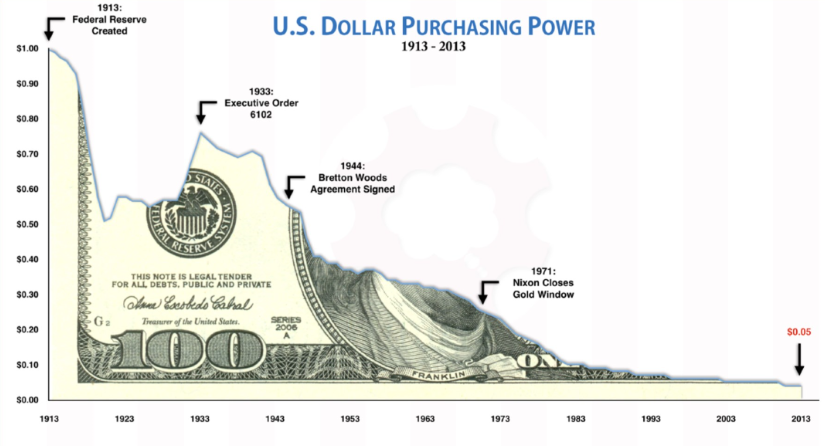 As earlier EVAs have conveyed, the US dollar admirably retained its purchasing power from the early days of America’s founding until WWI when the Fed came into being. There was one high-inflation period during the Civil War but in the following decades deflation was more common. There were also numerous panics and busts in the years from 1865 to 1914 (when WWI broke out in Europe) but it was also a time of strong economic growth. In fact, it was in these years that the Gilded Age occurred, and the country’s first great fortunes were created such as those of the Rockefellers, the Carnegies and the Mellons.
Unquestionably, the first 130 years of our country’s existence were tumultuous. The spectacular economic growth seen in that century-and-a-third was erratic and typically inequitably distributed. It was a time of repeated booms and busts with the last of the latter—the panic of 1907—producing a groundswell of support to create a central bank that would smooth out severe economic ups and downs.
Consequently, at a seaside resort on Jekyll Island, Georgia in late 1910, the plans were laid for what a few years later would become America’s Federal Reserve Bank. It was a momentous development, to say the least (some might say “monstrous”, but I believe that is too harsh).
For the first twenty years of its existence, the Fed didn’t do much at all; however, during the late 1920s it did accidently provide a sneak preview of its behavior some 80 years later. The Roaring Twenties gave birth to the first great bubble the Fed faced since its formation—the epic stock market mania that famously crashed in October, 1929. So catastrophic was this event that it scarred the entire planet for the following decade and arguably set the wheels in motion for WWII.
The Fed’s next great challenge was after the crash as America and the world entered the Great Depression. Staggering sums had been wiped out in the stock market plunge and then the banking system began to collapse in an era when there was no deposit insurance. By 1932, there was very little money left to be spent or invested. The Fed allowed the money supply to collapse in the early 1930s, an error so grievous that even left- and right-wing economists agree on its enormity. And, thus, it had two chances to prevent a calamity yet it whiffed both times.
For the next 40 years or so, the Fed returned once again to the periphery, other than to help finance WWII with its first debt monetization program (where it used money it created to buy government bonds). It then employed various tools to keep rates suppressed after the war was over, allowing the US government to use gradually rising inflation to lower the real value of the unprecedented sums it borrowed to defeat the Axis powers.
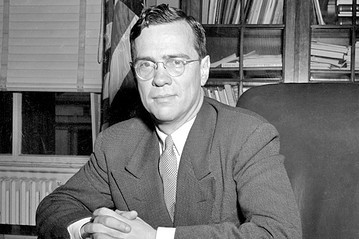
During the 1950s, characterized by a jagged but powerful recovery after WWII, one of the great Fed chairmen took the helm – William McChesney Martin. It was he who coined the now iconic phrase: “it’s the Fed’s job to take away the punch bowl just as the party gets going”.
As earlier EVAs have conveyed, the US dollar admirably retained its purchasing power from the early days of America’s founding until WWI when the Fed came into being. There was one high-inflation period during the Civil War but in the following decades deflation was more common. There were also numerous panics and busts in the years from 1865 to 1914 (when WWI broke out in Europe) but it was also a time of strong economic growth. In fact, it was in these years that the Gilded Age occurred, and the country’s first great fortunes were created such as those of the Rockefellers, the Carnegies and the Mellons.
Unquestionably, the first 130 years of our country’s existence were tumultuous. The spectacular economic growth seen in that century-and-a-third was erratic and typically inequitably distributed. It was a time of repeated booms and busts with the last of the latter—the panic of 1907—producing a groundswell of support to create a central bank that would smooth out severe economic ups and downs.
Consequently, at a seaside resort on Jekyll Island, Georgia in late 1910, the plans were laid for what a few years later would become America’s Federal Reserve Bank. It was a momentous development, to say the least (some might say “monstrous”, but I believe that is too harsh).
For the first twenty years of its existence, the Fed didn’t do much at all; however, during the late 1920s it did accidently provide a sneak preview of its behavior some 80 years later. The Roaring Twenties gave birth to the first great bubble the Fed faced since its formation—the epic stock market mania that famously crashed in October, 1929. So catastrophic was this event that it scarred the entire planet for the following decade and arguably set the wheels in motion for WWII.
The Fed’s next great challenge was after the crash as America and the world entered the Great Depression. Staggering sums had been wiped out in the stock market plunge and then the banking system began to collapse in an era when there was no deposit insurance. By 1932, there was very little money left to be spent or invested. The Fed allowed the money supply to collapse in the early 1930s, an error so grievous that even left- and right-wing economists agree on its enormity. And, thus, it had two chances to prevent a calamity yet it whiffed both times.
For the next 40 years or so, the Fed returned once again to the periphery, other than to help finance WWII with its first debt monetization program (where it used money it created to buy government bonds). It then employed various tools to keep rates suppressed after the war was over, allowing the US government to use gradually rising inflation to lower the real value of the unprecedented sums it borrowed to defeat the Axis powers.
During the 1950s, characterized by a jagged but powerful recovery after WWII, one of the great Fed chairmen took the helm – William McChesney Martin. It was he who coined the now iconic phrase: “it’s the Fed’s job to take away the punch bowl just as the party gets going”.
Source: Wall Street Journal
In other words, once the economy was roaring, stocks were booming, and everyone was feeling giddy, the Fed’s job was to take away the hooch of easy money. It needed to act in what economists call a “counter-cyclical” way. That one simple concept gets to the core of how a responsible central bank should operate, in addition to the other necessary counter-cyclical action of infusing as much money as necessary to deal with panics and crashes. The first part of this ideal mission statement gets to the heart of what I believe the Fed has failed to do over the last quarter-century. To reiterate a point made in “End Game” Part 1, citing the ever-astute Mike O’Rourke, the Fed has become asymmetrical. In plain English, this means that it excels at money creation to fight busts but it has forgotten Bill Martin’s admonition about taking the punch bowl away just as the party gets going. The emphasis was added to underscore the concept that the joy-juice removal needs to happen early, not after everyone is falling-down drunk. At that point, the damage has been done. Bill Martin’s successor at the Fed, Arthur Burns, ignored this golden rule of central bankers. He was harassed by a GOP president obsessed with getting re-elected (sound familiar?). In allowing easy monetary conditions to persist for too long, Mr. Burns helped accelerate the inflationary fiasco of the 1970s. After a brief stint by another ineffectual Fed-head, the next great Fed Chairman, the recently deceased Paul Volcker, was given the keys to the Mariner Eccles building. As most EVA readers know, Mr. Volcker did what was popularly thought to be impossible: he crushed inflation. He also triggered a brutal recession which some hold against him to this day, typically economists and politicians who support perma-easy money policies, inflation be damned (this is a key point that I’m definitely going to come back to later in this closing chapter). Others would argue, myself included, that Mr. Volcker set the stage for the remarkable performance of the US economy from 1982 through 1999. Mr. Volcker resigned in 1987, reportedly due to his anger at being pressured into easy money policies by the Reagan Administration. His successor was Alan Greenspan who would “reign” for eighteen years and preside over most of the golden years of the ‘80s and ‘90s. His reputation would become so lustrous that he was dubbed “the Maestro” by an adoring media. Unfortunately for his legacy, Mr. Greenspan chose to stay on the job a bit too long. The worst bear market of the post-WWII era happened on his watch, triggered by the 2000 to 2002 tech stock collapse. The internet frenzy of the late 1990s was, of course, Bubble 1.0, as mentioned in numerous past EVAs. To further tarnish his once impeccable curriculum vitae (CV), Mr. Greenspan was also instrumental in the inflation of Bubble 2.0, the great housing frenzy that characterized the first decade of this century/millennium. Without a doubt, Mr. Greenspan ignored Bill Martin’s fundamental rule of central banking. This is despite the fact that he did raise rates in the late 1990s. Any credit he gets for that was undercut because he cut rates during a relatively minor market setback in 1998. Worse, he left them reduced as the tech bubble swelled to immense proportions through the first half of 1999. Additionally, in the second half of that year, he injected huge sums into the US financial system due to Y2K fears. Then, bizarrely, as the absurdly over-owned tech sector vaporized, the Maestro kept raising rates before doing a radical mid-course adjustment, slashing the fed funds rate down to the lowest seen since the Great Depression (outside of a brief stretch in the 1950s). As mentioned in “End Game (Part I)”, Mr. Greenspan kept rates at panic levels even as the economy was recovering from the shock of 9/11 and Gulf War II. This catalyzed housing to enter a full-fledged bubble. But before that explosively burst, he had the good sense to retire and leave the next bust on the resumé of his successor, Ben Bernanke. (However, many learned sources correctly blamed him for much of the resulting cataclysm.) Which leads us to the current decade and the ultimate end game I see heading our way… It was Mr. Bernanke who came up with the idea of Quantitative Easings (QEs) once he’d cut interest rates so close to zero that any further cuts would have been ineffectual, if not counterproductive. (We have seen ample evidence of the latter in Europe where negative interest rates have been in place for years and have devastated its banking system.) Frankly, I was in favor of QE1 though, as expressed at the time and in this book, I’d hoped it would have targeted corporate bonds and non-government mortgages. But subsequent QEs did precious little to help the economy and they created extreme asset price inflation, aka, bubbles. And, hopefully, one takeaway all readers will get from this book, is that EVERY bubble meets its pin prick at some point. The bigger and longer the bubble, the more painful the aftershocks tend to be. So, now we are on the fifth iteration of QE (I’m not giving the Fed a pass on QE 4 per last week’s EVA, which was launched due to turmoil in the overnight bank repo market*). As noted in that issue, QE 5 is almost certain to be bigger than QEs 1 through 4 combined. Is the Fed wrong to be doing these things under today’s panic-stricken conditions? It may shock you to read this, but I don’t think so. In my opinion, it doesn’t have any other choice, though I would also argue it should never have come this—such radical measures could have been avoided by diligently following Bill Martin’s golden rule. Moreover, I think recent market action confirms a point I’ve tried to make for years: if the Fed had targeted the most at-risk and problematic areas of the financial markets in the fall of 2008, right when that meltdown began, we would likely have avoided most of the carnage that came in its wake. This, in turn, caused the worst economic downturn since the 1930s (again, until this spring, that is). The proof is, I think, in the extraordinary rally both stocks and corporate bonds have had since late March when the Fed fulfilled my long and much-derided prediction that it would seek to bring credit spreads* down in the next crisis. At one point last month, the investment-grade corporate bond ETF (LQD) had swooned by 20%. That is a shocking decline for a high-grade bond vehicle, especially at a time when government bond yields were collapsing (driving up the value of Treasury bonds). This meant credit spreads were exploding, as you can see from the following chart.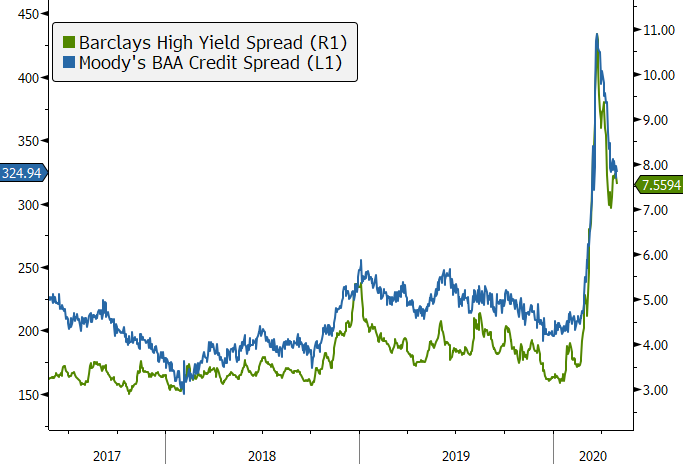
Source: Bloomberg, Evergreen Gavekal
But note what has happened to both the ETF price and credit spreads since the Fed trained its big guns on this market. By the way, it’s not a coincidence stocks have rallied hard since then because dramatically falling credit spreads have always trigger a powerful up-move in equities. *Credit spreads represent the difference between the interest rate on government vs corporate bonds.LQD (orange line) is the Investment Grade Corporate Bond ETF
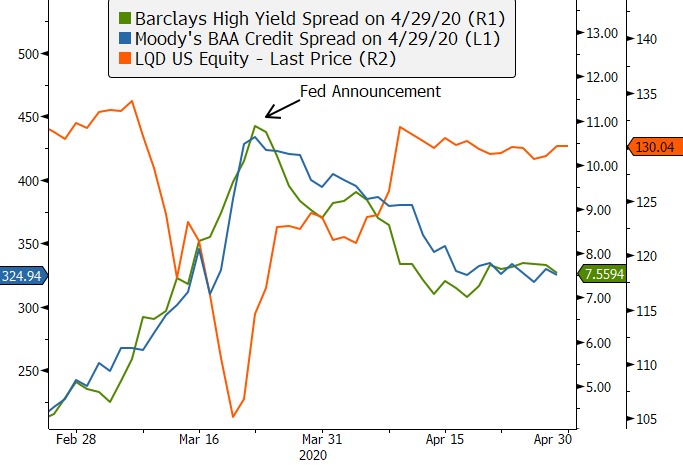
Source: Bloomberg, Evergreen Gavekal
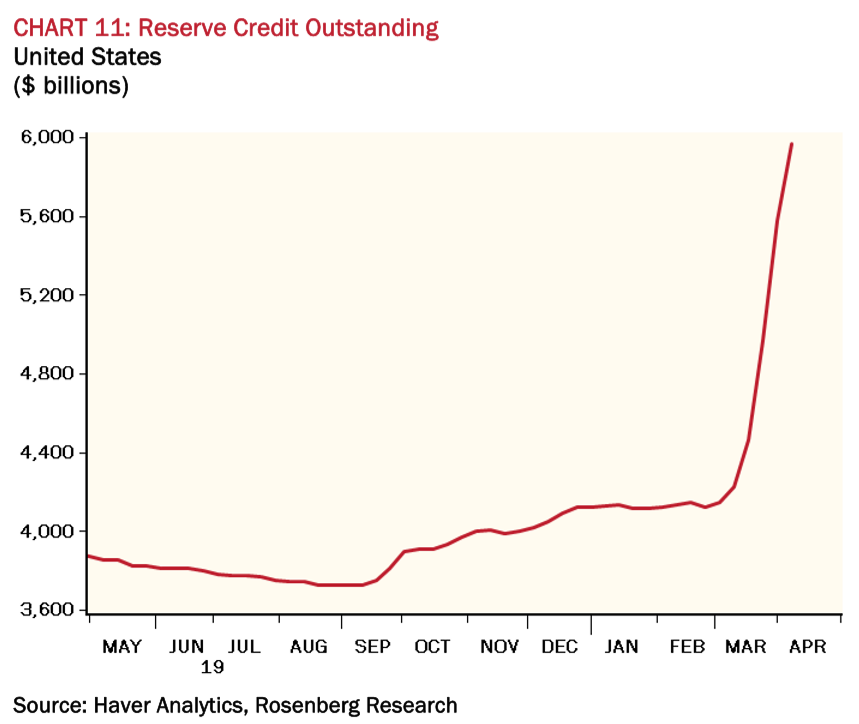
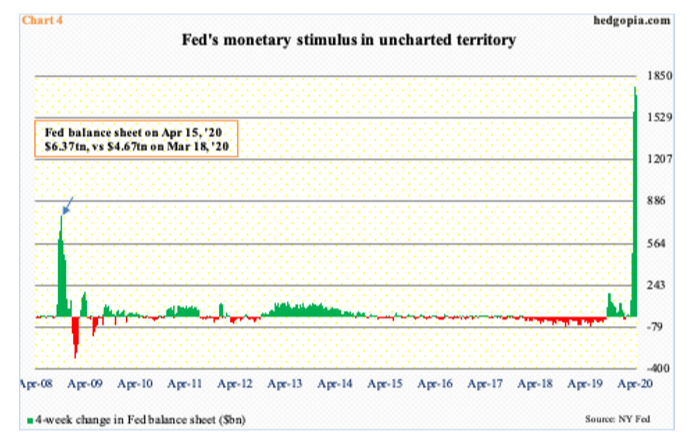
In my view, it’s nearly inarguable that this rapid and unprecedented move by the Fed is why we have the odd situation that was described by Schwab’s Liz Ann Sonders as “… a monster mash-up of the Great Depression in size, the crash of 1987 in speed, and a 9/11 attack in terms of fear” and yet a stock market that is technically back in a new bull market! No matter how long you’ve been in the financial game, this is like nothing we’ve ever seen before. But in my mind, it is proof-positive of the power of the Fed’s printing press, particularly when applied to something as meta-critical as credit spreads. (The other reality is that the corporate bond market is not nearly as large or liquid as the stock market, making it much easier for the Fed to bring about its desired outcome; again, it’s too bad they didn’t realize this in 2008.) So, how extreme is the Fed’s reaction to the pandemic panic? In this regard, a few images are worth a barrage of verbiage.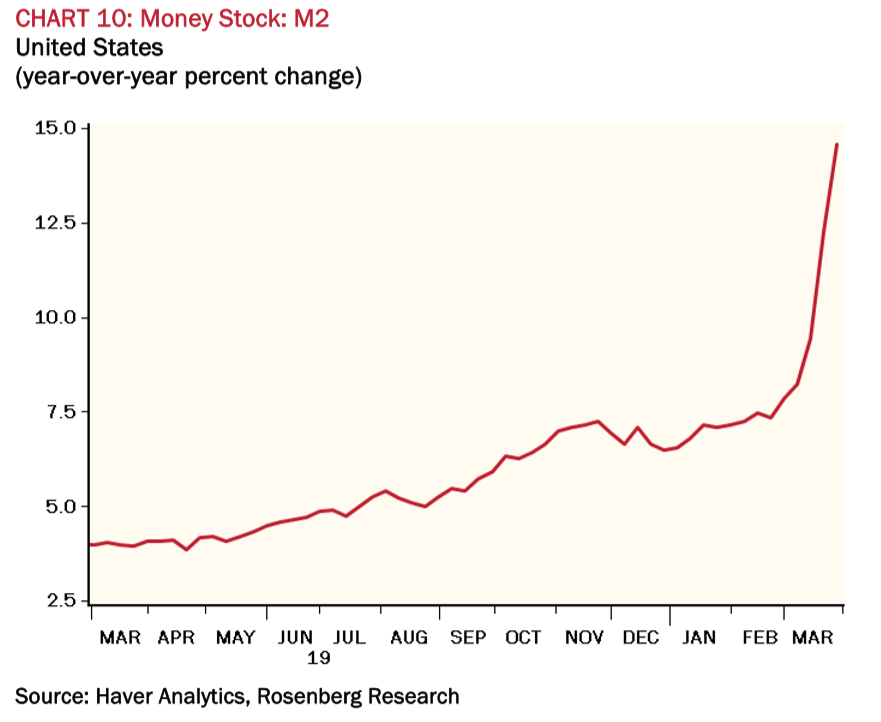
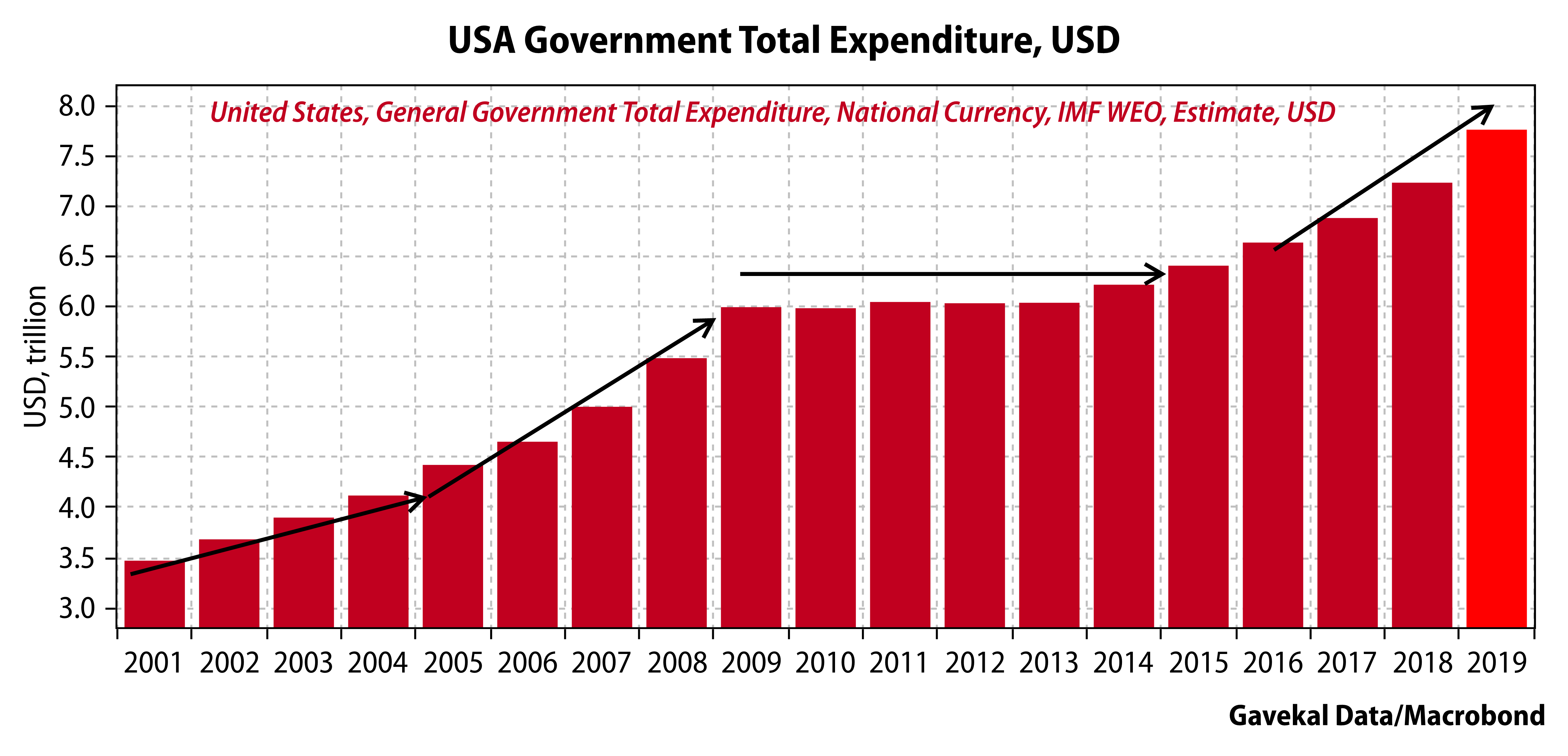 Consequently, what we had was an easy Fed but a somewhat “austere” (at least as far as fiscal austerity goes these days) federal spending environment. But that second part is not at all what we are seeing these days. Per the above chart, the US was already experiencing a worrisome rise in Federal outlays even before COVID19. Now, we may see expenditures nearly double in a year’s time, perhaps two.
My dear friend and partner Louis-Vincent Gave summed this up very well a couple of weeks ago:
“I start off with the reality that what really matters is the interaction of fiscal policy and monetary policy. Specifically, we can have:
Consequently, what we had was an easy Fed but a somewhat “austere” (at least as far as fiscal austerity goes these days) federal spending environment. But that second part is not at all what we are seeing these days. Per the above chart, the US was already experiencing a worrisome rise in Federal outlays even before COVID19. Now, we may see expenditures nearly double in a year’s time, perhaps two.
My dear friend and partner Louis-Vincent Gave summed this up very well a couple of weeks ago:
“I start off with the reality that what really matters is the interaction of fiscal policy and monetary policy. Specifically, we can have:
- Tight money: monetary aggregates grow less fast than structural GDP growth rate
- Loose money: monetary aggregates grow faster than structural GDP growth rate
- Very loose money; monetary aggregates grow more than 2x as fast as structural GDP growth rate
- Crisis money: monetary aggregates grow more than 3x as fast as structural GDP growth rate
- Tight fiscal: government spending grows less fast than structural GDP growth rate (govt spending very seldom shrinks! Growing less fast is as good as it gets)
- Loose fiscal: government spending grows faster than structural GDP
- Very loose fiscal: government spending grows twice as fast as structural GDP
- Crisis fiscal: government spending grows more than 3x as fast as structural GDP growth rate.

Source: Wall Street Journal
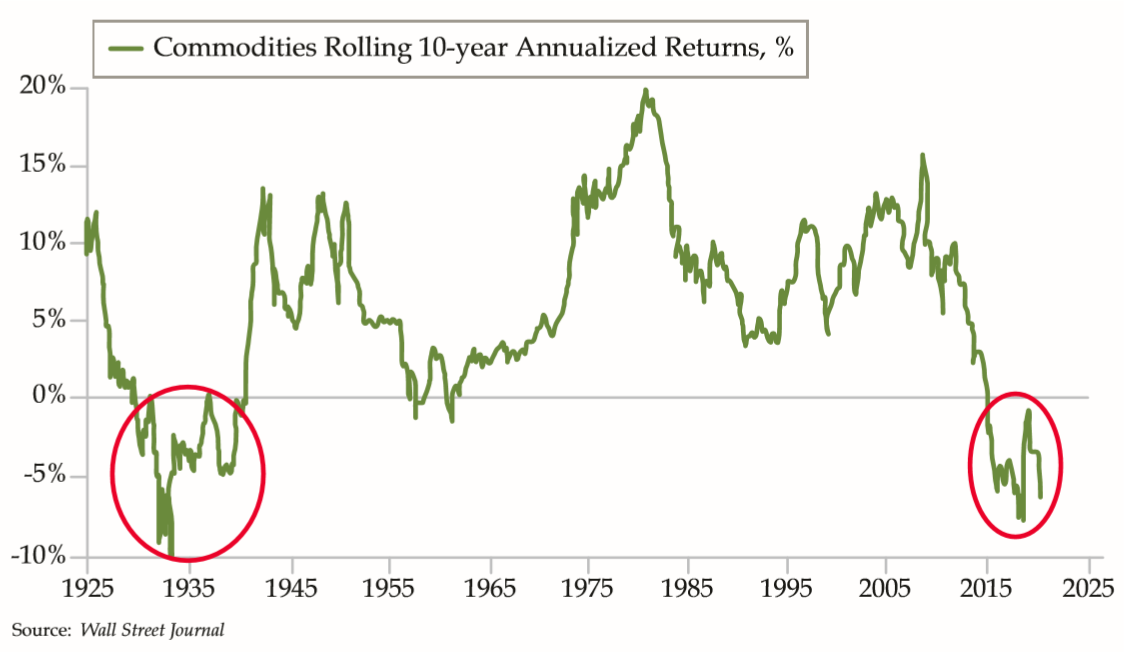
As Louis-Vincent Gave has written on this issue: “Is there any doubt the end result of all this will be: (1) The start of some kind of Universal Basic Income in most Western countries and (2) Financed by MMT (the Magic Money Tree)…For today, the only promise we have from governments is that currencies will be debased and sacrificed.” Now we’re really zeroing in on the target. The US will survive and eventually thrive but the US dollar, as we know it, may be the sacrificial lamb to avoid class- and intergenerational-warfare. It is likely to be sacrificed on the altar of something I think you’re going to hear much more about in upcoming years: a debt jubilee. Because total US govt liabilities, including estimates of $50 to $100 trillion in entitlements like Medicare and Medicaid, are simply unaffordable, some kind of debt “reset” is nearly inevitable. (There are those who might challenge that figure, but I’d further add that the government is now assuming countless trillions in additional liabilities from corporations and I have a hard time believing the same won’t happen with municipal debt. Much of it is almost certain to be forgiven.) It would be political suicide to attempt to drastically reduce the benefits Americans have been promised and have come to expect. Let’s face it – we feel very entitled to our entitlements! Thus, what we’re looking at is an endgame plan along the lines of the Fed canceling half of the Treasury debt it holds (which might soon exceed $10 trillion) in return for a non-interest bearing—i.e., zero-coupon—100-year maturity bond. Presto, chango, debt crisis solved! Was that easy, or what? Logic would indicate that there will, of course, be a price to pay. One of the most important thought exercises of the next few years is likely to be what form that will take. Will it be like Japan where all the money its central bank has manufactured and used to buy government and corporate bonds, as well as stocks, just sits idle in its financial system? Or will it behave in a much more volatile way? As the venerable Ned Davis recently wrote, the key tell may well be money velocity*—the rate at which money turns over in the economy. For now, that is once again falling and will likely continue to do so for the next few months. After that, it’s a much tougher call. If the Fed ends up injecting around $10 trillion into the system AND the federal government deficit spends most of that, including in direct payments to consumers and businesses, it’s hard to believe a debt forgiveness in the trillions won’t be highly inflationary at some point. This is NOT the old QEs that printed but didn’t spend. If the Fed magically cancels the treasury debt it has bought, those trillions will still be in the system and if they start circulating, then things, such as inflation, will heat up very rapidly. A far smarter man than I, Bill White, quoted at the top of this letter and one of the few to see the last financial crisis coming, has observed that countries can move from deflation to hyper-inflation quite quickly once they resort to the type of actions being taken today. (He further believes some type of debt moratorium will be needed.) Yet, putting aside the inflation argument, the fact of the matter is there is simply way, way too much debt in the world these days and governments are frantically piling on more by the nanosecond. We all know it will never be paid back but the bigger question is can it be serviced? In other words, can the interest on it be covered? With interest rates around zero or below on most government debt, that seems like a non-issue but think about what this means long-term: interest rates gone missing forever. It’s terrible news for the enormous global Baby Boomer investor cohort which is now also seeing dividends cut in growing numbers on their equity portfolio. Talk about a double-whammy! The story of countries that have resorted to ever-increasing government debt levels combined with non-existent interest rates is one of very low economic growth and depressed stock prices. Both Japan and Europe have stagnated economically for years while the Japanese stock market has gone nowhere since 1990 (except down) and the European stock index has flat-lined since 2000. That’s why I don’t find the “sunny” view of Japan’s experience with these policies to be comforting. It’s also clear our economy and financial system have become increasingly fragile. The fact that the kind of sheer collapse we’ve seen since February can happen almost overnight, speaks volumes about that fragility. But as the S&P fights its way closer to even for the year, the attitude is taking hold that the pandemic won’t be a big deal in the long-run. Obviously, I don’t buy that logic. In my view, the repercussions of this disaster will be with us for a great many years, including an increasing loss of faith in policymakers and international organizations (such as the now disgraced World Health Organization). Many, including Pres. Trump, have likened the battle against Covid-19 to a war. If they’re right, it’s important to remember that wars almost always lead to shortages. We’ve seen a wide range of those with medical supplies and household products. But now we’re also seeing supply deficiencies in items as disparate as wind-turbine blades, gold bullion, uranium, and, as mentioned, certain food categories. Overall, there is still a glut of most commodities, products and services. But 2021 might just be the year of shortages as demand recovers and supply struggles to keep up. Oil might even shock the world by moving from massive excess inventories into a shortfall condition over the next 18 months or so. This newsletter has repeatedly urged readers to accumulate gold and gold-related securities over the last year. These have now entered a low-profile bull market as the oldest known money has been making new highs against most major currencies, ex-the US dollar. Even against the greenback, gold has experienced a multi-year upside breakout and is not far from an all-time high. Near-zero government bond yields and de facto MMT create a dream scenario for gold, a reality to which the market seems to be gradually awakening. But there are many other so-called hard assets, besides gold, that may be poised for a surprising surge, with most investors woefully underweight commodities, in general, and precious metals, in particular. Inflation arises when there is too much money, chasing too few goods and that could be the story of next year. There’s no doubt about the “too much money” part and if shortages do become far more commonplace, the following chart might look very different in a few years time. In other words, we could be on the verge of one of those seismic shifts in the financial markets that seem to happen roughly every decade. Are you ready for that? If not, the good news is there’s still time…for now.
 *For monetary purists/geeks, money velocity is a dependent variable, i.e., it doesn’t drive inflation it merely indicates when the economy is growing faster than the money supply, indicating rising money velocity.
Corrections, clarifications and amplifications from last week’s issue:
In the Likes/Neutrals/Dislikes section, the commentary on pipelines/MLPs should have read:
*For monetary purists/geeks, money velocity is a dependent variable, i.e., it doesn’t drive inflation it merely indicates when the economy is growing faster than the money supply, indicating rising money velocity.
Corrections, clarifications and amplifications from last week’s issue:
In the Likes/Neutrals/Dislikes section, the commentary on pipelines/MLPs should have read:
- Publicly-traded pipeline partnerships (MLPs and other mid-stream energy securities) yielding something approaching infinity (distribution cuts are spreading due to the unprecedented collapse in energy demand and after a near doubling off the low, reassessing exposure and trimming a portion is appropriate; long-term there remains excellent value)
- “Personally, I don’t think the one who pores gasoline on a fire should get credit for putting it out” should have read “Personally, I don’t think the one who pours gasoline on a fire should get credit for putting it out”
