


“Your success in investing will depend in part on your character and guts and in part on your ability to realize, at the height of ebullience and the depth of despair alike, that this too, shall pass.” – Jack Bogle
Introduction
At the beginning of the year, it seemed almost unfathomable to those in the West that the world would change as drastically as it did at the end of the first quarter. In fact, as recently as the end of February when we published “The Virus Heard ‘Round the World,” we received some serious blowback on our alarmist message that Covid-19 was a serious threat to people, companies, and markets. One reader even commented, “I’m no bull, but I can’t buy the Coronavirus being a serious matter. I think you cherry-picked your sources to be pessimistic.” Just over a month later, the number of confirmed Covid-19 cases has officially – and unceremoniously – surpassed the million-person mark globally. When we published our missive five weeks ago, the pandemic was concentrated in Asia and Europe, with only a very small sprinkling of cases in the USA. Today, the United States leads the globe in the number of reported cases by a pretty unhealthy healthy margin. The point of this quick look-back is not to gloat that Evergreen was ahead of the curve in our understanding of the impact of Covid-19. Rather, it serves as a very important reminder of how quickly this pandemic has evolved – and could evolve further. While there’s plenty of uncertainty around the long-term impact of Covid-19, what’s clear about the pandemic is that it’s not just attacking people’s physical health. It’s also trickling cascading into the financial, emotional, and mental health of people everywhere. As such, the question “who will win the war on Covid-19” might seem tone-deaf at face-value. After all, does anybody really “win” a war? You may have heard the old saying that when it comes to war it’s not who is right but who is left! However, the question is a very important one because in the midst of incredible uncertainty and fear is when opportunity presents itself. One of Warren Buffett’s most famous quotes is, “Be fearful when others are greedy, and greedy when others are fearful.” Two weeks ago, when markets were in the midst of an unprecedented (and fear-inducing) slide, we argued that it was time to buy depressed securities. Within a week, the Dow roared back into bull territory. Again, the point is not to gloat in any short-term successes, particularly since we are concerned that this bear market isn’t done mauling the millions of investors who allowed themselves to become over- exposed to stocks. Yet, despite our near-term worries, we’d like to relay the message that “this too shall pass” – and when “this” does, investors who sat paralyzed by fear will have wished they’d sprung into action. (To reiterate a long-standing EVA recommendation, we strongly believe investors these days should be springing into precious metals and those companies that produce gold, platinum and silver. The enormous government expenditures now occurring to win this particular war, combined with equally enormous monetary stimuli, are producing a hurricane-force tail wind for this still very neglected corner of the investment world.) This week, we are presenting another missive by our esteemed partner, Louis-Vincent Gave, on winners that are likely to emerge following the war on Covid-19. For those anticipating a Special Edition EVA between Louis and Evergreen’s CEO, Tyler Hay, our plan is to publish that discussion in the coming weeks.Who Will Win The War On Covid-19? by Louis-Vincent Gave
Faced with the Covid-19 pandemic, politicians in countries around the world—Sweden and Japan are among the few exceptions—have resorted to the martial rhetoric of wartime leaders, and in many cases have invoked outright wartime powers. Mass media have been mobilized to broadcast that the world is at “war” against this new plague—a total war that will permit no conscientious objectors or draft-dodgers, and which will reshape societies once victory is won. As in any total war, monetary and budgetary constraints have been thrown out of the window. The only thing that matters is victory. As a result, in the coming months, most countries will register new record highs in public debt and monetary aggregates. For example, take the United States, where US government debt grew to 30% of GDP during the US Civil War, shrank, leapt back to 30% in World War I, and then leapt again to 120% of GDP during World War II. Now, the coming weeks are likely to see that 120% record broken on the back of the stimulus measures already announced and the inevitable collapse in GDP.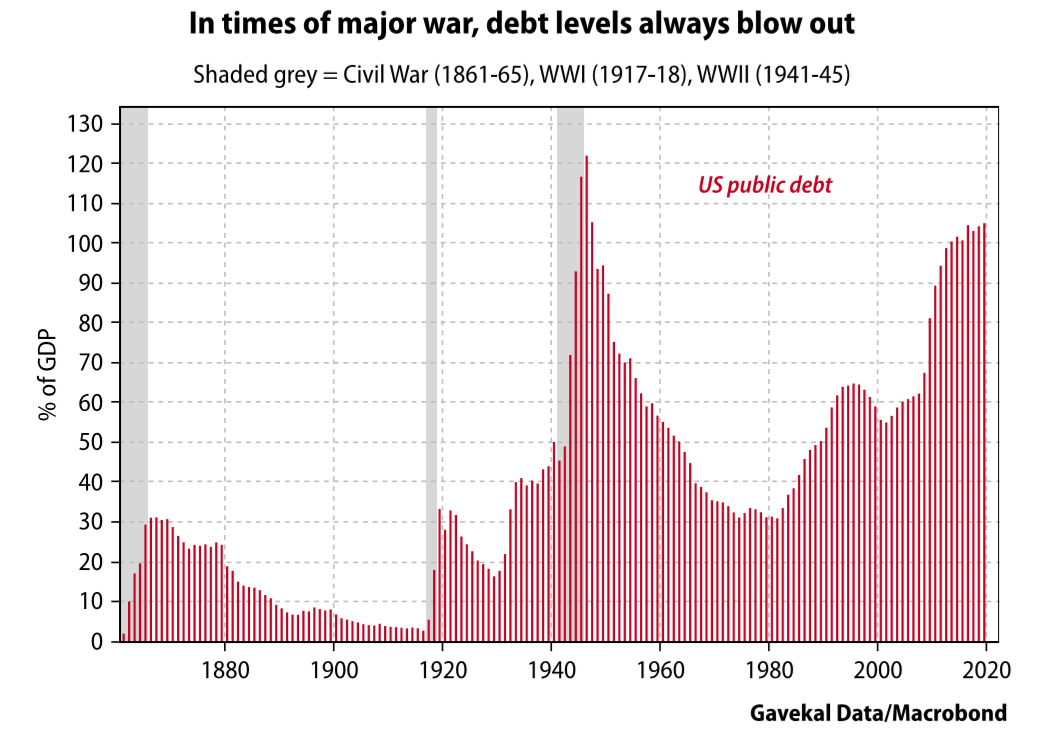
- If Europe’s institutions do not protect Europeans against anything and— on all the evidence—serve no purpose in a time of crisis, especially an international crisis, then what purpose do they serve?
- If Europe’s institutions do not fulfill these basic regalian functions, why have European nations given up sovereignty over their budgets, their borders, their laws and their currencies to these same institutions?
- And, of course, why should Europeans pay with their taxes to fund this extra layer of useless government?
- Italian prime minister Giuseppe Conte folds and agrees to tap the European Stability Mechanism to deal with the crisis. But to do so would place his country under the economic tutelage of Brussels. In Italy’s current political climate, which is highly emotionally charged because of the (rightful) impression that neither Berlin nor Brussels has done anything to help Italy in her hour of need, this would be political suicide.
- German chancellor Angela Merkel folds and agrees to push for a change in the German constitution and the creation of a pan-European sovereign bond market. However, it is by no means certain that two-thirds of the Bundestag (or even her own party?) would follow Merkel down this path.
- Europe’s national leaders, physically exhausted and emotionally drained after a harrowing two months, fail to reach a working compromise over all-night video conferences, and Europe really starts to implode.
- The way the health care system is organized appears to have impaired the policy response across the country. In time, this will likely increase calls for a nationalization of the US health care industry—surely a hot topic in the upcoming US presidential election?
- Behind the Covid-19 crisis lies another challenge: the impending bankruptcy of large sections of the US energy complex. Simply put, at US$20/bbl for oil, the hundreds of billions of US dollars invested in happier times in US shale plays will need to be written off. This will cause considerable pain.
- The 30-sigma surge in US unemployment, itself a direct consequence of the Covid-19 crisis, complicates the economic stabilization attempts of the government for the simple reason that the US does not have much in the way of unemployment benefit infrastructure. Consequently, the US government is forced to direct its aid through companies (see Is US$2trn In Fiscal Support Enough?). Unfortunately, there are few guarantees this money will help those most in need. Instead, the aid ends up looking either like typical Washington pork spending (last week’s bill included a US$25mn subsidy for the Kennedy arts center), or the usual corporate welfare (the Boeing supply chain got a cool US$60bn).
- As it has traveled, the virus may have mutated into more lethal forms. This is a worrying thought.
- The deaths in China may be massively under-reported, either by local officials who dare not be the bearers of bad news, or simply by rural hospitals who don’t delve too deeply into causes of death among their elderly patients. This is a distinct possibility. But it is interesting that among China’s neighbors (where the data can be trusted), Covid-19 death tolls have been nowhere near as harsh as in Europe. South Korea, one “early adopter” has buried 158 souls, Japan has registered 54 deaths (despite keeping its economy largely open for business), Malaysia 37, Hong Kong four and Singapore three. Each death is a tragedy. But across Asia, just as in China, the virus seems to be far less deadly than in Europe.
- It could be that Asian societies were simply better prepared to tackle a pandemic like Covid-19 than Western countries. Airports in Asia have long had temperature monitoring devices, governments were quick to track potential contacts with carriers through cellphone data. Following 2003’s Sars outbreak, hospitals are well equipped with protective gear, and people readily don face-masks at the first sign of a cough or runny nose. This explanation makes sense. Although, again it should be noted that the virus was allowed to spread unchecked for at least 10 weeks before the authorities in China and elsewhere in Asia kicked into action. Even then, not all did. Japan has by and large continued to live life as normal and so far has seen neither a surge in deaths nor a flood of patients overwhelming its health care system—even though in demographic terms it is the “oldest” country in the world.
- It is conceivable that exposure to Sars-CoV, the coronavirus that caused Sars in 2003, and other coronaviruses has conferred on Asian populations an element of immunity to Sars-CoV-2, the coronavirus that causes Covid-19. At the risk of hyperbole, in this scenario Covid-19 would be akin to the onset of smallpox in the New World, but this time it is Europeans who are in the position of the Native Americans. This of course is an exaggeration; Covid-19 will not wipe out 90% of the European population, and unlike the world of the 16th century, today’s world— and many of its germs—are already globalized. Still, perhaps Europeans might look warily on gifts of free blankets coming from China?
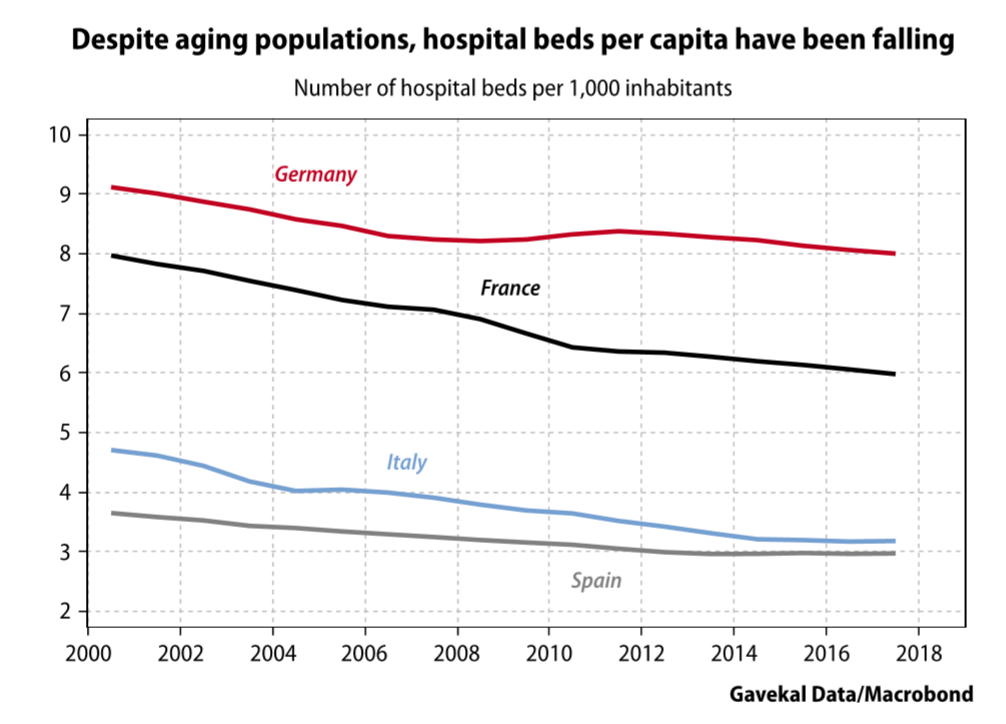
- The divergence between Asian and European fatality rates could reflect the under-funding and inadequate preparation of European health care systems. Or at least some of them—so far Germany, the Netherlands and Scandinavia appear to have been far less affected than Italy, Spain and France (even though Sweden has continued to live life much as normal). This intra-European divergence could simply be a question of timing; Italy got it first, and Germany is set to follow. Or could it reflect public policy failures on an epic scale in Italy, Spain and France?
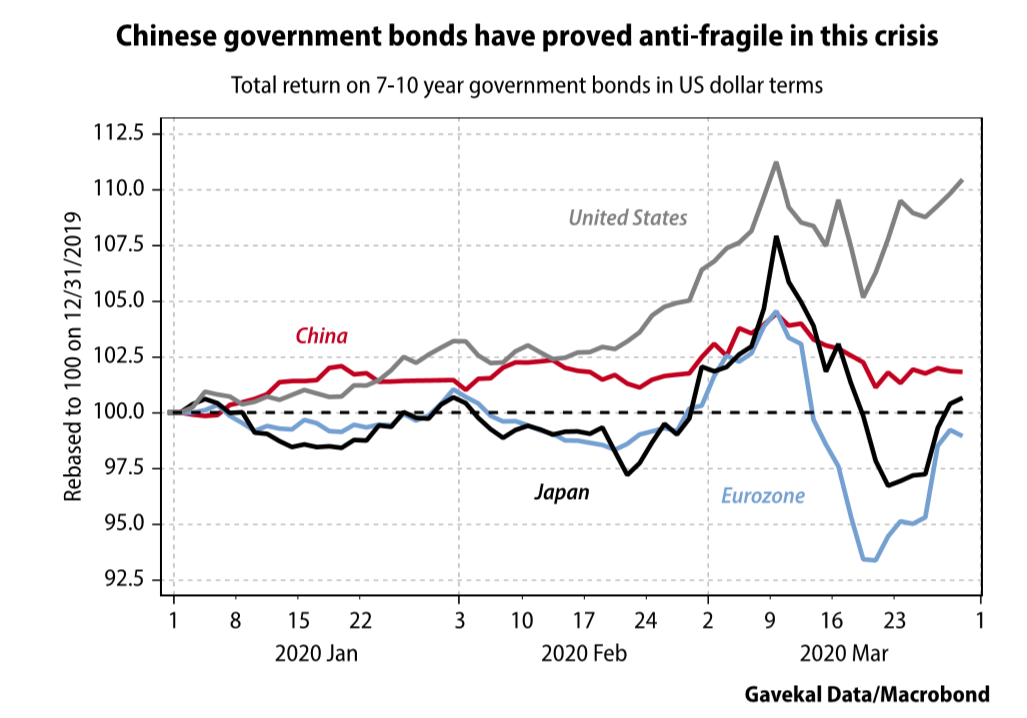
- The policy responses in Asia have been superior to the policy responses in the West.
- The level of pandemic preparedness in Asia was superior to that in the West.
- The level of political uncertainty in the West is now far greater than the political uncertainty in Asia. Will the European Union survive this crisis? In what form? Will the US presidential election lead to the nationalization of the US health care system? Can the US afford its policy responses?
- The human cost of the crisis appears to be much less in Asia than in the West.
- The implementation of economic policy responses has been far more conventional in Asia than in the West.
- A disease that appears especially dangerous for people over 60 (and two of Gavekal’s principals—Charles and Anatole—are the wrong side of 60, while a third—Arthur—is locked down in New York city).
- An economic dislocation such as the world has seldom before experienced in peacetime.
- Question marks over the future of the European Union, and over the existence of the euro.
- Threats to the continued pursuit of globalization, one of the greatest drivers of productivity gains in recent decades.
- For some European countries, not least Italy, the last 20 years of European monetary union have been an exercise in the kind of self-flagellation now forbidden by the Catholic Church. The old German proverb “better an end with horror, than a horror without end,” has surely never been more applicable than to Italy’s economic experience as a member of the euro. With this in mind, investors may want to start drafting a shopping list of European assets that could make interesting buys on the other side of a eurozone meltdown.
- If the euro does implode, Europeans will still need to find a home for their savings. The obvious initial destination would be the US dollar. But the Federal Reserve has made clear that it will do everything it can to prevent the US dollar from rising. So, a euro-implosion could trigger an even greater explosion of the Fed’s balance sheet. Such a surge could help put a floor under financial markets everywhere.
- Another destination could be other European currencies, whether the Swiss franc (pushing the Swiss National Bank into even more US equity purchases?), the pound (which remains grotesquely undervalued) or the Scandinavian currencies (also undervalued).
- Alternatively, some European savings seeking attractive yields could make their way into emerging market currencies, whether into the very undervalued and high-yielding Mexican peso, into the very stable renminbi, or perhaps even into the Canadian dollar (I know it’s not an emerging market currency, but the loonie obviously doesn’t, because it continues to behave like one).
- There is always gold.