


“History repeats itself, but in such cunning disguise that we never detect the resemblance until the damage is done.” –SYDNEY J. HARRIS, journalist and author
INTRODUCTION
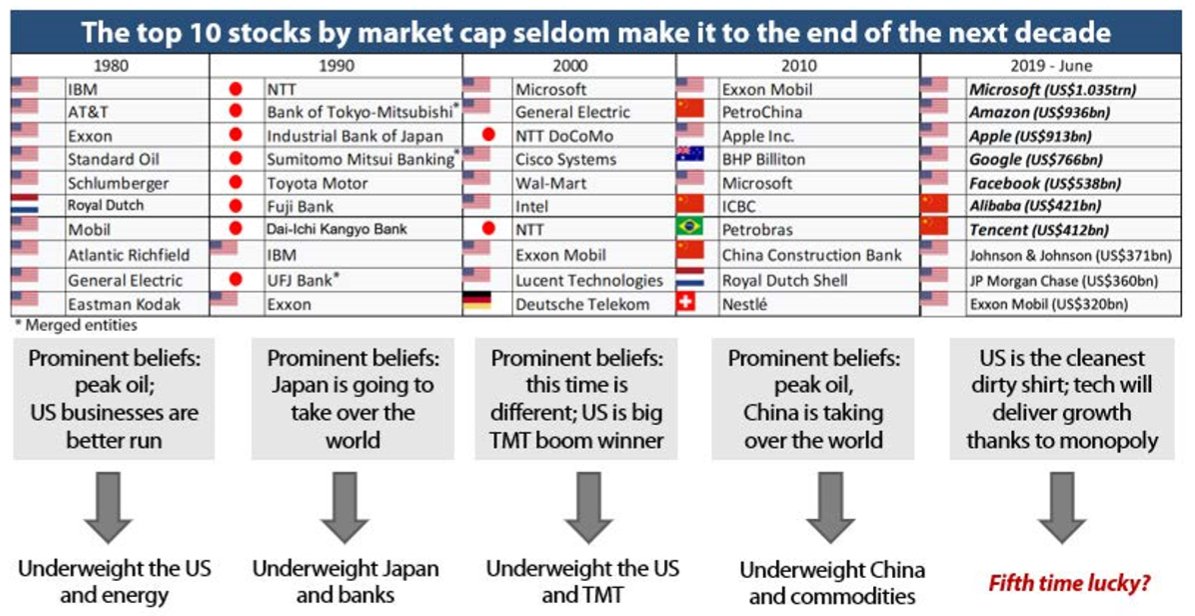
If someone were to dive deep into the Evergreen Virtual Advisor (EVA) archives, they would stumble upon a publication from two years ago titled, “America is Great, Home Country Bias Ain’t.” The bulk of the article was written by GMO’s Rick Friedman and its main premise is that investors skew their equity exposure towards their home country. Americans who have invested in line with this idea over the past decade have unquestionably been beneficiaries as benchmark indexes including the S&P 500, Nasdaq and Dow Jones have all been on epic bull runs. However, as last week’s “Instant Classic” newsletter outlines, legendary investor Ray Dalio believes there is a paradigm shift on the horizon and suggests investors rotate into assets that post good returns when money is devalued – such as gold. This week, Evergreen’s partner Louis-Vincent Gave makes a parallel argument, outlining his belief that investments following the prevailing groupthink of today will underperform other areas – such as emerging markets and commodities – over the next decade. Louis’ investment thesis for the 2020s is bold and likely at odds with anyone who has been lulled into the idea that cycles are antiquated. Those still inclined to believe that history does in fact repeat itself will find ample evidence in the article below that actual results often differ from popular beliefs when it comes to the long-term game of investing.AN INVESTMENT THESIS FOR THE 2020s By Louis-Vincent Gave Is long term success in investing more easily achieved by picking winners, or by avoiding losers? Arguably, the second path takes a lot less work. The table below illustrates the point nicely; it lists the world’s 10 biggest companies by market capitalization at the beginning of each decade since 1980. In 1980, the broad consensus was that “democracy inherently promotes inflation.” According to the prevailing belief of the day, politicians would always try to buy votes with unsustainable public spending, while central bankers would be unable to withstand pressure from governments twisting their arms to fund the ever-growing budget deficits. As a result, the only stocks worth holding were of companies with real assets, and especially commodity producers. At the time, energy names made up almost a third of the MSCI World index, and six of the world’s top 10 companies.
 So much for the consensus. In 1980 any investor brave enough to own zero energy in his or her portfolio could have packed up and gone to the beach for the next 10 years, and at the end of the following decade would have outperformed handsomely.
Remember when Japan was the future?
After his decade-long beach holiday, our outperforming investor would have returned to the office in 1990 only to be told that if he did not learn Japanese, then there would be no job for him in the coming years. Japan’s superior management techniques and bank-led financing model would ensure that Japanese corporates would take over the world. Given this consensus, it was no surprise that in 1990, eight of the top 10 companies in the world were Japanese, and six of those eight were banks. How could you lose money owning Japanese banks when Japan was set to take over the world?
Still, if our investor had decided to underweight Japan (which by January 1990, made up 45% of the MSCI World index), then once again he could have afforded to head for the beach for the entire following decade.
Coming back in 2000, our investor would have found a market segmented between attractively-valued “old economy” stocks, and “new economy” stocks valued on previously unheard of measures such as “price to eyeballs”. These new economy stocks, in media, telecoms and technology, made up more than a third of the MSCI World. Yet again, if our courageous investor chose to ignore the hype, he could have gone on holiday for another 10 years.
Returning in 2010, he would have found that the prevalent belief was that it was actually China that was going to take over the world. And China’s insatiable thirst for commodities meant that the world not only faced “peak oil”, but peak copper, peak nickel, and perhaps even peak coal. By that point, five of the world’s top 10 companies by market capitalization were involved in digging stuff out of the ground while, for the first time, three of the world’s top 10—PetroChina, ICBC and CCB—were not only state-owned companies, but state-owned companies of a nominally communist government which a generation earlier had been gunning down its own students on the streets of its capital. Freshly returned from the beach, our investor might have found this odd, and might reasonably have decided to deploy his capital elsewhere.
Back from the beach once again
All of which brings us to today and the approaching end of the current decade. Once again, our fantasy investor will be coming back from the beach to review the beliefs underpinning today’s bull market. And he will find that:
So much for the consensus. In 1980 any investor brave enough to own zero energy in his or her portfolio could have packed up and gone to the beach for the next 10 years, and at the end of the following decade would have outperformed handsomely.
Remember when Japan was the future?
After his decade-long beach holiday, our outperforming investor would have returned to the office in 1990 only to be told that if he did not learn Japanese, then there would be no job for him in the coming years. Japan’s superior management techniques and bank-led financing model would ensure that Japanese corporates would take over the world. Given this consensus, it was no surprise that in 1990, eight of the top 10 companies in the world were Japanese, and six of those eight were banks. How could you lose money owning Japanese banks when Japan was set to take over the world?
Still, if our investor had decided to underweight Japan (which by January 1990, made up 45% of the MSCI World index), then once again he could have afforded to head for the beach for the entire following decade.
Coming back in 2000, our investor would have found a market segmented between attractively-valued “old economy” stocks, and “new economy” stocks valued on previously unheard of measures such as “price to eyeballs”. These new economy stocks, in media, telecoms and technology, made up more than a third of the MSCI World. Yet again, if our courageous investor chose to ignore the hype, he could have gone on holiday for another 10 years.
Returning in 2010, he would have found that the prevalent belief was that it was actually China that was going to take over the world. And China’s insatiable thirst for commodities meant that the world not only faced “peak oil”, but peak copper, peak nickel, and perhaps even peak coal. By that point, five of the world’s top 10 companies by market capitalization were involved in digging stuff out of the ground while, for the first time, three of the world’s top 10—PetroChina, ICBC and CCB—were not only state-owned companies, but state-owned companies of a nominally communist government which a generation earlier had been gunning down its own students on the streets of its capital. Freshly returned from the beach, our investor might have found this odd, and might reasonably have decided to deploy his capital elsewhere.
Back from the beach once again
All of which brings us to today and the approaching end of the current decade. Once again, our fantasy investor will be coming back from the beach to review the beliefs underpinning today’s bull market. And he will find that:
- In spite of central banks’ best efforts, deflation is here to stay, forever.
- The global growth environment remains lackluster, and the risk is that it will deteriorate from here. As a result, you need to “pay up” for what little growth you can find. And the only obvious area where you can find growth is in technology, partly because so many tech companies enjoy quasi-monopoly situations thanks to scale and network effects. In fact, being a massive company is no longer a hindrance to growth, because you can now operate on a global scale and capture monopoly rents.
- In today’s world, what matters is no longer the ownership of physical assets (such as copper mines, oil wells or railway lines) but the ownership of intellectual property.
- Even though the US government is running a budget deficit of over 5% of GDP in the 10th year of an economic expansion, the US is by far the cleanest dirty shirt in a world rapidly moving ex-growth. That means you need to overweight not only US equities but the US dollar too.
- One of the key reasons for the high turnover in the world’s top 10 companies from decade to decade is that size and growth are usually hard to reconcile (only Exxon has consistently stayed in the list, and then only by merging with Mobil at the nadir of the energy cycle; though Microsoft deserves an honorable mention for its third consecutive decade in the top 10). This is almost a hard rule of capitalism. The bigger the organization, the more bureaucratic it will tend to become, the more entrenched in its ways, and the less likely to take risks and so deliver the outsized growth investors anticipate. Elephants and hippos are very resilient, but they are neither as fast, nor as agile, as cheetahs or leopards.
- With size usually comes much greater government scrutiny, if only because governments are jealous of their power and do not like to see corporate chieftains get too big for their boots. On this front, it is interesting to note that “big tech” companies are currently lined up in the sights of either the US FTC or Department of Justice, or the European Commission. Beyond this, the tech sphere has now been designated as a main battlefield in the unfolding US-China cold war, a designation which, all else being equal, is hardly bullish technology.
- The current macro view is that global growth will remain decent but unexciting, and that deflation will continue to rule the roost. This could well turn out to be a case of investors projecting the recent past far into the future, even as the underlying macro conditions are evolving. As we move from a globalizing world to a deglobalizing world, as the US and European governments switch from tight fiscal policies to counter-cyclically very loose fiscal policies, and as an unprecedented productivity boom in the extraction of commodities starts to fade into the rear view mirror, the macro environment could turn out to be rather different.
- Greed, driven by an expansion of capitalism into new territories (the South Sea Company, the Mississippi Company, the expansion into the American West, Japan, China etc.). Gavekal calls these “Ricardian” bubbles. Usually in Ricardian expansions, “value” investors do quite well.
- Greed, driven by new technologies (railways, radio, the internet, smartphones, big data etc.). Dubbed by Gavekal “Schumpeterian” bubbles, these are a personal favorite, as they allow for large expansions in capital spending and progress for humanity. In Schumpeterian bubbles “growth” investors tend to outperform.
- Fear-induced bubbles, driven by the notion that “there won’t be enough for everyone”. In times of such “Malthusian” thinking, investors in commodities tend to outperform.