


“The time to IPO for most startups has substantially elongated, in many cases ten or more years from founding.” –SCOTT KUPOR, Venture Capitalist and author of Secrets of Sand Hill Road
INTRODUCTION
Ben Horowitz, famed entrepreneur and venture capitalist, once quipped that as a startup CEO he “slept like a baby [because he] woke up every two hours and cried.” As many others at the head of early-stage businesses can attest, Ben isn’t overreaching all that far in his comparison. While many factors play into the often-disrupted sleep patterns of entrepreneurs, perhaps the most jarring is the fact that the vast majority of early-stage companies are destined to flop. Statistically speaking, nine out of ten startups will fail. However, for the relatively few businesses that go on to achieve long-term success, a mysterious reality faces them: the median time to IPO* for a company has ballooned from four years to ten years over the last two decades. And, while we will dive deeper into the possible reasons for this below, it’s important to understand the impact this has had on public markets. Consider, for a minute, that there were roughly 7,500 publicly traded companies and 300 IPOs per year on U.S. exchanges before the turn of the millennial – which coincided with the height of the dotcom bubble. Today, the number is closer to 3,600 total publicly traded companies and a little more than 100 IPOs per year, or down more than half over the last two decades.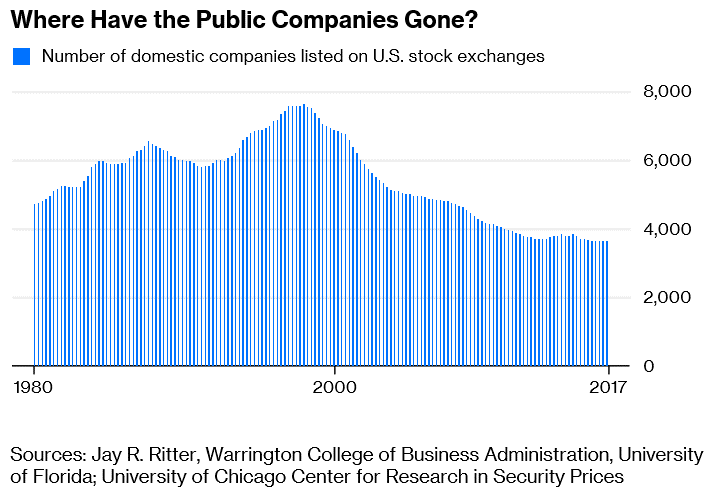 So, what’s happening? Simply put, over the past 20 years, there has been a much higher clip of public companies going private, merging with or acquiring other companies, or ceasing operations completely than the number of new companies entering public markets. And, although the swell of IPOs this year has sparked some enthusiasm around the idea that those numbers might begin to tick higher, the wave has incited an equal amount of skepticism as many of these companies (some of which we wrote about in our Chasing Unicorns: IPOs to Watch newsletter) have operated for a decade or longer without turning a meaningful or consistent profit. One thing to note in regard to the “disappearing publicly-traded stock” theme is that the steepest declines occurred from 2000 to 2011, further highlighting the mania in the ‘90s dotcom era that brought a significant number of marginal entities to public markets that either failed or were acquired.
But, before going any further, let’s take a step back.
If we assume that the current trend holds and the number of publicly traded companies continues to decline, one alarming repercussion is that the average investor will have fewer and fewer opportunities to invest in a diverse array of securities, specifically small-to-medium cap businesses. Last year, Nasdaq’s CEO, Adena Friedman, warned that if the trend continues, “job creation and economic growth could suffer, and income inequality could worsen as average investors become increasingly shut out of the most attractive offerings.”
Related to the factoid mentioned at the beginning of this article, the case of the elongated IPO further compounds this issue by bringing companies to market later in their funding cycle, thus introducing them to public markets at loftier valuations that, in the long-term, will likely not be sustained by business models that fail to create consistent profits. The New York Times ran a telling article on this point in March titled, “In This Tech I.P.O. Wave, Big Investors Grab More of the Gains: Unicorn Companies Are Finally Going Public, After Large Gains Have Been Captured by Elite Early Investors.”
While the trend of the elongated IPO is clear, there is still plenty of mystery surrounding how we got here. Below are four of the most popular theories as to why the median time to IPO has more than doubled over the last two decades, while the number of public companies has declined by 50%:
So, what’s happening? Simply put, over the past 20 years, there has been a much higher clip of public companies going private, merging with or acquiring other companies, or ceasing operations completely than the number of new companies entering public markets. And, although the swell of IPOs this year has sparked some enthusiasm around the idea that those numbers might begin to tick higher, the wave has incited an equal amount of skepticism as many of these companies (some of which we wrote about in our Chasing Unicorns: IPOs to Watch newsletter) have operated for a decade or longer without turning a meaningful or consistent profit. One thing to note in regard to the “disappearing publicly-traded stock” theme is that the steepest declines occurred from 2000 to 2011, further highlighting the mania in the ‘90s dotcom era that brought a significant number of marginal entities to public markets that either failed or were acquired.
But, before going any further, let’s take a step back.
If we assume that the current trend holds and the number of publicly traded companies continues to decline, one alarming repercussion is that the average investor will have fewer and fewer opportunities to invest in a diverse array of securities, specifically small-to-medium cap businesses. Last year, Nasdaq’s CEO, Adena Friedman, warned that if the trend continues, “job creation and economic growth could suffer, and income inequality could worsen as average investors become increasingly shut out of the most attractive offerings.”
Related to the factoid mentioned at the beginning of this article, the case of the elongated IPO further compounds this issue by bringing companies to market later in their funding cycle, thus introducing them to public markets at loftier valuations that, in the long-term, will likely not be sustained by business models that fail to create consistent profits. The New York Times ran a telling article on this point in March titled, “In This Tech I.P.O. Wave, Big Investors Grab More of the Gains: Unicorn Companies Are Finally Going Public, After Large Gains Have Been Captured by Elite Early Investors.”
While the trend of the elongated IPO is clear, there is still plenty of mystery surrounding how we got here. Below are four of the most popular theories as to why the median time to IPO has more than doubled over the last two decades, while the number of public companies has declined by 50%:
- It Costs Too Much Money to Go (and Stay) Public These Days. Following the dotcom bubble, Congress passed the Sarbanes-Oxley Act (SOX) in 2002. The legislation set new and expanded requirements for all U.S. public company boards, management and public accounting firms. This Act was designed to increase the visibility into the true financial state of public-traded companies through a more comprehensive set of financial disclosures. While the legislation was well-intentioned, an adverse effect is that the costs of going and staying public have skyrocketed. As such, the theory contends that fewer companies have chosen to go and stay public due to increased costs of regulatory compliance and that the money spent could be better funneled into other areas of the business such as engineering, research and development, and sales and marketing.
- Mutual Funds Tend to Invest in Large-Cap Stocks. Mutual funds are motivated to focus on large-cap, highly liquid companies since they put large amounts of money to work in individual stocks. As a result, mutual funds tend to concentrate investments in large-cap stocks at the expense of small-cap stocks. This theory argues that since there is less “big money” looking for investments in small-cap stocks these days, it is better to increase business value as a private company before entering into public markets.
- There are More Financing Options for Private Companies. Over the last five to ten years, public mutual funds, hedge funds, private equity buyout firms, family offices, traditional endowments, and sovereign wealth funds have all started investing in the later innings of a company’s development. This theory contends that the new availability of private capital has supplanted the need for companies to go public quickly.
- Large-Cap Companies Have Been Aggressive in Acquiring Smaller, Private Companies. Another factor in the mysterious case of the elongated IPO has been the hyper-aggressiveness of large-cap companies, especially in tech, to buy out smaller entities with exciting products, services, and teams, often before they go public. Take tech-behemoth Apple, for example. In May, CEO Tim Cook told CNBC that “Apple buys a company every two to three weeks on average. In roughly the last six months alone, Apple has bought approximately 20 to 25 companies [but] often doesn’t announce these deals because the companies are small, and Apple is primarily looking for talent and intellectual property.”
