


Click here to view as PDF. “History doesn’t repeat, but it does rhyme.” –Controversially attributed to Samuel Clemens, aka MARK TWAIN “A bull market does not stay down long enough for you to buy, and a bear market is one that does not stay up long enough for you to sell.” –MIKE O’ROURKE, Chief Market Strategist of Jones Trading
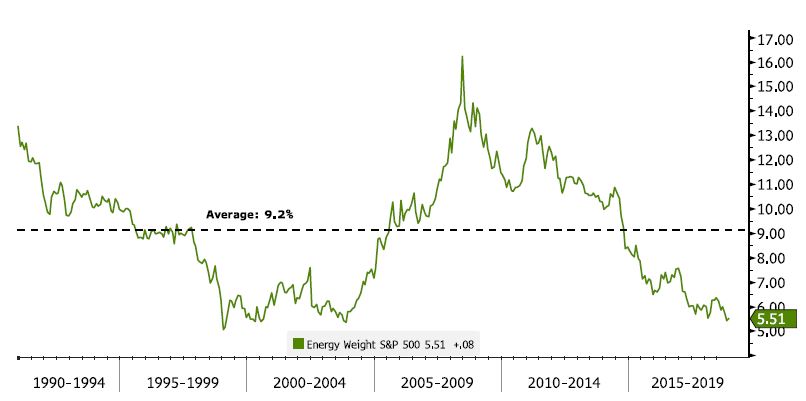
A Tale of Two Markets, Redux. It never ceases to amaze me how conditions can change almost instantaneously in the stock market. It was only a couple of months ago that the S&P 500 seemed invulnerable and on pace for a double-digit return year. However, as we approach the end of 2018, with countless investors praying for a Santa Claus rally, any gain would be appreciated. Now, a flat year is not exactly a disaster but, as was the case in 2015, the superficial return number for the S&P doesn’t come close to telling the full story. As of the close of this week, the performance of the NYSE issue was -5.9% while the ValueLine Universe of 1700 stocks was -7.9% (be sure to note the minus signs!). Moreover, it’s a global market out there even though investors have increasingly clustered into the US because – as usual – that’s what’s been working in recent years. The MSCI World Index, excluding US stocks, was down -11.3% through 12/14/18. Even in America, the still-stellar performance of a few monster-cap companies has propped up the S&P, as also happened in 2015, notwithstanding their recent de-rating (a fancy term for a market spanking). Almost all of these are tech or tech-related and several remain up 20% for the year. As the above implies, if one drills down a bit there has been considerably more carnage. This damage has become severe and widespread enough to qualify for a “two-tier market” designation. Please allow me to elaborate with a trip down memory lane. In the late spring of 2000, technology stocks (and a few mega-cap issues like, ironically, GE) had enormously out-performed the overall stock market over the prior two years. This is despite the fact that the great tech-wreck, which would lead to an eventual 78% obliteration of the NASDAQ, was already under way. In vivid contrast, most stocks, especially those of a value nature, had been in a below-the-radar bear market since the spring of 1998. During those 24 months or so of diverging performance, this author was constantly making the argument that it was a tale of two markets—i.e., a two-tier market—with a gaping chasm between the haves and have-nots. (Long-time EVA readers can easily imagine where my portfolios were most exposed in those days.) The re-emergence of this condition is the reason for this Special Edition EVA. The déjà vu I’m presently experiencing occurs when I look at high-quality companies selling at single-digit P/Es vis-a-vis those of comparable stature (or lower) trading at 25 times earnings, if not substantially more. This is simply too dramatic for me not to do a shout-out about. (Sorry, I know sentences aren’t supposed to end with prepositions, but I like the rhyme.) Consequently, it’s becoming hard to maintain a negative attitude toward the overall US stock market. It’s more accurate, I think, to say that large portions of it remain over-priced—in many cases, obscenely—while a growing share is looking downright appetizing. When foreign markets are included, the bargains are even more galore. Looking at specific examples is always more helpful. Accordingly, one of our recent purchases is among the most venerable and respected life insurance companies in the country and the world. It is down about 35% from its January 2018, high. It sells at a skimpy 7 times this year’s essentially in-the-bag earnings and sports a 4.4% dividend yield. Another much smaller company—and heavily exposed to the far more cyclical property/casualty side of the insurance business—sells at 25 times earnings with a mere 2.7% yield. This is far from an isolated instance. In fact, I’ll give you one more that is even more mystifying. Another recent purchase we made is a company that is in the IT category, though it has some financial sector characteristics. Its earning track record is simply one of the best I’ve ever seen. Profits even expanded by 15% during the Great Recession when most companies saw their sales fall by 20% to 25% and earnings were absolutely crushed (not to mention that a long list of actual financial institutions had near-death experiences). Over the past decade, this firm’s profits have swelled by 400% with nary a down year. Despite this remarkable performance, it is trading 40% below its peak in late 2015 and sells at a P/E of 8. That’s right—ocho. The counter-example for this one isn’t as clean a “comp” as with the two insurance companies because this priced-beyond-perfection issue is in a different industry. In fact, they sell a mundane product that is in almost everyone’s home and/or garage. To give you a bigger hint, it comes in a blue and yellow can. For sure, it’s had a nice earnings history, but profits did dip in both 2008 and 2009. Over the past 10 years, profits per share have compounded at a solid, but unspectacular, clip of 7%. Yet—and this is another clue as to its name—it sells for 40 times earnings. Go figure. Maybe you can justify the disparities, but we can’t. To further drive home this point, I’ve gone through the 47 companies that Evergreen holds for growth (vs income) purposes on behalf of its clients and 14 of them sell for single digit P/Es. Another 7 trade at between 10 and 12 times their estimated profits for this year. Moreover, they are scattered across most of the S&P sectors, so these alluring valuations are not just specific to one or two out-of-favor areas. Even in the once uniformly white-hot tech sector, there are a number of stocks whose prices have been pounded down enough to qualify as genuine bargains. (By the way, Forrest Gump’s favorite “fruit company”, which not long ago briefly pierced the $1 trillion market value mark, just missed the cut at 12.7 times this year’s profits). Therefore, even in tech, a two-tiered market has emerged. Admittedly, a number of the cheapest names we own are domiciled overseas. But, in most cases, they are world-class multinational enterprises. It’s no surprise that quite a few of them are energy-related and, once again, this sector has been taken out back and shot like a vicious dog. As you can see, the energy sector is trading at very close to 30-year lows relative to the overall stock market.
ENERGY SECTOR AS % OF S&P 500
 Source: Bloomberg, Evergreen Gavekal as of 12/12/2018
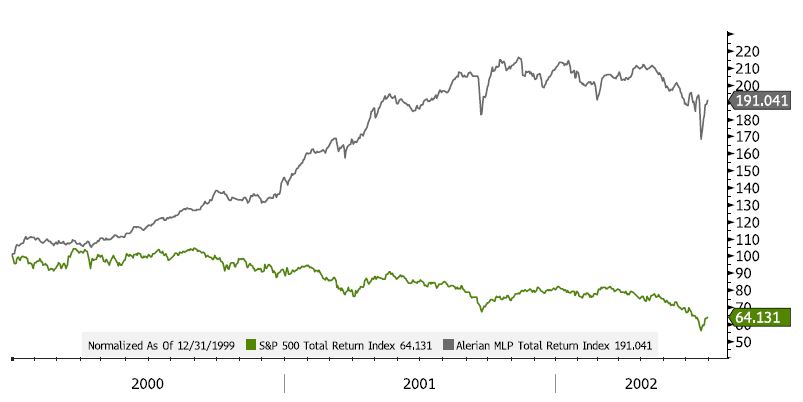
MLP INDEX VS. S&P 500 FROM JANUARY 2000 – JULY 2002
 Source: Bloomberg, Evergreen Gavekal as of 12/12/2018

OUR CURRENT LIKES AND DISLIKES
No changes this week.
LIKE *- Large-cap growth (select issues are looking more attractive after the recent correction)
- Some international developed markets (especially Japan)
- Cash
- Publicly-traded pipeline partnerships (MLPs) yielding 6%-12% (accelerate accumulation due to the recent sharp sell-off)
- Gold-mining stocks
- Gold
- Select blue chip oil stocks (also accelerate accumulation with crude prices down to $50)
- Investment-grade floating rate corporate bonds
- One- to two-year Treasury notes
- Canadian dollar-denominated short-term bonds
- Select European banks
- Short-term investment grade corporate bonds (1-2 year maturities)
- Emerging market bonds in local currency (start a dollar-cost-averaging process and be prepared to buy more on further weakness)
- Mexican stocks (due to the recent severe selloff, we are adding back exposure to a Mexican REIT that we sold materially higher)
- Most cyclical resource-based stocks (some are looking more attractive)
- Mid-cap growth
- Emerging stock markets; however, a number of Asian developing markets appear undervalued
- Solar Yield Cos
- Large-cap value (again, there appear to be a number of bargains in this style/category)
- Canadian REITs
- Intermediate-term investment-grade corporate bonds, yielding approximately 4%
- Intermediate municipal bonds with strong credit ratings
- US-based Real Estate Investment Trusts (REITs)
- Long-term investment grade corporate bonds
- Intermediate-term Treasury bonds
- Long-term municipal bonds
- Short euro ETF
- Long-term Treasury bonds (due to the decisive upside break-out recently by longer treasury yields, close out positions for now and wait to re-enter should the yield approach 4%)
- Small-cap value
- Mid-cap value
- Small-cap growth
- Lower-rated junk bonds
- Floating-rate bank debt (junk)
- US industrial machinery stocks (such as one that runs like a certain forest animal, and another famous for its yellow-colored equipment)
- Preferred stocks
- BB-rated corporate bonds (i.e., high-quality, high yield; in addition to rising rates, credit spreads look to be widening) * **
- Short yen ETF (i.e., we believe the yen is poised to rally)
- Dim sum bond ETF; individual issues, such as blue-chip multi-nationals, are attractive if your broker/custodian is able to buy them