

Click here to view as PDF. “The vulnerabilities that have built up around the globe during the long period of unusually low interest rates have not gone away. High debt levels…are still there—and so are frothy valuations.” -CLAUDIO BORIO, chief economist at the Bank of International Settlements (often known as the central banker for central banks)
Introduction
Bears repeating. In the financial newsletter industry, John Mauldin is like LeBron James. No one stands taller or is more popular than John with his million-plus circulation of Thoughts from the Frontline. Candidly, John’s work inspired me to start writing the Evergreen Virtual Adviser back in 2006 (so now you know who to blame!). Coincidentally, he is writing something similar to my “Bubble 3.0” series which he calls “The Debt Train Wreck”. In our July 6th EVA, we included a link to his June 29th installment, titled “Unfunded Promises”. For those of you who missed that issue (God forbid!), here it is again. Very, VERY, long-time EVA readers will recall the repetitive warnings I gave about the impending housing debacle in 2006 and 2007 in these pages. Frankly, if it wasn’t for John Mauldin, I doubt I would have been nearly as convicted—or convincing—in sounding those alarms. It was through attending his Strategic Investment Conferences in that era of NINJA (no income, no jobs, no assets) lending that I came to believe that it was essential to position client portfolios for the coming crash. It was one of the most important moves of my career and for that alone I will always be grateful to John. Many alleged experts laughed at John (and yours truly) in those days but that laughter turned to tears a few short years later. In those pre-bubble bursting days, though, it seemed like the insanity would never end. In other words, it was a lot like today. In the years that have passed, I have been honored to consider John a friend. In fact, I chatted with him on the phone this week and we commiserated over what we both see as another pending debt disaster. It bothers us both greatly that investors are currently totally oblivious to the long-term risk posed by this enormous bubble in debt issuance. If you think that’s an exaggeration, just wait two paragraphs. In this month’s Guest EVA, we are running the July 13th installment of his must-read series. To his considerable credit, John is refusing to turn a blind eye to the brewing debt crisis we’ve allowed our policymakers to lead us into—again. Many, of course, disagree with that but, as the late Senator Daniel Patrick Moynihan supposedly said (I’m always hesitant to make absolute attributions of pithy sayings these days): “You can have your own opinions but not your own facts.” As you will soon read, John brings up some findings by the Institute for International Finance (IIF) outlining the staggering rate of debt growth that has occurred over the past decade. To put a huge exclamation point on this, right after John published “The Debt Train Will Crash“, the IIF released what I think is the most horrifying statistic I’ve seen in this regard—and that’s really saying something given the enormity of prior numbers. To wit, late last week, the IIF reported that global debt has exploded by $25 trillion in just ONE YEAR. If that doesn’t send chills up your spine, perhaps you’ve been enjoying too many adult beverages. For the US government alone, the numbers are appalling. The official debt figure of $21 trillion is awful enough, but the off-balance sheet liabilities of Social Security and Medicare/Medicaid have become, to use a highly technical term, ginormous. These amount to another $50 trillion and, possibly, as high as $200 trillion (by the way, the former number comes from the Congressional Budget Office and the latter from a highly respected source). Under our current tax structure there simply isn’t enough revenue to finance these benefits. And less affluent US citizens are almost certain to become extremely grumpy if their Social Security check gets cut by a third or their Medicare card doesn’t work. So vast new amounts of tax revenues need to be found. If you are a high net worth American, you’ve got a big bulls-eye on your back. John believes we will eventually see a Value-Added Tax (VAT), essentially a national sales tax, which has the potential to raise vast sums for the government. Our mutual friend, venerated economist Woody Brock, believes a wealth tax is coming, something I’ve long suspected. Or, it could well be both. Regardless, a massive tax increase—that would likely dwarf the recent Trump tax cut—is not a bullish development. It may drive some of our biggest taxpayers out of the country, similar to what certain high-tax states are experiencing now. John correctly notes that this is far from just a government debt issue. Global corporations have been dramatically leveraging up. Collectively, they now have a debt-to-cash flow (EBITDA) ratio of 4.1 times versus 3.4 times in 2007. In other words, relative to the cash flow necessary to cover interest costs, the planet’s non-financial companies are 20% worse off than they were at the top of what had been the biggest credit bubble of all-time. As John also perceptively points out, “lower asset prices won’t be the result of the next recession, they will cause that recession”. My partner Charles Gave has observed that as well, and even Fed chair Jay Powell has opined that the last two recessions were caused by plunging markets rather than vice versa. In my mind, this is critically important and underscores the dangers to the real economy posed by the realities of margin debt at the highest level since WWII and US stocks that remain among the most expensive of the last sixty years—if not nearly ninety. To close on that last note, many experts have criticized the Shiller, or cyclically-adjusted, P/E for being distorted by the profit collapse of the Great Recession. Accordingly, Wharton professor and best-selling author (“Stocks For The Long Run”) Jeremy Siegel has created a variation of the Shiller P/E that uses National Income and Product Account (NIPA) profits. These have been much less volatile than S&P earnings and, thus, show a less alarming reading. The problem, as you can see below, is that even using this approach valuations today are at a rarely attained peak, one which was only briefly exceeded during the nuttiest days of the tech bubble.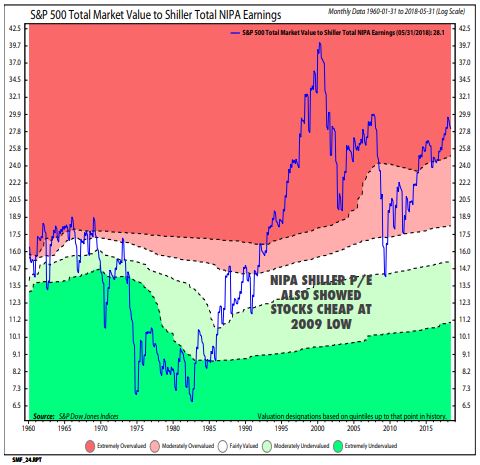 Considering the Himalayan mountains of debt out there now and interest rates rising materially, does that make sense to you? Or does it sound like the kind of situation that could trigger the next recession?

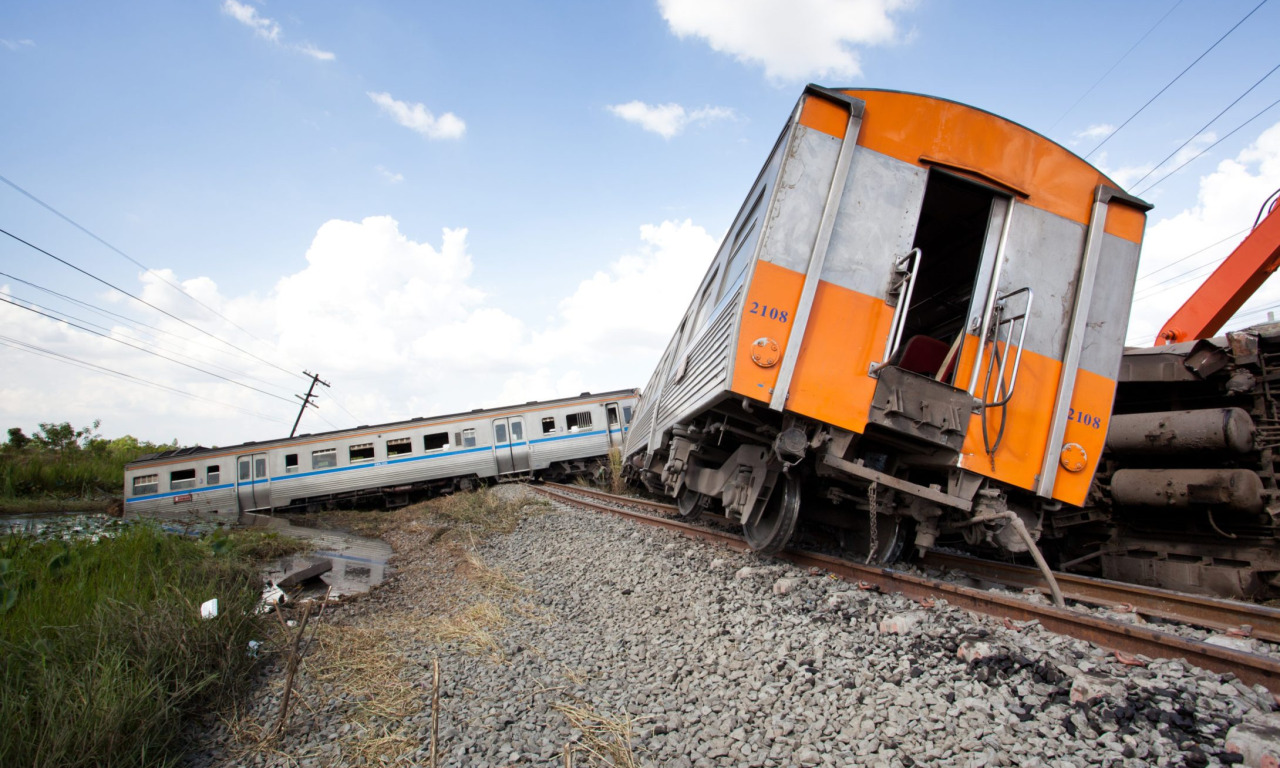
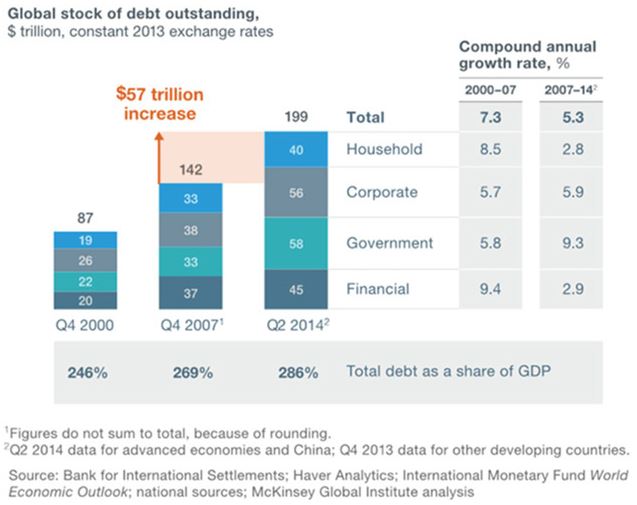
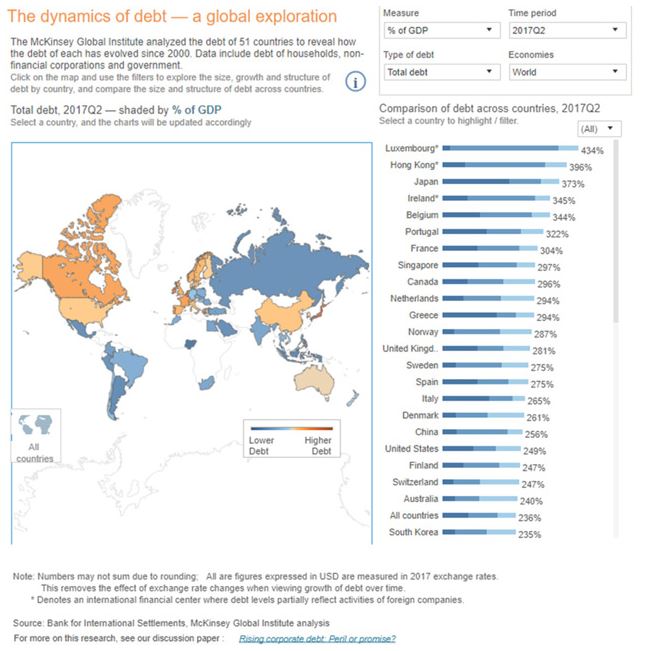
THE DEBT TRAIN WILL CRASH By John Mauldin We are approaching the end of the Debt Train Wreck series. I’ve spent several weeks explaining why I think excessive debt is dragging the world economy toward an epic crash. The tracks ahead are clear for now but will not remain so. The end probably won’t be pretty. But there’s good news, too: we have time to get our portfolios, our businesses, and our families prepared. Today, we’ll look at some new numbers on just how big the problem is, then I’ll recap the various angles we’ve discussed. This problem is so big that we easily overlook key points. I hope that listing them all in one place will help you grasp their enormity. Next week, and possibly a few after that, I’ll describe some possible strategies to protect your assets and family. Off the Tracks Talking about global debt requires that we consider almost incomprehensibly large numbers. Our minds can’t process their enormity. How much is a trillion dollars, really? But understanding this peril forces us to try. Earlier in this series, I shared a 2015 McKinsey chart that summed up global debt totals. They pegged it at $199 trillion as of Q2 2014. Note that the debt grew faster than global GDP. Everything I see suggests it will go higher at an ever-increasing rate.
 Source: McKinsey Global Institute
 Source: McKinsey Global Institute
- The Beginning of Woes: Something, possibly high-yield bonds, will set off a liquidity scramble. It will spread through the already-unstable financial system and trigger a broader credit crisis.
- Lending Drought: Rising defaults will force banks to reduce lending, depriving previously stable businesses of working capital. This will reduce earnings and economic growth. The lower growth will turn into negative growth and we will enter recession.
- Political Backlash: Concurrent with the above, employers will be automating jobs as they grow desperate to cut costs. Suffering workers—who are also voters—will force higher “safety net” spending and government debt will skyrocket. A populist backlash could lead to tax increases that prolong the recession.
- The Great Reset: As this recession unfolds, the Fed and other central banks will abandon plans to reverse QE programs. I seriously think the Federal Reserve’s balance sheet assets could approach $20 trillion later in the next decade. But it won’t work because the world simply has too much debt. They will need to find some way to rationalize or “reset” the debt. Exactly how is hard to predict but it probably won’t be good for lenders, or for the holders of government promises like pensions and healthcare.
Ten years into the ongoing laboratory experiment being conducted by the world’s central banks, everywhere you look there are multiple examples of the kind of lunacy those policies have fomented by reducing the cost of capital to virtually zero and forcing investors to take risks they would ordinarily avoid in order to find some kind of return. WeWork is one example of a company for whom, in the face of rapid growth, massive negative cashflows aren’t a problem, but there are plenty of others. Uber, AirBnB, SnapChat and, of course, Tesla have all captured the imagination of investors thanks to lofty dreams, articulated by charismatic CEOs—but the day things turn around and the economy begins to weaken or, God forbid, investors seek a return on their investment as opposed to settling for rolling promises of gigantic, game-changing revenues to come, it is over.We went on to talk about the insanity of yield-hungry investors practically throwing cash at borrowers while demanding little in return. I also showed how this is not simply a junk-rated company problem, since almost half of investment-grade companies are rated BBB and could easily slip to junk status in a downturn.
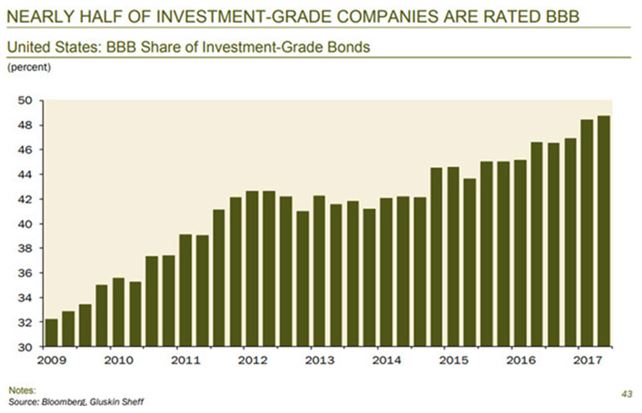 Source: On My Radar
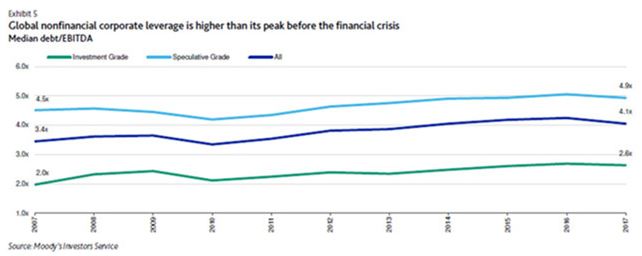 Source: Moody’s Investors Service
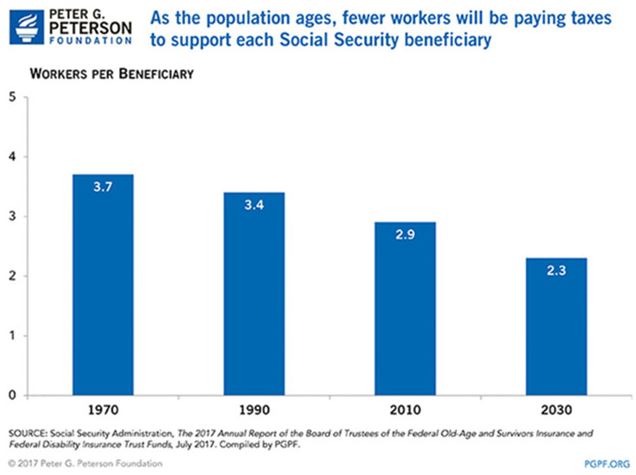 Source: Peter G. Peterson Foundation
OUR CURRENT LIKES AND DISLIKES
No changes this week.
LIKE- Large-cap growth (during a deeper correction)
- International developed markets (during a deeper correction)
- Cash
- Publicly-traded pipeline partnerships (MLPs) yielding 6%-12% (buy carefully after the recent rally; long-term, however, future returns look highly attractive)
- Gold-mining stocks
- Gold
- Select blue chip oil stocks (as with MLPs, be selective given the magnitude of the recent rally)
- Mexican stocks
- Short euro ETF (due to the euro’s weakness of late, refrain from initiating or adding to this short)
- Investment-grade floating rate corporate bonds
- One- to two-year Treasury notes
- Canadian dollar-denominated short-term bonds
- Select European banks
- Short-term investment grade corporate bonds (1-2 year maturities)
- Emerging market bonds in local currency (start a dollar-cost-averaging process and be prepared to buy more on further weakness)
- Bonds denominated in renminbi trading in Hong Kong (dim sum bonds)
- Most cyclical resource-based stocks
- Mid-cap growth
- Emerging stock markets; however, a number of Asian developing markets appear undervalued
- Solar Yield Cos
- Large-cap value
- Canadian REITs
- Intermediate-term investment-grade corporate bonds, yielding approximately 4%
- Intermediate municipal bonds with strong credit ratings
- US-based Real Estate Investment Trusts (REITs)
- Small-cap value
- Mid-cap value
- Small-cap growth
- Lower-rated junk bonds
- Floating-rate bank debt (junk)
- US industrial machinery stocks (such as one that runs like a certain forest animal, and another famous for its yellow-colored equipment)
- Preferred stocks
- Long-term Treasury bonds
- Long-term investment grade corporate bonds
- Intermediate-term Treasury bonds (moving to “dislike” on longer bonds due to recent breakout above 3% on the 10-year T-note)
- BB-rated corporate bonds (i.e., high-quality, high yield; in addition to rising rates, credit spreads look to be widening) * **
- Long-term municipal bonds
- Short yen ETF