


Click here to view as PDF. “In the absence of the gold standard, there is no way to protect savings from confiscation through inflation. There is no safe store of value.” -ALAN GREENSPAN “Gold is money. Everything else is credit.” -JP MORGAN
INTRODUCTION
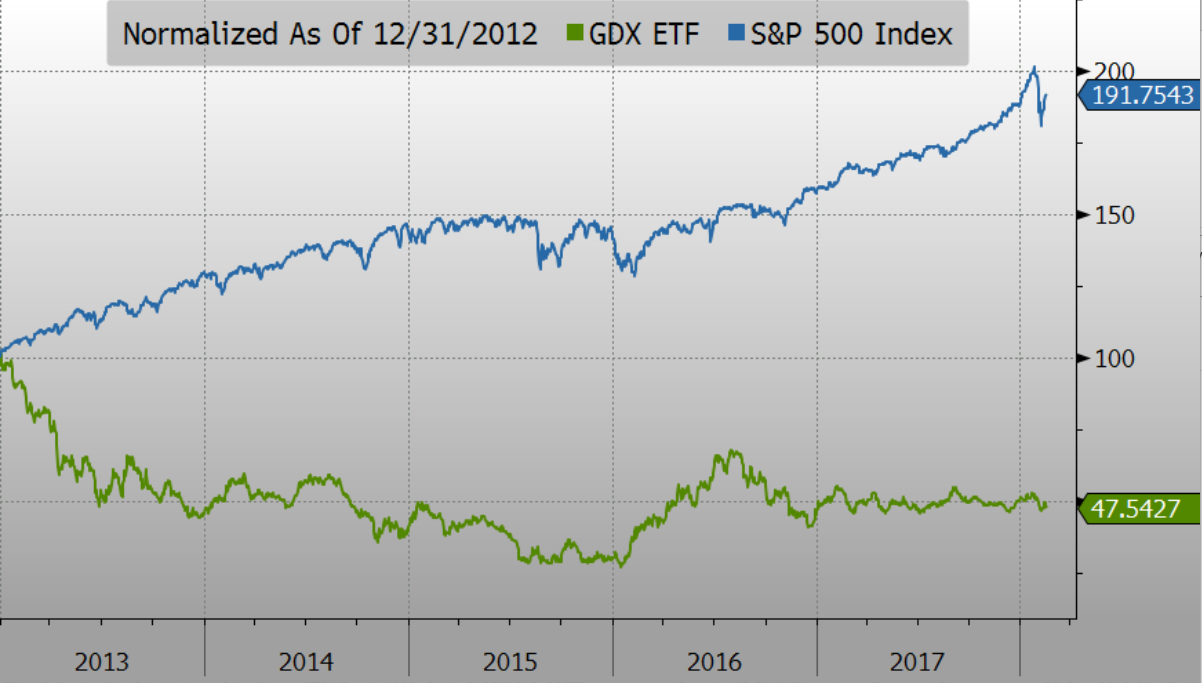
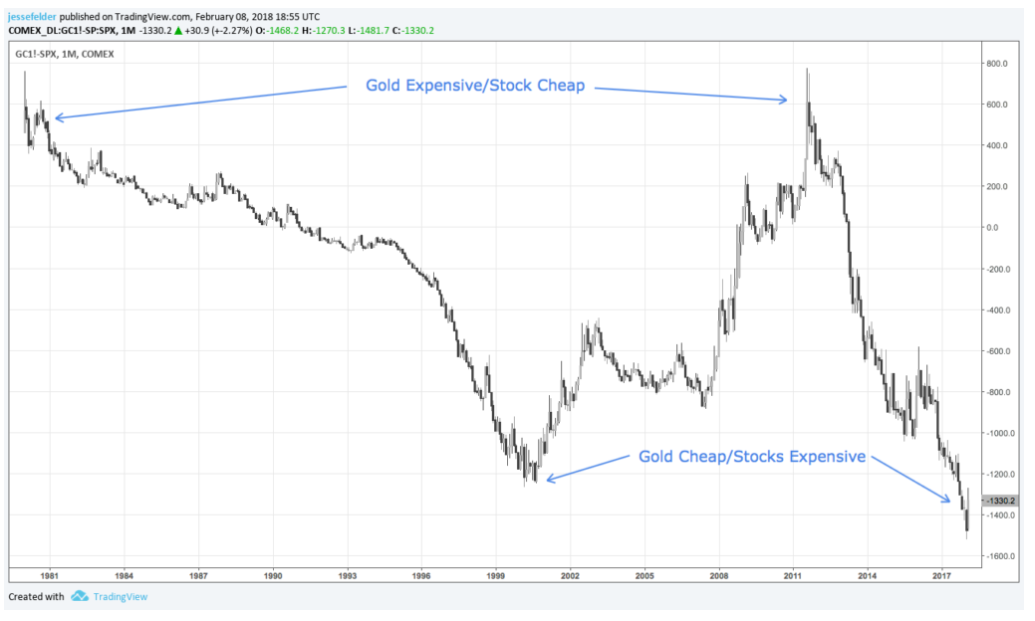
The 2018 Winter Olympic Games are nearly behind us, and so is the latest chase for the ultimate sports prize: a gold medal. For anyone keeping tabs on this year’s Olympics, only about 6g of each medallion is made from 24-karat gold, meaning the scrap value of that long-awaited prize is roughly $575 USD. (Although, the resale value of a winning medal could fetch a much higher price, as collectors have been reported to pay anywhere between $10,000 USD and $1.47M USD, depending on the value to buyers.) While winning athletes competing in these games may not make their fortunes off of the scrap value of that tiny, shiny artifact, there could be a lot gained for the rest of us by investing in gold or gold-related securities. In fact, as the pages outline below, when comparing the relative price of gold to US stocks, gold is at its cheapest level in over 35 years. We are the first to point out that going “all in” on gold is likely not a winning strategy; however, we do believe investing in gold and gold mining stocks provide a necessary hedge against inflation and a weak US dollar, and that current levels are attractive when compared to other asset classes. Due to these factors, here are four reasons Evergreen is “going for gold” in the first half of 2018: 1. Gold is a Hedge Against Inflation and a Weak US Dollar As noted in last week’s Unexpected Outcomes EVA, central banks have created enormous asset price inflation as they’ve attempted to attain a 2% CPI rate by pushing trillions of dollars into the system. Additionally, wages have continued to rise due to a tight labor market with a historically low unemployment rate of 4.1%. Economists expect the labor market to reach a vise-tight unemployment level of 3.5% by the end of 2018 – barring a recession – which will continue to put upward pressure on compensation. On top of that, the recent $1.5 trillion tax plan pushed through by the Republican-controlled legislature has both increased the take-home pay of most working Americans and encouraged employers to pay out one-time bonuses or raise wages even further for employees. The trickle-down (sorry, but I had to) effect is that with more money in their pockets, American workers may spend more, increasing the demand for goods and services and, in turn, pushing up prices. The result of this scenario is that excess money in the system decreases the purchasing power of the good ole’ US dollar, putting pressure on instruments that do not store value as prices rise. In other words, if your assets are not keeping up with inflation, your hard-earned coin becomes less and less valuable. Historically, one way to hedge against this phenomenon is to increase exposure to gold, which benefits from rising prices. Interestingly, though, when higher than expected (.3% vs. .2% median estimate) CPI data was released on February 14th, the price of gold declined temporarily before recovering.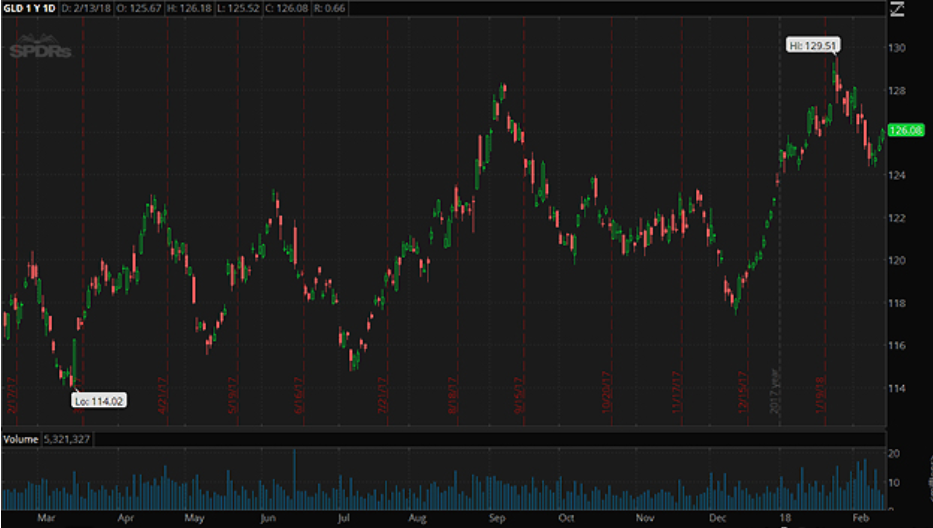 Source: NASDAQ.com
 Source: Evergreen Gavekal, Bloomberg
 Source: Jesse Felder, The Felder Report
 Source: Evergreen Gavekal, Bloomberg
CONCLUSION
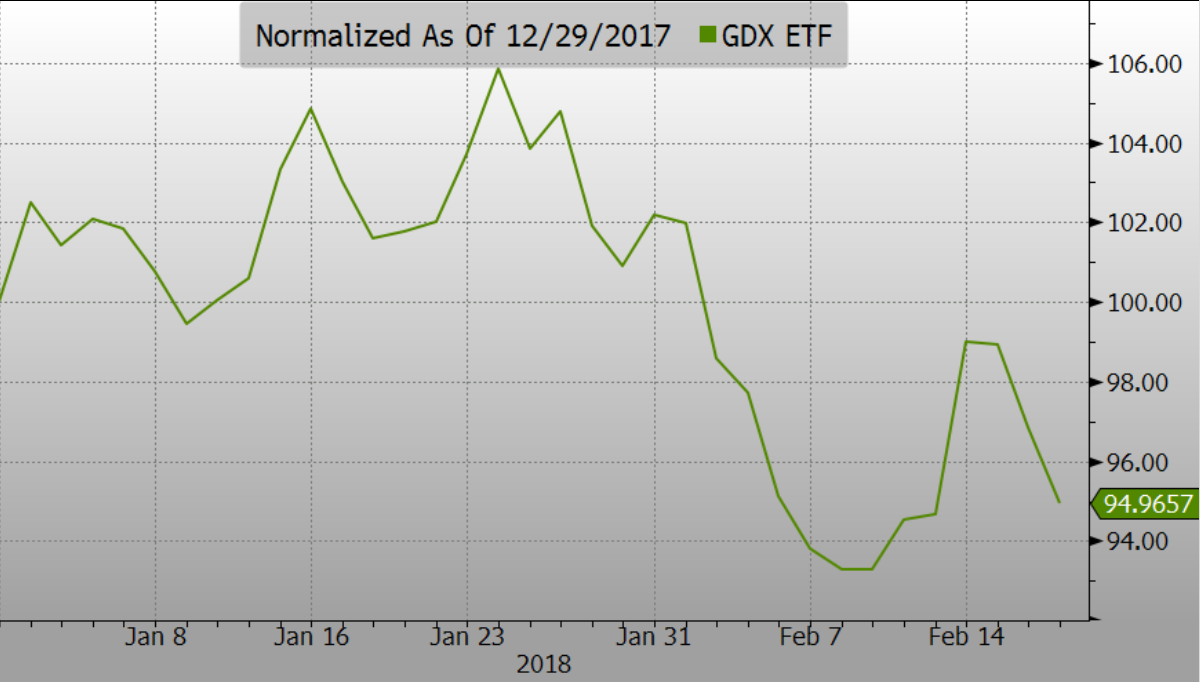
In any sport, the key to building a winning team is to diversify skillsets and piece together a number of “assets” that complement each other. The same is true with investing. We believe that “going for gold” and adding gold or gold-related securities as a compliment to other investments is a wise play to hedge against inflation, a weak US dollar, and as central bank insurance. Additionally, we believe that current levels are attractive when compared to other asset classes and gold mining stocks are poised to outperform in the first half 2018.
OUR CURRENT LIKES AND DISLIKES
Changes highlighted in bold.
LIKE
- Large-cap growth (during a correction)
- International developed markets (during a correction)
- Cash
- Publicly-traded pipeline partnerships (MLPs) yielding 7%-12% (use the recent weakness as a buying opportunity)
- Gold-mining stocks
- Gold
- Select blue chip oil stocks (take advantage of the recent weakness to do selective buying)
- Mexican stocks (at lower prices after this year’s robust rally)
- Bonds denominated in renminbi trading in Hong Kong (dim sum bonds)
- Short euro ETF (due to the euro’s weakness of late, refrain from initiating or adding to this short)
- Intermediate municipal bonds with strong credit ratings
- Investment-grade floating rate corporate bonds
NEUTRAL
- Most cyclical resource-based stocks
- Short-term investment grade corporate bonds
- High-quality preferred stocks yielding 6%
- Mid-cap growth
- Emerging stock markets, however a number of Asian developing markets, ex-India, appear undervalued
- Select European banks
- BB-rated corporate bonds (i.e., high-quality, high yield)
- Long-term Treasury bonds
- Long-term investment grade corporate bonds
- Intermediate-term Treasury bonds
- Long-term municipal bonds
- Emerging bond markets (dollar-based or hedged); local currency in a few select cases
- Solar Yield Cos (taking partial profits on these)
- Large-cap value
- Canadian REITs
- Intermediate-term investment-grade corporate bonds, yielding approximately 4%
DISLIKE
- US-based Real Estate Investment Trusts (REITs) (once again, some small-and mid-cap issues appear attractive; also, some retail-exposed REITs look deeply undervalued)
- Small-cap value
- Mid-cap value
- Small-cap growth
- Lower-rated junk bonds
- Canadian dollar-denominated bonds (the loonie is currently overbought)
- Short yen ETF (in fact, the yen looks poised to rally)
- Emerging market bonds (local currency)
- Emerging market bonds (local currency)
- Floating-rate bank debt (junk)
- US industrial machinery stocks (such as one that runs like a certain forest animal, and another famous for its yellow-colored equipment)
DISCLOSURE: This material has been prepared or is distributed solely for informational purposes only and is not a solicitation or an offer to buy any security or instrument or to participate in any trading strategy. Any opinions, recommendations, and assumptions included in this presentation are based upon current market conditions, reflect our judgment as of the date of this presentation, and are subject to change. Past performance is no guarantee of future results. All investments involve risk including the loss of principal. All material presented is compiled from sources believed to be reliable, but accuracy cannot be guaranteed and Evergreen makes no representation as to its accuracy or completeness. Securities highlighted or discussed in this communication are mentioned for illustrative purposes only and are not a recommendation for these securities. Evergreen actively manages client portfolios and securities discussed in this communication may or may not be held in such portfolios at any given time.