

Click here to view as PDF. “The first lesson of economics is scarcity: that there is never enough of anything to fully satisfy all those who want it. The first lesson of politics is to disregard the first lesson of economics.” -THOMAS SOWELL, American economist, political philosopher and author “There are too many pigs for the teats.” -ABRAHAM LINCOLN, the 16th President of the United States of America “To take from one, because it is thought that his own industry and that of his fathers has acquired too much, in order to spare to others, who, or whose fathers have not exercised equal industry and skill, is to violate arbitrarily the first principle of association, — the guarantee to every one of a free exercise of his industry, & the fruits acquired by it.” -THOMAS JEFFERSON, the 3rd President of the United States of America (Note: An astute EVA reader pointed out that our Thomas Jefferson quote from last week was erroneous. So, we have located the full and correct version, though we believe the spirit of the message is largely the same.)
SUMMARY
- Bull market optimists and a recent study have fueled the debate that Social Security trust funds should be invested in the stock market.
- Those in favor of investing in the stock market claim that the trust would remain solvent past the projected 2034 depletion of funds.
- Those against investing in the stock market claim that the federal government shouldn’t meddle in equities.
- Why does this debate even exist? For one thing, the Social Security trust is invested entirely in U.S. Treasuries; but the yield on these securities has been declining for 30 years. Additionally, America’s largest generation began retiring in 2011 and life expectancy has increased substantially since the program was enacted.
- If the trust was to be invested in the stock market, it would most likely be invested in mutual funds or exchange traded funds (ETFs).
- However, there is strong evidence to suggest that we are in an indexing bubble that could burst and deplete the funds further.
- Therefore, when answering whether trust assets be invested in stocks, it is essential to do so gradually, particularly given today’s lofty valuations based on historically-proven measures.
To Invest, or Not to Invest, that is the Question. The Wall Street Journal recently ran an article debating whether the Social Security trust fund should be allowed to invest in stocks. The piece juxtaposes two opposing views; one side arguing ‘Yes’ and the other ‘No’. Admittedly, as a Millennial with 38 years until I can collect support, Social Security benefits have been a distant thought. In fact, I’ve heard so many stories about the trust’s (almost certain) mid-2030s depletion of funds, that I’ve never counted on Social Security as a substantial source of retirement income. The silver lining for Baby Boomers, Millennials, and anyone expecting (or rather hoping) for full benefits after 2034, is that there is a potential solution to the problem. During the bull market of the late-1990s, Bill Clinton proposed investing Social Security funds in the stock market. Opponents, including then-Federal Reserve Chairman Alan Greenspan, quickly shot down the idea claiming that the federal government shouldn’t meddle in equities. The L.A. Times even went so far as to question whether Clinton was a socialist for floating the idea. While the solution is not necessarily new, it has received a recent shot-in-the-arm from current bull market optimists and a 2016 publication claiming that:
- Prospective and retrospective analyses suggest that investing a portion of the Social Security Trust Fund in equities would improve its finances.
- Little evidence exists that Trust Fund equity investments would disrupt the stock market.
- Accounting for returns on a risk-adjusted basis would not show any up-front gains from equity investment, but gains would become evident over time if higher returns were realized.
- Equity investments could be structured to avoid government interference with capital markets or corporate decision-making.
FIGURE 1: PROJECTED TRUST FUND RATIO, 2016-2090
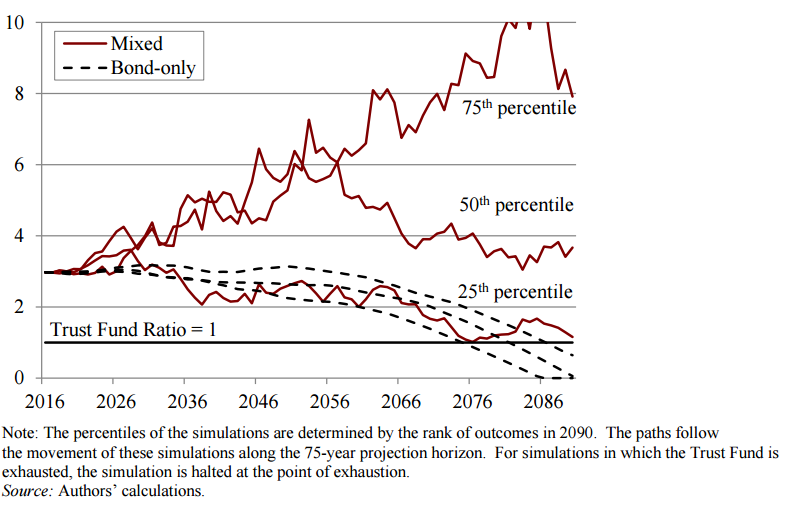 Source: Center for Retirement Research at Boston College
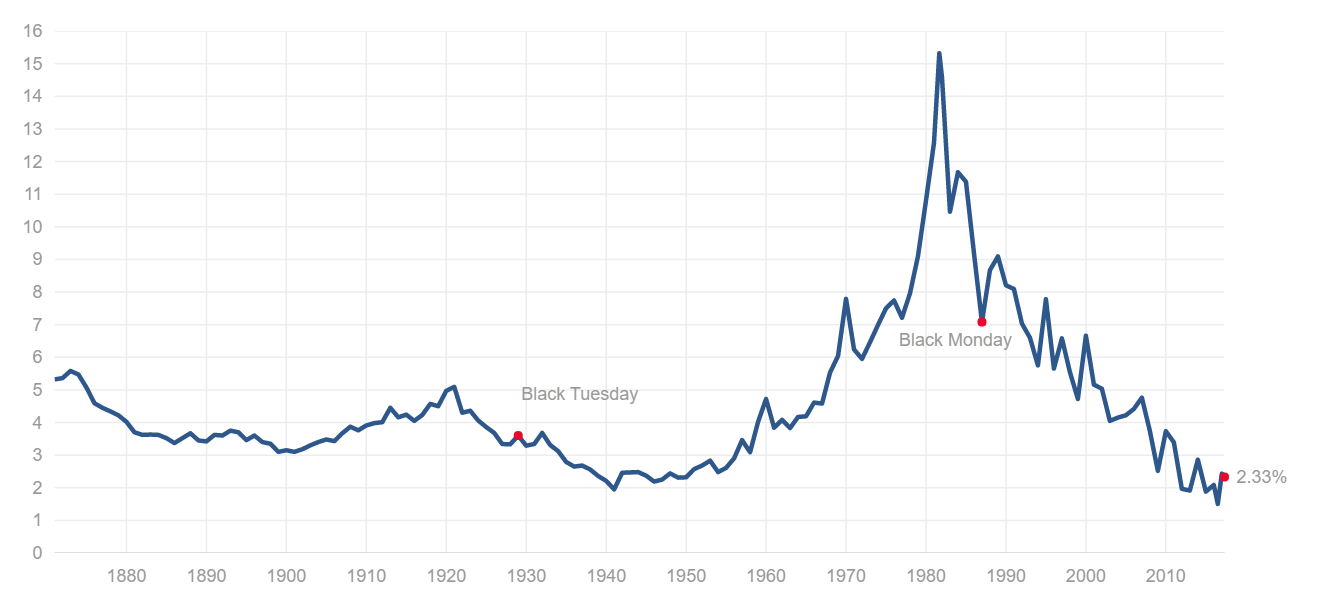
“Bonds in the Social Security trust fund aren’t actual assets, but merely claims against future revenues. To invest those funds in other assets, the Social Security Administration would first have to redeem those bonds for cash…with the U.S. running a deficit and already $20 trillion in debt, finding money to redeem the bonds likely would require either additional taxes or borrowing or both.”While his point is not without merit, it’s a weak opening salvo considering we live in an age where central banks and governments unapologetically meddle in the affairs of public financing. A (seemingly) more convincing argument is that stocks owned by the Social Security trust fund “would be about 14% of [total] stock value.” That is, of course, assuming all of the $2.9 trillion trust is invested in the $21 trillion equity market. The logic here is that the U.S. government would own a significant stake in major U.S. companies and, for those against government in business, this is an undoubtedly troubling thought. But, evaluated more carefully, this is a very disingenuous position to take. Not even those rallying around ‘Yes’ would argue for 100% of the trust to be invested in stocks. Rather, the argument that Munnell and others make is for a 40% ceiling on equity allocation, which would put the total value of stocks owned by the federal government closer to 5.5%. But do we really want the federal government owning any portion of U.S. companies? Should we heed the advice of our 31st President, Herbert Hoover, who said “it is just as important that business keep out of government as that government keep out of business”? To fully comprehend where the debate on Social Security reform is heading, it’s important to understand the foundations of Social Security. In the following section, I will take readers through a brief history of our country’s bedrock social program before circling back around to the questions at hand. A Brief History. Revolutionary War figure Thomas Paine was one of the first proponents of a modern retirement benefits system in the United States. In 1795, he published Agrarian Justice, which called for the establishment of a public system of security in America. While his revolutionary (no pun intended) idea was not widely accepted, he did lay the foundation for this type of social program in our young country. In the 1880s, significant changes in America led to an increasingly obsolete traditional system of social support. Three triggering events were the Industrial Revolution, the urbanization of America, and an increase in life expectancy. The net result of these changes was that America was more industrial, more urban, and older. Fast-forward a few decades… And imagine the opening bell of the New York Stock Exchange on the morning of October 24, 1929. Over the course of three months, the stock market lost 40% of its value. As America slipped into economic depression over the next few years, unemployment reached 25%, close to 10,000 banks failed, the Gross National Product (GNP) declined from $105 billion to $55 billion, and net new business investment was -$5.8 billion. In response to this major depression, President Franklin D. Roosevelt announced his intention to provide a program for Social Security in a message to the Congress on June 8, 1934. The Social Security Act was signed into law one year later. The new Act created a social insurance program designed to pay people age 65 or older a stream of income after retirement. The novelty of this was that workers contributed to their future retirement benefits by making regular payments into a Social Security fund during their working years. Declining Rates and Baby Boomers. To remind readers why the question of investing the Social Security trust fund in the stock market even exists, consider the following: interest rates have been trending downward for over 35 years. That means that an entire generation of professionals have experienced nearly their entire career in a declining rate environment. (Imagine if the reverse were true, and equity markets were in a 35-year free-fall!)
10 YEAR U.S. TREASURY RATE
SOCIAL SECURITY TRUST FUND RESERVES AND EXPENDITURES
UNDER TWO ALTERNATIVE MEASURES, 1980-2040
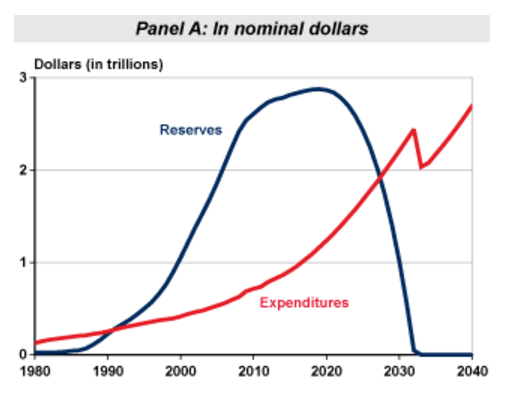
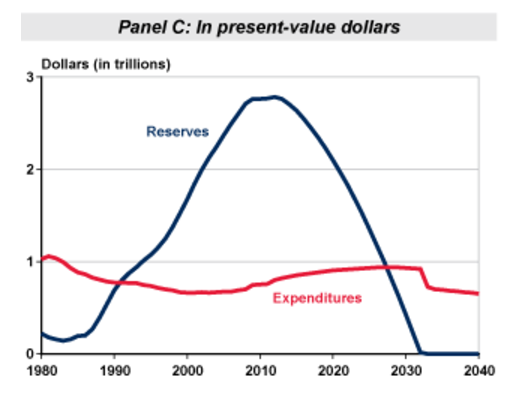 Source: Social Security Administration
CUMULATIVE NET FLOW FROM ACTIVELY MANAGED FUNDS TO INDEXES
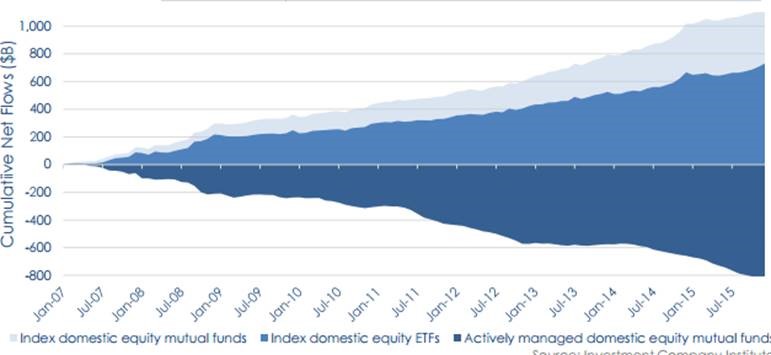 Source: Investment Company Institute
NUMBER OF LISTED U.S. COMPANIES AND ETFS (1975-2016)
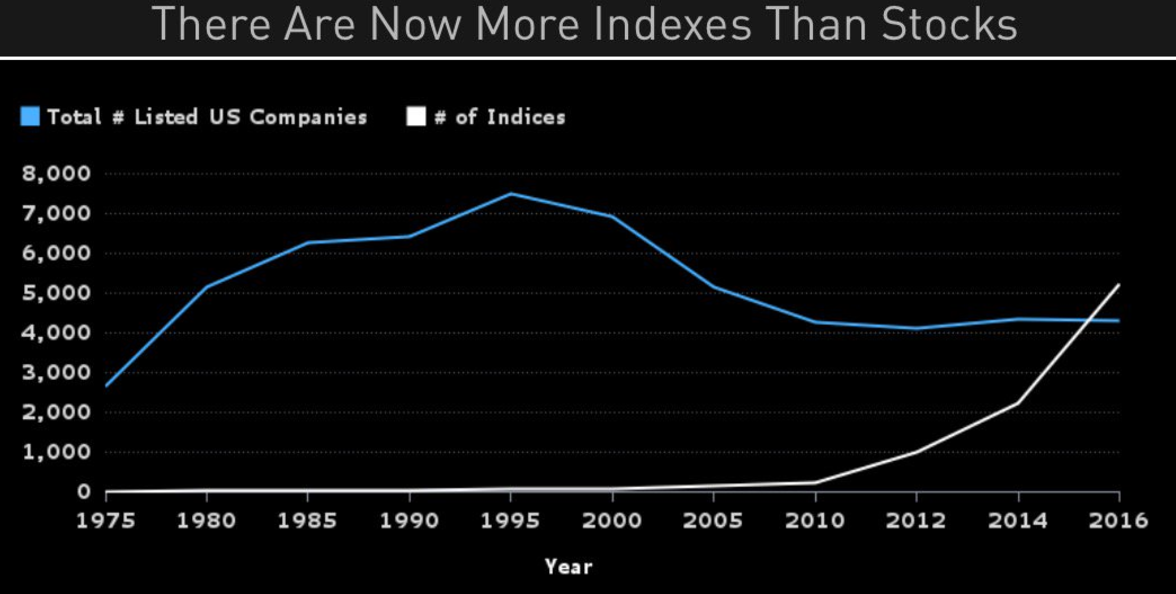 Source: Eric Balchunas (@EricBalchunas)
- Turnover rates for two of the most popular ETFs are more than 3500%, with an average turnover of about a week.
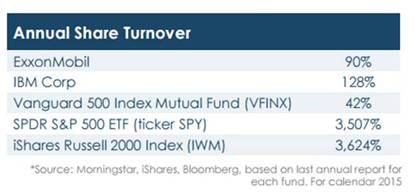
- ETFs are not as diversified as one might think. For example, over 50% of IYE (the energy ETF) is invested in four stocks. (Wasn’t diversification a main tenet and catalyst for the indexation trend…?)
- ETFs must have a low beta to launch (beta is a measure of volatility between a security and the market as a whole). To achieve this, many ETFs are overly concentrated in financials, which have had low volatility lately. However, if interest rates rise or if the yield curve flattens (i.e. the difference between short- and long-term interest rates narrows or even inverts), financials may become more volatile and prone to big swings.
- International central banks have entered the stock market and become big buyers in ETFs. Among the central banks with disproportionally large equity holdings are the Bank of China, the Swiss National Bank, and the Bank of Japan. In fact, with $62B invested in the US stock market, the Swiss National Bank would be the 4th largest ETF in the US! As a result, central banks are artificially propping up valuations by printing money and investing in equities.
- Money has been structurally channeled into the most liquid securities on the market. The correlation between large S&P 500 companies and the S&P is extremely high, especially compared to correlations in 1995. (What’s even more astounding is that international ETFs are extremely correlated with the S&P.)
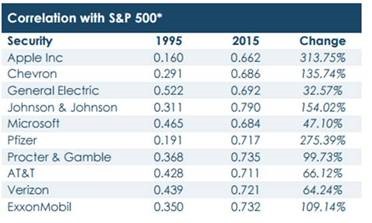 While nobody knows for certain when this bubble will burst (it could be three weeks; it could be three years, or longer), it is a troubling proposition to “just place 25%-30% of assets into passive index funds” as one reader in the Wall Street Journal suggests. One might argue that taking this approach could leave the Social Security trust in worse shape if the bubble pops, and equity markets correct, at the wrong time. (Note: The original Wall Street Journal article mentioned at the beginning of this EVA sparked a lot of debate. The Journal ran a follow-up article with an edited transcript of readers’ responses.)
Closing Salvo. Even though the “Yes” and “No” camps don’t have much in common, one thing both sides can agree on is that there needs to be Social Security reform. But what does that look like?
In Evergreen’s view, the overarching issue is the logic of investing trust fund assets completely in US government IOUs. Imagine if Boeing or IBM funded their retirement plans with nothing but their own debt. The howls of protest would be deafening!
Critics would rightly claim such a scheme is nothing but a totally unfunded liability. When the number of retirees was modest compared to the working population, it was a non-issue (except for those rational folks who looked far enough ahead to predict the coming demographic shifts). It should be clear, based on the foregoing, that we are rapidly approaching a reckoning point.
There have been several reasonable proposals floated in recent years to restore the solvency of Social Security that do not include investing trust fund assets in equities. Some of these ideas include means-testing and gradually extending benefit start dates (there has been some deferral of eligibility but, thus far, it’s been too modest to shore up the system). The problem is these proposed fixes have been regularly ignored. It seems nearly all politicians are terrified of touching the allegedly deadly “third-rail” of Social Security reform. As a result of this total lack of foresight and courage, the pain of making the necessary adjustments is increasing as future liabilities continue to mount.
We believe a gradual process of shifting the trust’s assets into a diversified and balanced portfolio of corporate stocks and bonds should be initiated. This could be done without reducing the government’s promise to pay benefits in any way. Thus, it would be similar to a defined benefit corporate plan where the sponsoring company is on the hook should returns fall short. However, by effectively dollar-cost-averaging into stock and bond markets, poor timing risks would be minimized.
Despite the claims of a forthcoming indexing bubble, we believe it’s most feasible to invest these funds in index vehicles with one caveat. We would suggest a valuation-sensitive approach to underweight expensive market sectors and overweight those that are inexpensive. While we realize this aspect is very unlikely to see the light of day, simply funding Social Security with assets whose returns are not a function of tax revenues – but rather are generated from the remarkable profits engine of the private sector—would be good enough for (sorry) government work…and for us.
Ok, enough editorializing. We want to hear your views. We concede there are no foolproof answers and both camps have valid arguments. But we also believe it’s a vital topic that impacts (or will impact) a large majority of the population. As such, we should all be actively involved in the discussion and weigh in on this issue. Please leave your opinion in the comments section of the blog post or email mjohnston@evergreengavekal.com.
While nobody knows for certain when this bubble will burst (it could be three weeks; it could be three years, or longer), it is a troubling proposition to “just place 25%-30% of assets into passive index funds” as one reader in the Wall Street Journal suggests. One might argue that taking this approach could leave the Social Security trust in worse shape if the bubble pops, and equity markets correct, at the wrong time. (Note: The original Wall Street Journal article mentioned at the beginning of this EVA sparked a lot of debate. The Journal ran a follow-up article with an edited transcript of readers’ responses.)
Closing Salvo. Even though the “Yes” and “No” camps don’t have much in common, one thing both sides can agree on is that there needs to be Social Security reform. But what does that look like?
In Evergreen’s view, the overarching issue is the logic of investing trust fund assets completely in US government IOUs. Imagine if Boeing or IBM funded their retirement plans with nothing but their own debt. The howls of protest would be deafening!
Critics would rightly claim such a scheme is nothing but a totally unfunded liability. When the number of retirees was modest compared to the working population, it was a non-issue (except for those rational folks who looked far enough ahead to predict the coming demographic shifts). It should be clear, based on the foregoing, that we are rapidly approaching a reckoning point.
There have been several reasonable proposals floated in recent years to restore the solvency of Social Security that do not include investing trust fund assets in equities. Some of these ideas include means-testing and gradually extending benefit start dates (there has been some deferral of eligibility but, thus far, it’s been too modest to shore up the system). The problem is these proposed fixes have been regularly ignored. It seems nearly all politicians are terrified of touching the allegedly deadly “third-rail” of Social Security reform. As a result of this total lack of foresight and courage, the pain of making the necessary adjustments is increasing as future liabilities continue to mount.
We believe a gradual process of shifting the trust’s assets into a diversified and balanced portfolio of corporate stocks and bonds should be initiated. This could be done without reducing the government’s promise to pay benefits in any way. Thus, it would be similar to a defined benefit corporate plan where the sponsoring company is on the hook should returns fall short. However, by effectively dollar-cost-averaging into stock and bond markets, poor timing risks would be minimized.
Despite the claims of a forthcoming indexing bubble, we believe it’s most feasible to invest these funds in index vehicles with one caveat. We would suggest a valuation-sensitive approach to underweight expensive market sectors and overweight those that are inexpensive. While we realize this aspect is very unlikely to see the light of day, simply funding Social Security with assets whose returns are not a function of tax revenues – but rather are generated from the remarkable profits engine of the private sector—would be good enough for (sorry) government work…and for us.
Ok, enough editorializing. We want to hear your views. We concede there are no foolproof answers and both camps have valid arguments. But we also believe it’s a vital topic that impacts (or will impact) a large majority of the population. As such, we should all be actively involved in the discussion and weigh in on this issue. Please leave your opinion in the comments section of the blog post or email mjohnston@evergreengavekal.com.

OUR CURRENT LIKES AND DISLIKES
Changes in bold.
LIKE
- Large-cap growth (during a correction)
- International developed markets (during a correction)
- Canadian REITs
- Cash
- Publicly-traded pipeline partnerships (MLPs) yielding 7%-12%
- Intermediate-term investment-grade corporate bonds, yielding approximately 4%
- Gold-mining stocks
- Gold
- Intermediate municipal bonds with strong credit ratings
- Select blue chip oil stocks
- Emerging bond markets (dollar-based or hedged); local currency in a few select cases
- Mexican stocks
- Solar Yield Cos on a pull-back
- Long-term municipal bonds
NEUTRAL
- Most cyclical resource-based stocks
- Short-term investment grade corporate bonds
- High-quality preferred stocks yielding 6%
- Short yen ETF
- Emerging market bonds (local currency)
- Short euro ETF
- Bonds denominated in renminbi trading in Hong Kong (dim sum bonds)
- Canadian dollar-denominated bonds
- Mid-cap growth
- Emerging stock markets, however a number of Asian developing markets, ex-India, appear undervalued
- Floating-rate bank debt (junk)
- Select European banks
- BB-rated corporate bonds (i.e., high-quality, high yield)
- Investment-grade floating rate corporate bonds
- Long-term Treasury bonds
- Long-term investment grade corporate bonds
DISLIKE
- US-based Real Estate Investment Trusts (REITs) (once again, some small-and mid-cap issues appear attractive)
- Small-cap value
- Mid-cap value
- Small-cap growth
- Lower-rated junk bonds
- Large-cap value
DISCLOSURE: This material has been prepared or is distributed solely for informational purposes only and is not a solicitation or an offer to buy any security or instrument or to participate in any trading strategy. Any opinions, recommendations, and assumptions included in this presentation are based upon current market conditions, reflect our judgment as of the date of this presentation, and are subject to change. Past performance is no guarantee of future results. All investments involve risk including the loss of principal. All material presented is compiled from sources believed to be reliable, but accuracy cannot be guaranteed and Evergreen makes no representation as to its accuracy or completeness. Securities highlighted or discussed in this communication are mentioned for illustrative purposes only and are not a recommendation for these securities. Evergreen actively manages client portfolios and securities discussed in this communication may or may not be held in such portfolios at any given time.