

“It’ll be gone by June.”
– Variety magazine referring to rock ‘n roll, in 1955
“We don’t like their sound, and guitar music is on the way out.”
– A Decca Records executive on declining to sign the Beatles in 1962
“Reagan doesn’t have the presidential look.”
– A United Artists executive, rejecting Ronald Reagan for the lead role in the 1964 political drama, The Best Man
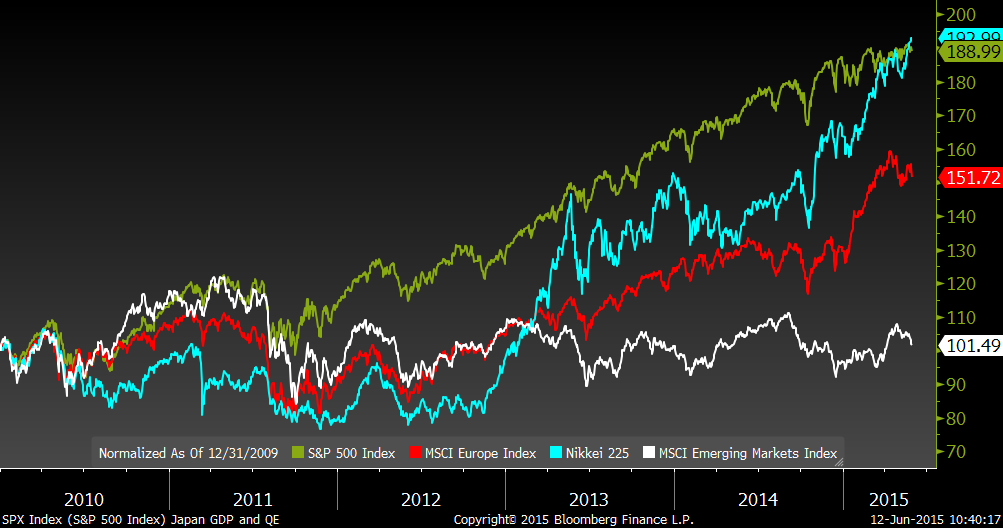
Don’t sleep on the underdogs. If there’s one dominant message that comes through from this newsletter, it’s my sincere hope it’s the danger of investing alongside the Wall Street consensus. A prime example of the risks of falling for the “wisdom” of the Street was its nearly universal recommendation to overweight emerging stock markets five years ago. This was based on expectations of much faster growth vis a vis the lethargic “rich” countries. Yet, as you can see in the below headline, from yesterday’s front page of the Financial Times, the tables have definitely turned.

 Ironically, as previously observed in past EVAs, emerging nations actually have, until recently, experienced more robust economic results than their lumbering developed country counterparts (think: US, Japan and Europe). Despite this, emerging market shares have been chronic laggards compared to the sloth-like mature economies.
FIGURE 1: FROM STELLAR TO CELLAR–EMERGING STOCK MARKETS VS THE US, JAPAN & EUROPE
Source: Evergreen Gavekal, Bloomberg
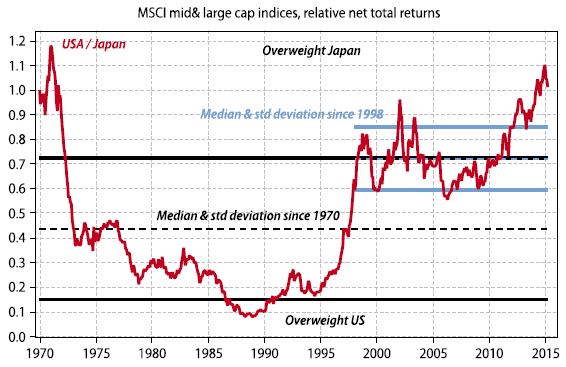
In this month’s Guest EVA, I’m turning to one of America’s most storied money management firms, GMO, and its erudite asset allocation chief, Ben Inker, to shed some light on this apparent paradox. While Ben’s essay was written early this year, his essential points are timeless. He hits on one of our core beliefs: Markets (or asset classes) that have been champs over a-three-year period frequently turn into chumps during the next three. On the flip side, the former duds morph into studs. (Similarly, Ben and his team also found that the fasting growing economies over the prior three years tend to lag over the next three, although the tendencies aren’t as powerful as they are with stock prices.) As he points out, when investors are bullish on the prospects for a country’s—or a region’s—stock market, valuations are generally high. This premium makes it very difficult to continue producing superior returns. Much more likely is a reversion to the mean, or, in English, poor performance that wipes out the previous excess returns. Ben has found that above-average economic growth often doesn’t translate into faster than normal earnings per share increases, with the latter being a much more important driver of stock prices. (The difference being primarily due to the share issuance/dilution that is often necessary to finance rapid economic development.) He further discovered that often the catalyst for bull markets is surprising economic growth spurts. In other words, if a country is not expected to do much and it suddenly comes alive, this typically leads to superior stock market gains. Usually, those countries with subdued growth expectations typically have undervalued share prices, a nice launch pad for future outperformance. In that regard, here is a key excerpt: “If you can find cheap countries that are going to have a big positive surprise over the next three years, you’ll outperform by a whopping 14.1% for the next three years…if you are unlucky enough to buy the cheap countries with the worst GDP surprise, the outperformance is only 0.7%.” Note, however, that even in the “’unlucky” scenario, you still achieve better than average results. The trick is, of course, in predicting positive surprises, which, by definition, are unlikely. But the point is, if a country is predicted to be a tortoise and it turns out to be more like a hare, you can make a lot of money. If you’re wrong, investors still do okay.FIGURE 2: RELATIVE PERFORMANCE OF THE US VERSUS JAPAN, IN USD
Source: Gavekal Data/Macrobond
A case in point today is Japan, where the economy is only projected to grow at ½% ad infinitum. This may turn out to be the case but, if so, investors might still make decent money owning Japanese shares due to their massive underperformance versus the US market over the last quarter century. (There’s little doubt that this extraordinary lag was a function of the great expectations for both its economy and its stocks at the end of the 1980s, when the Japanese model was the envy of the world.) As noted in earlier EVAs, many blue chip Japanese companies are currently trading at 0.2 to 0.3 times sales per share versus an average of 1.7 times for the priced-for-perfection US market. So if you’re interested in following Ben’s advice, the land of the rising sun might just be a diamond in the rough. For the non-professional investors among you, here’s a little “cheat-sheet” for some of the terms Ben uses:
“Cyclically-adjusted P/E”: Essentially, the Shiller P/E, or the ten year average of inflation-adjusted earnings on a market like the S&P 500.
“Correlations”: A linkage between two or more different securities, asset classes, or markets. A perfect correlation is 1.0.
“Value”: When he refers to value on page 5, he’s referring to value, or contrarian, investing; i.e., buying the lowest priced securities (based on P/E and other metrics).
“Change the sign”: At the bottom of page 5 he uses this to mean that countries with expensive stock markets, based on various valuation measures, underperform even when they produce faster-than-expected economic growth.
DITCH THE GOOD, BUY THE BAD AND THE UGLY
Ben Inker
There has seldom seemed to be a much starker choice facing equity investors than there is today. On the one hand you have U.S. stocks, where profits* have compounded at 11% for the past four years, real GDP has grown at 2.2%, accelerating to an annualized 4.8% over the past six months, and neither inflation nor deflation seems a credible threat. Or you can invest in the eurozone, where profits have compounded at -6% over the last four years in U.S. dollars, real GDP has grown at an annualized 0.3%, “accelerating” to 0.4% over the past six months, and consumer prices have been falling since April–months before oil prices began to fall. Or Japan, where profits have compounded at 6% over the past four years in U.S. dollars, the economy has grown at 0.3% over the same period, falling at a 4.3% annualized rate over the past six months, and a recent burst of inflation associated with a consumption tax hike has brought the level of consumer prices all the way back up to where they were in 1999. Or you could pick emerging markets, where earnings have compounded at 1.3% for the past four years, economic growth is decelerating in fast growers like China and economies are shrinking in commodity producers like Russia, and some combination of inflation (Russia, India, Brazil, Turkey) and deflation (Korea, China) threatens many countries.
And the problems for the non-U.S. options don’t stop there. The new Greek government is heading for a showdown with its paymasters, which may put it on a path to exit the eurozone, and far left and right parties are on the rise in much of Europe, which is not a shock given that the German-inspired austerity path to prosperity seems to be failing. Japan is facing some of the worst demographics in the world, has government debt of over 250% of GDP, and the only obvious cure for its wretched return on capital–investing less–would only worsen its economic plight in the medium term. The problems for the emerging world are truly legion, from an epic credit bubble in China, to an economic crisis in Russia, to the plundering of state-owned enterprises from Argentina to Venezuela. (I wanted to throw in Zimbabwe for a true A to Z listing, but at this point, Zimbabwe would have to crane its neck pretty far to even see its way to being a frontier market, let alone an emerging one.)
Given the backdrop, it is no wonder that the U.S. stock market has been the envy of the world, and with P/Es far from the nosebleed territory of the 2000 bubble, it seems awfully tempting to just follow the advice of the venerable Jack Bogle and avoid non-U.S. stocks entirely.** And yet, as the New Year begins, we in Asset Allocation find ourselves slowly selling down even our beloved U.S. quality stocks in favor of the various problem children of the investing world. We are riding away from the Good and into the arms of the Bad and the Ugly. You might chalk it up to sadomasochist tendencies on our part. However, there is a method to our madness.
The short explanation is that markets don’t work quite the way people assume they do. A slightly longer answer is that things that “everybody knows” are generally priced into markets, despite the fact that most of the time what “everybody knows” turns out to be pretty wrong. If you could accurately forecast the surprises, it would be quite helpful, but in the absence of that ability, buying the cheap countries has generally been the right strategy. And the U.S. is about as far from cheap as any country in the world right now. To use one of the better single valuation measures out there, the cyclically adjusted P/E for the U.S. stock market is 26, versus just under 16 for the U.K. and Europe and a little under 14 for emerging. It will take a lot of good economic news to justify that kind of valuation premium in the medium term.
If You’re Going To Be a Jerk, at Least Be a Contrarian Jerk
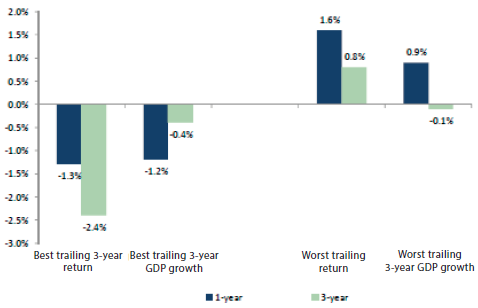
Investors are probably ill-advised to be a knee-jerk anything. It may pain me to say it, but things are always at least a little different this time. We have never seen an economic environment quite like the one the eurozone is facing, with demographic headwinds, a seriously flawed monetary union, high debt loads, and falling household incomes. Certainly Japan is in uncharted territory as well, and if you can find a really good historical comparison for China, Russia, India, or any of the other major emerging markets, you probably are not paying enough attention. On the other hand, history tells us that if you are going to be a knee-jerk anything, at least be a knee-jerk contrarian. The 20% of developed stock markets that outperformed most over a three-year period underperformed on average by 1.3% in the following year and by 2.4% annualized over the next three years. The worst 20% of prior performers outperform by 1.6% and 0.8% annualized.*** The pattern is similar, if weaker, with regard to GDP growth. The fastest GDP growers over the prior three years underperform over the next one and three years by 1.2% and 0.4%, while the worst growers outperform by 0.9% over the next year and marginally underperform by 0.1% over the next three. The performance is summarized in Figure 1.
For the non-professional investors among you, here’s a little “cheat-sheet” for some of the terms Ben uses:
“Cyclically-adjusted P/E”: Essentially, the Shiller P/E, or the ten year average of inflation-adjusted earnings on a market like the S&P 500.
“Correlations”: A linkage between two or more different securities, asset classes, or markets. A perfect correlation is 1.0.
“Value”: When he refers to value on page 5, he’s referring to value, or contrarian, investing; i.e., buying the lowest priced securities (based on P/E and other metrics).
“Change the sign”: At the bottom of page 5 he uses this to mean that countries with expensive stock markets, based on various valuation measures, underperform even when they produce faster-than-expected economic growth.
DITCH THE GOOD, BUY THE BAD AND THE UGLY
Ben Inker
There has seldom seemed to be a much starker choice facing equity investors than there is today. On the one hand you have U.S. stocks, where profits* have compounded at 11% for the past four years, real GDP has grown at 2.2%, accelerating to an annualized 4.8% over the past six months, and neither inflation nor deflation seems a credible threat. Or you can invest in the eurozone, where profits have compounded at -6% over the last four years in U.S. dollars, real GDP has grown at an annualized 0.3%, “accelerating” to 0.4% over the past six months, and consumer prices have been falling since April–months before oil prices began to fall. Or Japan, where profits have compounded at 6% over the past four years in U.S. dollars, the economy has grown at 0.3% over the same period, falling at a 4.3% annualized rate over the past six months, and a recent burst of inflation associated with a consumption tax hike has brought the level of consumer prices all the way back up to where they were in 1999. Or you could pick emerging markets, where earnings have compounded at 1.3% for the past four years, economic growth is decelerating in fast growers like China and economies are shrinking in commodity producers like Russia, and some combination of inflation (Russia, India, Brazil, Turkey) and deflation (Korea, China) threatens many countries.
And the problems for the non-U.S. options don’t stop there. The new Greek government is heading for a showdown with its paymasters, which may put it on a path to exit the eurozone, and far left and right parties are on the rise in much of Europe, which is not a shock given that the German-inspired austerity path to prosperity seems to be failing. Japan is facing some of the worst demographics in the world, has government debt of over 250% of GDP, and the only obvious cure for its wretched return on capital–investing less–would only worsen its economic plight in the medium term. The problems for the emerging world are truly legion, from an epic credit bubble in China, to an economic crisis in Russia, to the plundering of state-owned enterprises from Argentina to Venezuela. (I wanted to throw in Zimbabwe for a true A to Z listing, but at this point, Zimbabwe would have to crane its neck pretty far to even see its way to being a frontier market, let alone an emerging one.)
Given the backdrop, it is no wonder that the U.S. stock market has been the envy of the world, and with P/Es far from the nosebleed territory of the 2000 bubble, it seems awfully tempting to just follow the advice of the venerable Jack Bogle and avoid non-U.S. stocks entirely.** And yet, as the New Year begins, we in Asset Allocation find ourselves slowly selling down even our beloved U.S. quality stocks in favor of the various problem children of the investing world. We are riding away from the Good and into the arms of the Bad and the Ugly. You might chalk it up to sadomasochist tendencies on our part. However, there is a method to our madness.
The short explanation is that markets don’t work quite the way people assume they do. A slightly longer answer is that things that “everybody knows” are generally priced into markets, despite the fact that most of the time what “everybody knows” turns out to be pretty wrong. If you could accurately forecast the surprises, it would be quite helpful, but in the absence of that ability, buying the cheap countries has generally been the right strategy. And the U.S. is about as far from cheap as any country in the world right now. To use one of the better single valuation measures out there, the cyclically adjusted P/E for the U.S. stock market is 26, versus just under 16 for the U.K. and Europe and a little under 14 for emerging. It will take a lot of good economic news to justify that kind of valuation premium in the medium term.
If You’re Going To Be a Jerk, at Least Be a Contrarian Jerk
Investors are probably ill-advised to be a knee-jerk anything. It may pain me to say it, but things are always at least a little different this time. We have never seen an economic environment quite like the one the eurozone is facing, with demographic headwinds, a seriously flawed monetary union, high debt loads, and falling household incomes. Certainly Japan is in uncharted territory as well, and if you can find a really good historical comparison for China, Russia, India, or any of the other major emerging markets, you probably are not paying enough attention. On the other hand, history tells us that if you are going to be a knee-jerk anything, at least be a knee-jerk contrarian. The 20% of developed stock markets that outperformed most over a three-year period underperformed on average by 1.3% in the following year and by 2.4% annualized over the next three years. The worst 20% of prior performers outperform by 1.6% and 0.8% annualized.*** The pattern is similar, if weaker, with regard to GDP growth. The fastest GDP growers over the prior three years underperform over the next one and three years by 1.2% and 0.4%, while the worst growers outperform by 0.9% over the next year and marginally underperform by 0.1% over the next three. The performance is summarized in Figure 1.
FIGURE 1: TRAILING GDP GROWTH AND EQUITY RETURNS TO PREDICT FUTURE EQUITY RETURNS (1984-2014)
 Source: GMO, MSCI, S&P 500, Datastream
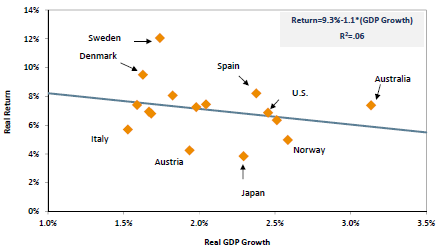
FIGURE 2: STOCK MARKET RETURNS AND GDP GROWTH FOR DEVELOPED MARKETS (1980-2010)
 Source: MSCI, S&P 500, Datastream
FIGURE 3: STOCK MARKET RETURNS AND GDP GROWTH FOR EMERGING MARKETS (1980-2010)
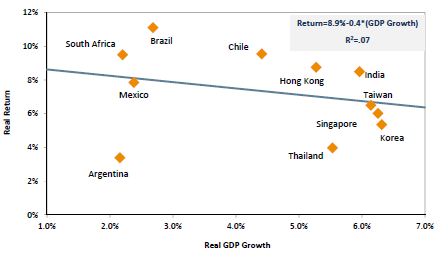 Source: MSCI, S&P 500, Datastream
FIGURE 4: FUTURE GDP GROWTH AND GDP “SURPRISE” TO EXPLAIN EQUITY RETURNS (1984-2014)
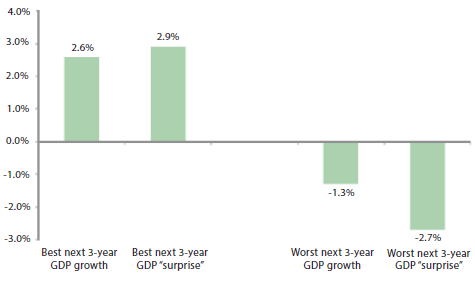 Source: GMO, MSCI, S&P 500, Datastream
FIGURE 5: VALUE AND GDP “SURPRISE” TO PREDICT FUTURE EQUITY RETURNS (1984-2014)
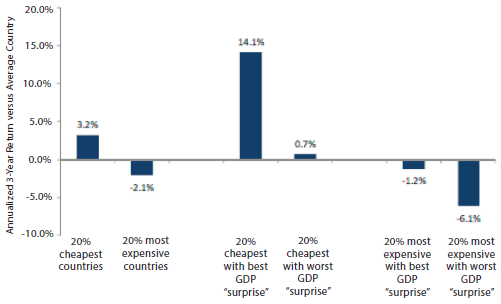 Source: GMO, MSCI, S&P 500, Datastream
Note: “Cheap” and “Expensive” determined by GMO Multi-Factor Valuation Model
Source: GMO, MSCI, S&P 500, Datastream
Note: “Cheap” and “Expensive” determined by GMO Multi-Factor Valuation Model