

Not-so-safe assumptions. One of those simple but clever old sayings goes, “You know what happens when you assume: You make an ass out of you and me.” Despite that admonition, we all continually make assumptions every day. Perhaps nowhere is this more evident than in the oft-intersecting worlds of investments and economics. For example, there are certain bed-rock assumptions about finance that are too obvious to question, such as lenders will always receive a positive rate of return on the funds they extend (at least from a safe borrower who doesn’t default.) In a healthy economy, this means an actual real yield (i.e., net of inflation). It’s also assumed that during times of easy money—and none could be easier than right now—lending longer term would yield much more than lending short. For those EVA readers with a bit of economic theory in their backgrounds, you would recognize this as the steep yield curve scenario, where short rates are considerably lower than long rates. This is a classic situation when central banks are seeking to stimulate the economy by driving short rates down. The inverse is the dreaded inverted yield curve when short rates are higher than long rates, a condition that almost always precipitates a recession. Yet, as investors are slowly and uncomfortably accepting, this fundamental belief about the return on lent capital is being increasingly disabused (and those with money to lend are also feeling a growing sense of being badly abused). Even stranger, it’s become ever more common to accept a negative return on money placed with a purportedly safe borrower, even before inflation is considered. Lenders to governments in Europe are particularly getting the short end of the deal—even when they invest long. Yields on government debt in Switzerland are negative out to 10 years, in Germany out as far as seven years. Meanwhile, Sweden and Denmark are seeing negative yields on even shorter maturities. In numerous other countries around the globe, yields seem to be heading that way with sub-1% 10-year bond yields for even less-than-stellar credits like France, and barely over 1% for countries that not long ago were in the pariah category, such as Spain and Italy. Of course, there is also debt-drenched Japan where rates are essentially zero all the way out to 10 years. Japan was long believed to be a special oddity but now we are finding it was, in actuality, merely ahead of its time. It’s true that if there is an expectation of deflation, as has been so often the case in Japan, a zero interest rate might be a good deal. However, that brings up another basic assumption that is under siege these days: Fabricating vast sums of money was supposed to render falling prices a virtual impossibility. Instead, endless experiments in quantitative easing (QE) have made it a virtual reality in some countries, one that is more real than virtual—and certainly not virtuous. Even those nations not enduring deflation are flirting with it. A prime case in point is China, which not long ago was dealing with the high inflation that hyper-growth often brings. Lately, inflation in that land of the 1.4 billion mouths to feed (not to mention several hundred million palms to grease) has tumbled down to the eurosclerosis-like level of 1%. Truth be told, many of the assumptions that prevailed when central banks first discovered the “thrills of trills” (i.e., printing money by the trillions), have turned out to be as inaccurate as the Club of Rome’s infamous 1970s assertion the world would run out of oil by 2000. The lengthy list of assumptions-gone-awry includes the one that seemed to be a lead—not to mention zinc, copper, and steel—pipe cinch. A most unlikely victim. Few would have suspected that when the Fed launched QE1, as it valiantly and desperately sought to avoid the second coming of the Great Depression, it was opening the floodgates to over $10 trillion of global QEs. Even fewer would have believed that if such an unlikely chain of events were to transpire, it would sound the death-knell for the so-called “Commodity Super-Cycle”. This referred to the epic rise in the price of “real” resources such as metals and energy. The commodity lift-off began around the time the Greenspan-led Fed allowed short-term interest rates to fall (and stay) far below the economy’s growth rate in the early 2000s. As you can see, this cycle was super indeed—at least until 2008—and, undoubtedly, it was heavily influenced by China’s consumption of around 40% of almost every resource known to man.
FIGURE 1: THOMSON REUTERS CORE COMMODITY INDEX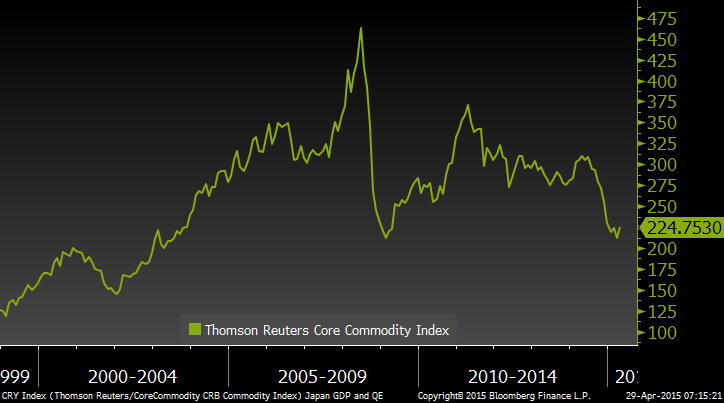 Source: Evergreen GaveKal, Bloomberg
FIGURE 2: IRON ORE SPOT PRICE (USD/DRY MT)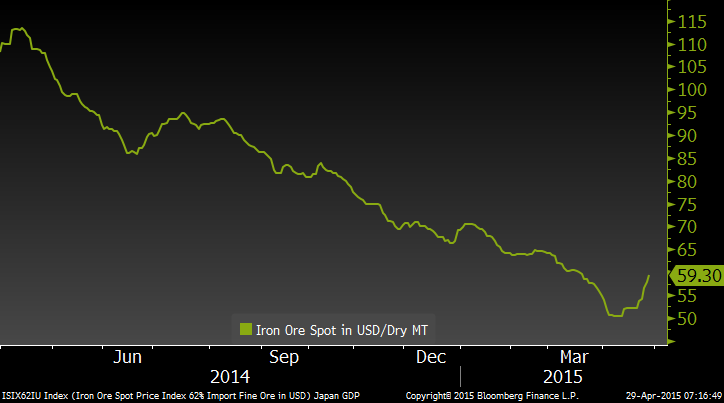 Source: Evergreen GaveKal, Bloomberg
FIGURE 3: WEAKEST GROWTH IN PRIVATE CAPITAL STOCK IN 60 YEARS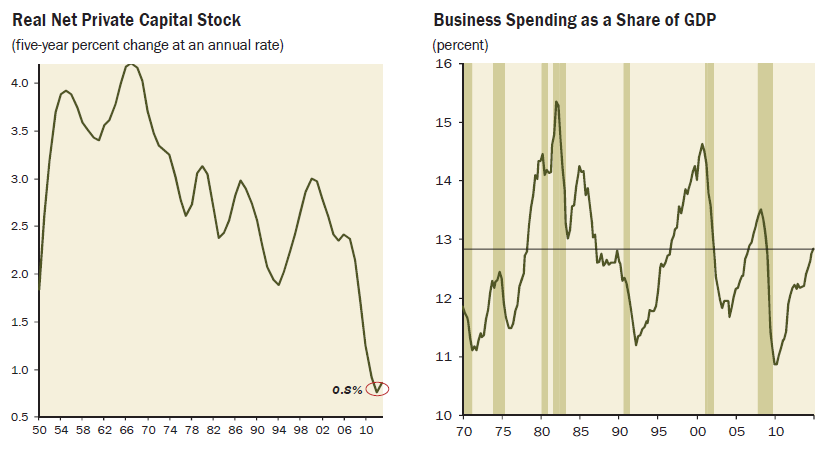 Shaded regions represent periods of US recession
Source: Federal Reserve Board, National Bureau of Economic Research, Gluskin Sheff
Shaded regions represent periods of US recession
Source: Federal Reserve Board, National Bureau of Economic Research, Gluskin Sheff
FIGURE 4: REAL OUTPUT PER HOUR OF ALL PERSONS (YEAR-OVER-YEAR CHANGE)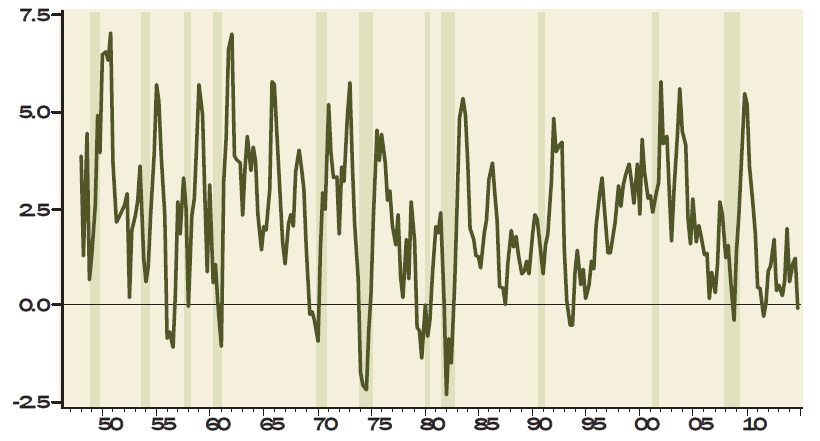
Shaded regions represent periods of US recession Source: Haver Analytics, Gluskin Sheff
FIGURE 5: UNITED STATES, AVERAGE AGE OF PRIVATE FIXED ASSETS (IN YEARS)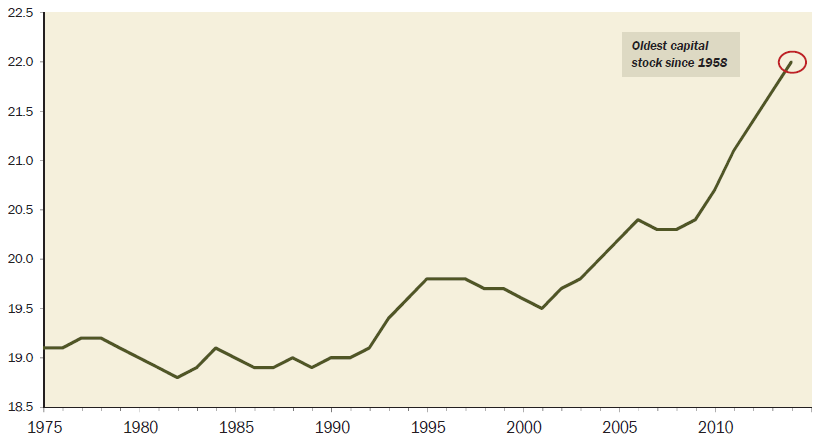
Source: Haver Analytics, Gluskin Sheff
There may be multiple reasons for the relentless bear market in productivity but I do agree with the theory (OK, assumption) that a major factor is that it’s safer for a company to goose earnings through share buy-backs than via making long-term investments (which may or may not be rewarding). Investors have certainly celebrated this approach but it’s reasonable to question just how healthy it is for the sustainable growth of our nation’s economy. It’s hard to overstate the importance of productivity to sustaining economic vibrancy, though I’ve given it my best shot. In an aging society, which almost all the leading economies are these days, it’s the only way to achieve the kind of growth rates needed to extricate us from our debt traps. The assumption has been for years that it was only a matter of time until companies, flush with cash and emboldened by low interest rates, would open their checkbooks on capital projects. Yet, the years go by and the “cap ex” numbers continue to erode. Without robust capital spending, it’s nigh on impossible to generate adequate productivity. The only thing that might be more out-of-favor right now than commodities is the reputation of one of my favorite sources for cogent thinking: John Hussman. Many EVA readers know that John was once among the most radiant stars in the investment firmament, but has now been relegated to village-idiot status due to his poor performance over the last six years. However, I don’t know how anyone can read the following and not be moved to question the assumptions of those currently pulling the monetary levers: “All securities are essentially a way to trade current saving for a claim on future output. The value of all the securities in the economy derives from the claim on future output that this stock of real and intellectual capital can generate over time. During speculative bubbles and periods of malinvestment (my note: like companies buying back their own stock at ever higher prices) saving is invested in unproductive projects that essentially result in unintended consumption (my note again: think massive write-offs due to overpaying for acquisitions). This means that the stock of outstanding securities is essentially ‘backed’ by a smaller stock of productive capital to service those securities over time. This point is fundamental, because it is a part of the reason the US economy has been failing much of its population. The economic policies we’ve pursued have put a premium on current consumption and have encouraged yield-seeking speculation, while discouraging saving and productive investment in both the private and public sectors.” As former perma-bear, turned quasi-bull, David Rosenberg, wrote last month, “the private sector capital stock has eroded so much that productivity is not only slowing, but contracting outright.” It could be argued that another reason companies are engaging in short-termism and not investing for the future is the aforementioned glut in so many real assets. Yet, that means there is insufficient demand and the assumption by those Jim Grant calls the “monetary mandarins” was that such a shortfall could be eliminated by whipping up enough ersatz money. Stoking demand has for sure worked with stocks and bonds (hence the reason investors are willing to settle for yields that are an insult to the word “pathetic”). But where’s the beef when it comes to the real economy? Yes, I realize the labor market looks healthy, with “looks” being the operative word. If it’s as good as it seems, though, how come there are over 100 million employable Americans not working? And why are 46 million US citizens using food stamps, up from less than 7 million in 2000 (before the Fed began its uber-easy money policies)? Why is the share of 65 year olds in the labor force continuing to rise?FIGURE 6: SHARE OF EMPLOYED 65 YEARS AND OVER IN USPOPULATION HAS PERSISTENTLY RISEN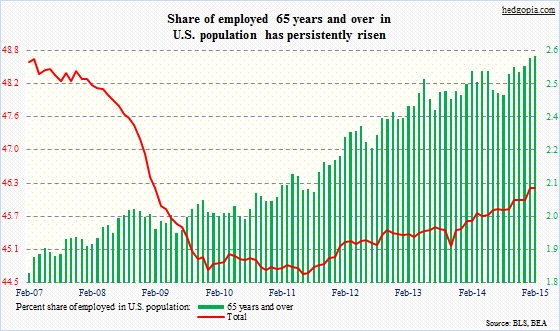 Source: BLS, BEA, Hedgopia.com
FIGURE 7: TOTAL RETURN US SHARES VS. US LONG DATED GOV. BOND BASE 100 IN 1880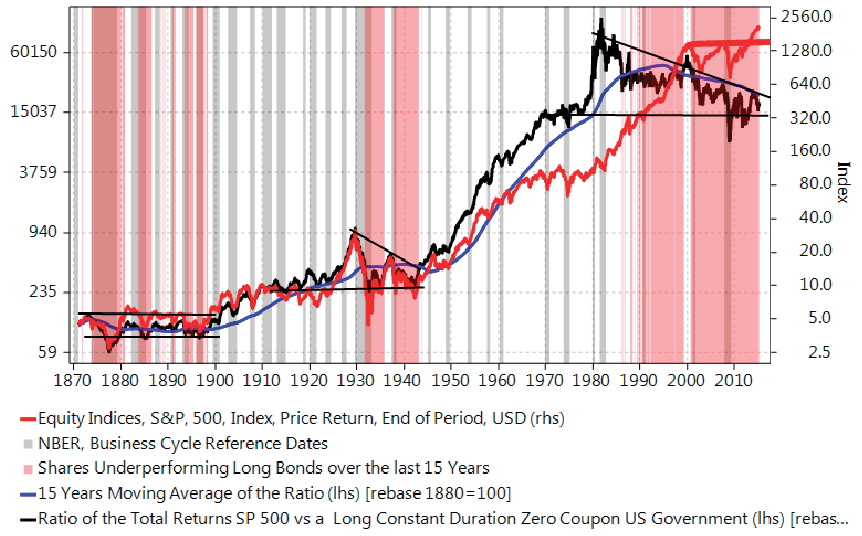 Source: GaveKal Data/Macrobond
FIGURE 8: GOLD SPOT PRICE (USD/OUNCE) AND PRECIOUS METAL ETF FUND FLOWS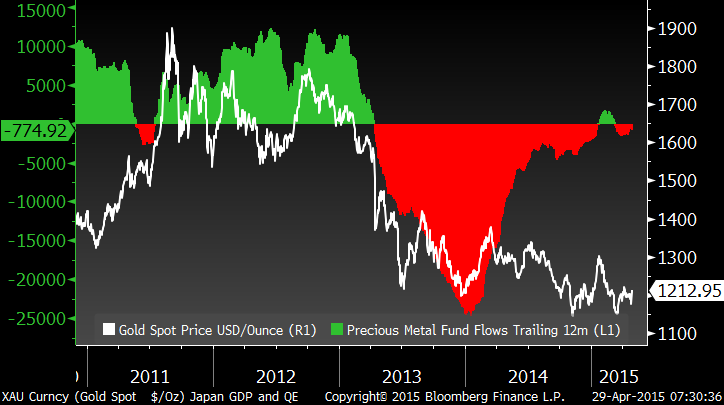 Source: Evergreen GaveKal, Bloomberg
FIGURE 9: US CRUDE OIL INVENTORIES
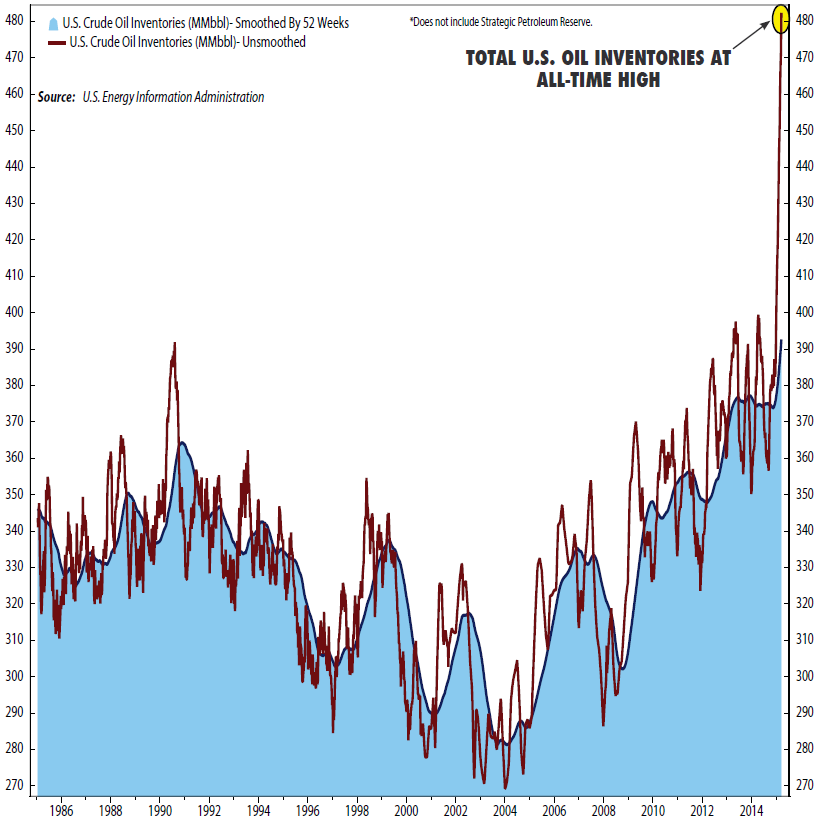 Source: Ned Davis Research
